Problem Solving the Philippines: Idea Post. Who carries a student invention the last mile?
By Giancarlo Angulo
Two UP graduates built a home dialysis assistant for a student budget. Who has to help for it to reach a patient safely?
I read the ABS-CBN story about BiDaKidney and thought: this is the kind of idea that needs a lot of people to move one stone each. As with the previous idea post (Can we stop and talk a while?), this one starts with a good idea and asks who should help.
TLDR:
- Quezon City (QC) should support the research.
- PhilHealth (PHIC), the DOH and UP should continue helping the team, or start if they haven’t.
- DOST and COA should look at whether small grants need the same paperwork as big ones.
- Keep the safety rules. Cut the duplicate paperwork.
What BiDaKidney is
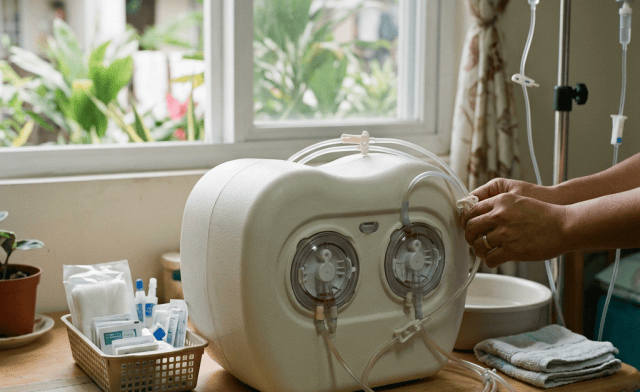
Andrew Jacob Buensalido and Allyson Cabrestante, UP Diliman mechanical engineering graduates, built BiDaKidney as a capstone. It is a semi-automated peritoneal dialysis (PD) machine. In PD the lining of the abdomen filters the blood. Today, a patient doing PD at home controls the fluid lines by hand and weighs the bags to track each session of three to four hours, several times a day. BiDaKidney handles the weighing, the fluid transfer and the timing, and works with the bags patients already use (ABS-CBN, The Beat).
The first prototype’s raw materials cost about P6,000. The team’s own market search found PD cyclers at P500,000 to 600,000, or P100,000 to 150,000 a month to rent. The team is careful: the price “will still possibly go up or down depending on the medical clearance… regulations, and compliance.” It has been tested on a training mannequin, not on patients (The Beat).
It won the national prize in the 2026 James Dyson Award, P398,280 (Daily Tribune). On 14 October, Dyson named it to the international Top 20, the 20 global finalists, chosen by a panel of 12 Dyson engineers and judged on functionality, design process, originality and commercial viability. Each finalist is in the running for £30,000, and James Dyson picks the global winners on 4 November (Dyson). As of 21 October the global result is not out. The Dyson list describes it as a low-cost, semi-automated dialysis machine designed to improve access to life-saving treatment.
The team’s Dyson entry says they are building an upgrade to manual PD, not a rival to high-end automated cyclers, which it says cost upwards of $10,000. It also says they got positive feedback on the core fluid automation and volume monitoring from PD nurses and nephrologists at the Philippine Children’s Medical Center (PCMC). That feedback is not a patient trial, and no trial results are reported. Formal clinical testing is listed as a future plan.
None of the articles I read mention DOST, DOH or PhilHealth funding. I don’t know if there is any. Absence in a news story is not proof of absence.
Why it matters: the money and the gap
Most Filipino dialysis patients are on hemodialysis in a facility. The split usually quoted is about 94% center-based hemodialysis, 4% PD and 2% transplant (Bayani et al. 2021). The Ateneo Policy Center put hemodialysis at 95.8% in 2020 and called PD’s uptake low (Rappler). Bayani and colleagues also found that more than half of patients dialyzed twice a week or less to stretch the 90 sessions then covered, that almost all attended with an unpaid caregiver, and that hemodialysis costs patients at least 12 hours a week. Those findings predate the 156-session benefit.
PhilHealth hemodialysis claims were about P14 billion in 2021 and P17.3 billion in 2022 (Rappler). They were reported at about P28 billion for 2024 (Malaya) and P48.76 billion in the first half of 2026 alone (Philstar). On 1 October PhilHealth’s acting chief said about a quarter of payouts, roughly P100 billion of P400 billion, goes to dialysis (Manila Times). That was a spoken estimate, not an audited figure. PD is small by comparison: about P121 million for 14,000 claims in the first half of 2025, against about P27 billion for hemodialysis (GMA).
PhilHealth now pays P6,350 a session for up to 156 hemodialysis sessions a year, up to P990,600 per patient (PhilHealth). The PD “PD First” package began at P270,000 a year (PhilHealth Circular 18 s. 2014). PhilHealth Circular 2024-0036 replaced it. I read its explainer: for adults on manual PD (CAPD), the package is P389,640 a year for three 2-liter bags a day or P510,140 for four. It covers the solutions, transfer sets, training, catheter insertion and outpatient peritonitis care (PhilHealth explainer, Circular 2024-0036).
The same explainer says automated PD, the kind that uses a machine, is open only to patients up to 18 years old, and that it starts as a pilot in selected facilities. So for adults the package pays for supplies and the manual method. It lists no payment for a machine. PhilHealth named three pilot sites for the children’s automated PD benefit in an advisory signed 22 December 2025: NKTI and PCMC, both in Quezon City, and UP-PGH in Manila (PhilHealth Advisory 2025-0074). PCMC is also where the BiDaKidney team got its clinical feedback. PhilHealth extended that pilot by six months to 31 July 2026 (Advisory 2026-0013). I found nothing on what came after.
My own arithmetic: a year of hemodialysis at the cap is two to two and a half times a year of adult PD at these rates. That is cost to PhilHealth. It says nothing about outcomes. A 2021 economic evaluation of kidney replacement coverage found a PD-first policy the most favored of the options it compared, at about P570,000 per quality-adjusted life year, against about P1.5 million for expanding hemodialysis to 156 sessions. Every option was above the P150,000 threshold the authors used, so it is the best of expensive choices (Bayani et al. 2021).
A machine is not the only thing missing. Ateneo counted 42 PD-contracted facilities in January 2023, 17 of them in NCR, with none in Region II or BARMM. PhilHealth’s own list now shows 58 PD Z providers, 32 government and 26 private, as of 30 September 2026 (PhilHealth). Ateneo also reported that patients faced out-of-pocket costs when coverage ran short, and a shortage of trained staff (same source). A cheaper machine does not fix those.
On the size of the problem, NKTI reports 64,845 Filipinos on dialysis in 2024, up 22% from 53,296 in 2023 (Inquirer). ABS-CBN quotes a registry figure of 180,000 dialysis patients, almost three times that. I could not reconcile the two or find the 180,000 figure anywhere else, so I use NKTI’s number.
Red tape: when it is the right challenge
The key for any startup is to have the right kind of challenges. Some red tape is the wrong challenge, and some is the correct one.
Uber is the example I keep coming back to. In May 2015 the DOTC created a new category, the transportation network company, in Department Order 2015-011 (Supreme Court E-Library). A Quezon City court issued a 20-day TRO against it that December (Philstar), and the LTFRB fined Grab P10 million in 2017 over a fare rule (BusinessWorld). That was a fight over whether a category should exist and who sets the price.
BiDaKidney is different. A machine in the loop of a patient’s abdomen can cause harm if it overfills, mistimes or lets in infection. Safety clearance here is not an obstacle to fight. It is part of the product. The team says as much: affordability and safety have to develop together.
So the challenge is a country’s challenge. This is the kind of regulation-heavy product that needs a government, a university and a city around it, not three students and a prize. The question is how much of the cost is safety and how much is process. Duplicate forms, an unclear device class and nobody telling an inventor early what evidence will be asked for are process.
What I know about the path:
- The FDA, an agency of the DOH, sorts medical devices into Classes A to D. Class A needs a notification and B, C and D need registration (FDA Philippines). I could not find where a PD machine falls. For devices not on the FDA’s lists, the applicant classifies by intended use under the ASEAN rules.
- The FDA posted draft rules for clinical investigations of medical devices, with comments due 25 August 2026. They apply to all new devices, whether or not meant for sale. A trial of a Class B, C or D device would need prior approval from both a Level III PHREB-accredited ethics committee and the FDA, and the sponsor needs an FDA license to operate. The investigational device needs a single-use listing certificate and must be made under a quality management system (FDA draft). I did not find a final version. If it is adopted as drafted, a university team would face a licensing and quality-system bar before the first patient, and that is the cost the inventors cannot see yet.
- On paper, registration itself is cheap and slow: the FDA’s 2023 citizen’s charter lists P7,575 and 110 working days for an initial Class C or D registration if nothing is deficient, plus 10 working days of pre-assessment (FDA charter). A consultancy lists dialysis machines as Class C, but I did not confirm the official class.
- Local precedents exist, but they are thin. The DOST-funded GenAmplify COVID test kit got FDA approval within weeks in 2020, with the FDA engaged early (FDA Advisory 2020-513). That was an emergency, not a baseline. The UP-PGH OstreaVent2 ventilator, funded mostly by alumni donations, went through third-party certification, a safety trial on ten patients and a medical device listing (Acta Medica Philippina, 2024). I found no Philippine-developed dialysis device or PD cycler that has done this. Elsewhere, a locally built automated PD machine in Pakistan has treated eight patients for more than 1,600 hours (Peritoneal Dialysis International, 2024; abstract only).
The paperwork problem
I have a friend who went through the DOST route. The documentation requirement of government for COA is really a drag, given the limited time that people have. I do not want to dox my friend, so I will not say who they are, which project it was or what was returned. I only want to say that the complaint comes from someone who lived it.
COA is guarding public money, and that is its job. I’m not asking for fewer rules. I’m asking whether a P400,000 award should carry the same documentation load as a P100 million one. I found no study measuring the burden on researchers or startups, so at the moment this rests on one friend’s experience. That is exactly why it needs measuring.
DOST’s Grants-in-Aid program funds R&D under DOST’s priorities and has its own financial reports and liquidation steps (DOST). DOST-PCHRD’s startup research grant goes up to P3 million (PCHRD). Its 2026 regular call took concept proposals in March for funding that starts in January 2028, about 22 months later (DOST-PCHRD). DOST has also reissued its grant guidelines (Memorandum Circular 003, s. 2025). I could not read the liquidation provisions, so I cannot say whether they ease anything.
The asks, agency by agency
Each is a question the agency can answer.
- Quezon City: support their research. UP Diliman is in Quezon City. StartUp QC (Ordinance SP-3109, s. 2022) already gives equity-free grants of up to P1 million to professional-track teams that have a minimum viable product and at least one member living in QC, plus student awards of up to P100,000 (QC, DTI). The Innovative Startup Act lets LGUs and public universities host such programs (RA 11337). The clinical help is already nearby: PCMC and NKTI are both in Quezon City, and both are PhilHealth pilot sites for children’s automated PD (PCMC). They are national hospitals, not city ones. So the ask is for QC to fund the next stage and help convene the hospital, the university and the inventors. QC’s own hospitals offer free hemodialysis, with five machines at QC General Hospital for admitted and ER patients and room for up to nine patients a day at another city hospital. I found no home or PD program (QC). Whether a city facility could host an evaluation is a question, not a claim.
- PHIC: tell them what it would pay for. Circular 2024-0036 pays for supplies and manual PD for adults, and automated PD only for children, as a pilot. What evidence would PhilHealth want before paying for an assist device for adults? Telling an inventor this early is cheaper than finding out after clearance. Thailand shows what a payer can do: its PD First default and free dialysate took PD patients from about 2,760 to over 25,000 between 2008 and 2021, and when the default ended in 2022 PD’s share of new patients reportedly fell from 50% to 14% (reported in a 2026 abstract; Mahidol).
- DOH and FDA: what class, what evidence, which trial path. Can a local inventor get a pre-submission meeting? I did not find that one exists today. And for a university team, who holds the sponsor license that the draft trial rules would require?
- UP: continue, or start. UP’s Office of the Vice President for Research and Innovation has already publicized the award. Who owns the intellectual property, who finds the clinical partner, and who helps with grant paperwork?
- DOST: a lighter track for small awards. Is a proportional documentation track possible within the COA rules?
Where they already help, good. The post is only asking that they keep going. Where they haven’t, please start.
How I could be wrong
- It is a prototype with clinician feedback but no patient trial. The P6,000 is raw materials, not a price.
- PD has not clearly beaten hemodialysis on survival. Thai national data show median survival of 4.2 years on PD against 5.1 on hemodialysis, with the selection problems any observational study has (Sangthawan et al. 2025). The case for PD here is access and cost, not that it saves more lives.
- The binding constraint on PD may be catheter surgery, training and accredited facilities, not the machine.
- PD does not suit every patient, and it carries risks such as peritonitis. I did not research clinical suitability, and a nephrologist should check this post.
- PhilHealth may pay for supplies but not a device, so a cheap machine could still have no buyer. It is the same lesson as the canning post: the buyer has to exist before the product does.
- The government support may already be there and simply not reported.
- The paperwork complaint rests on one friend’s story until someone measures it.
Why this series
The problem solving series is about trying to chip at the problems of the Philippines. It is about finding solutions that may work because we will never admit defeat.
Sources
- ABS-CBN News, 17 Oct 2026, Dialysis at home: How two UP graduates developed an affordable, handy treatment option for CKD patients
- The Beat Asia, UP Graduates Create BiDaKidney for At-Home Dialysis Care
- Daily Tribune, 18 Sep 2026, UP Diliman grads win James Dyson Award
- James Dyson Award, BiDaKidney project entry
- Dyson, James Dyson Award 2026 Global Top 20 shortlist, 14 Oct 2026
- Bayani et al. 2021, economic evaluation of kidney replacement coverage in the Philippines, Nephrology
- Rappler opinion (Ateneo Policy Center), 2 May 2024
- Inquirer, Kidney specialists aim to curb PH’s number of dialysis patients
- Malaya, PhilHealth list of procedures paid (hemodialysis about P28 billion, 2024)
- Philstar, 5 Sep 2026, PhilHealth pays P210 billion in medical claims
- Manila Times, 3 Oct 2026, PhilHealth: 25% of payouts go to dialysis
- GMA, 23 Jun 2025, PhilHealth claims
- PhilHealth, hemodialysis P6,350 per session, 27 Mar 2025
- PhilHealth Circular 18 s. 2014 (PD First)
- PhilHealth Circular 2024-0036 explainer, Z Benefits package for peritoneal dialysis
- PhilHealth Advisory 2025-0074, pilot sites for automated PD in children, 22 Dec 2025
- PhilHealth Advisory 2026-0013, APD pilot extension
- PhilHealth, accreditation status of providers, 30 Sep 2026
- FDA Philippines, device classes under AO 2018-0002
- FDA Philippines, draft rules on clinical investigation of medical devices (comments to 25 Aug 2026)
- FDA citizen’s charter, initial CMDR Class C and D
- FDA Advisory 2020-513, first locally made COVID-19 test kit
- Acta Medica Philippina 2024, OstreaVent2 safety trial
- Peritoneal Dialysis International 2024, locally built APD machine in Pakistan (abstract)
- DOST, Application to the Grants-In-Aid Program
- DOST-PCHRD, startup research grant
- QC, StartUp QC FAQ
- QC, free dialysis services in QC-owned hospitals
- DTI and Quezon City, StartUp QC
- RA 11337, Innovative Startup Act
- Supreme Court E-Library, DOTC Department Order 2015-011
- Philstar, 4 Dec 2015, court suspends Uber and GrabCar applications
- BusinessWorld, Grab files motion on P10-million LTFRB fine
- Sangthawan et al. 2025, PLoS One, Thai KRT survival
- Mahidol repository, Thailand PD First abstract
- Wikipedia, Philippine Children’s Medical Center
Lovingly made with Claude.


