Huck Finn, Gross Stupidity and Filipinos
Many writers tread the fine edge between insecurity and arrogance, using that tension to craft the words that pull from weakness to express strength. If a writer has not shed tears, it is hard to write about sorrow. If he has not been angry, it is hard to comprehend the motivation to murder. If he has not laughed ROTFLMAO, it is hard to write humor.
Two authors shape my stylistic aspirations: Mark Twain and Jonathan Swift.
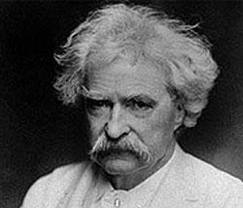 |
| MARK TWAIN |
“Huckleberry Finn” and “The Adventures of Tom Sawyer” stand out as Mark Twain’s most popular novels. His writing style in the two books reflects the slang of the time in the southern U.S., and the hardness of the civil war era. But the stories are written with a sophistication of understanding of the human heart that conveys tears and joy and anger and laughter in the most elegant of ways, even within intense poverty and brutality. Interestingly, Twain was one of the most ardent opponents of the Philippine-American War, and American occupation of the Philippines.
Huck Finn is our own conscience, our own battles with good and evil, wading through the darkness of a cruel world blessed now and then with exceptional kindness.
Jonathan Swift is a genius at satire, which is the place where a sharp mind dissects the way we live and finds a great deal of gross stupidity and absurd humor. Anyone with the courage to suggest solving poverty by eating the excess babies, and publish the idea in top-rung publications, will let no artificial social barriers stand between him and the hard truth. (Read “A Modest Proposal”; it resulted in changes in government policy in Ireland to improve how the nation dealt with poverty.)
 |
| JONATHAN SWIFT |
I strive for a certain earthiness or bluntness in my writings, and literate, satirical or twisty ways to express things. Visions arise in my brain and come out on paper as a line of words. God gifted me with bent perception and, by God, I’m gonna use it.
My enjoyment of the Philippines derives in part from the friction between the American experience and the very different Filipino experience. The friction produces the energy that sparks ideas. The energy is both maddening and invigorating. Now whether anything I write actually means anything, I have no idea. It doesn’t really matter, I think, as the world will find a way to its ultimate chaos just fine with or without the miniscule contributions of one fictitious Joe America.
I suppose I find the same satisfaction in writing that a sculptor does when he stands back and approves his work. Or when a painter nails a few special strokes and says, “ah, that’s it!”.
Here is a paragraph I enjoyed from one of my recent blogs:
[The secret “can’t hide no more” social microscope] can monitor a person engaged in some untoward activity – corruption, rude behavior, murder, whatever is going on in the normal course of the day – and with one flip of a switch or two, parse the historical and psychological foundations that motivate the dude to partake in what, in other societies, would be called illegal, unkind, or deviant behavior.
- The “can’t hide no more” characterization is linguistically from the street. It calls it like it is. People hide their true character. We all do. This machine promises to make them naked.
- The “secret” obviously is not one, so calling it secret is a mild poke in the funny bone.
- The satirical revelation that normal in the Philippines is corrupt, rude and murderous is true, but it is also not the whole truth. And the parallel judgment other people would apply to Filipino behavior is accurate. They generalize to the whole from their individual experiences: corrupt = illegal, unkind = rude, and murderous = deviant. And yet illegal, rude and deviant is the lifestyle Filipinos accept as normal. You know they do because that is the way they live, what they complacently accept, what they do not change. There is a difference between saying they WANT it to be different, and actually making change occur. Hope is not real; it is a dream. Change is real.
- ” . . . parse the historical and psychological foundations that motivate the dude to . . .” Sometimes rare words leap from my brain, as “parse” did. I don’t know where such words derive. I am just a farm boy, a regular Joe, not a literary phenom, but words pop from my recollection as if some other guy with a big vocabulary lived in my head. I smiled when one blog commenter erroneously called me an “intellectual”. My readings are broad but not deep. Anyway, linking big words with the street-talk “dude” amused me, for the contradiction.
I believe one’s mind should know no limits. It should explore the reaches of God’s gifts of perception, imagination and expression. On the other hand, I believe one’s actions should be limited by principles that reflect that we are not on earth by ourselves, and the well-being of all of us depends on our behaving well. Writing should be somewhere between the two; uninhibited, but structured to achieve a purpose.
I personally think Filipinos display a certain civic laziness – a laziness of principle – and their kids suffer because of it. And their poor suffer needlessly. And too many people get hurt.
Somehow, my own personal principles get rubbed edgy by that.
And so I write . . .


 The Society of Honor by Joe America
Joe this article is resonant with me almost to a “t” albeit via Classics Illustrated. Your commentary is spot on. Your style and approach would be me in Tagalog. The depth is you, of course. Thank you.
I’m glad it resonated, sonny. It perhaps explains better than any other article what in the world I (and you haha) are doing here.
Yes. Mark Twain was the first American I remembered the first time I visited New Orleans, There I was completely awed by the presence of huge ocean-going vessels being tendered in a mighty river, the Mississippi. The analogy of the Mississippi is so American! My sister crossed the headwaters by jumping across the stream in Itasca, Minnesota. One can follow the twists turns, minor falls and deep runs from Minnesota, thru Wisconsin, Illinois and also all the confluences that feed the run until it crashes as that huge basin in New Orleans. Enter Sam Clemens and the human settlements that fed off this mighty river and yell with him “mark, twain!” in those paddle-wheeled thingies. This picture explained to me the thoughts of the Americans of 1898 when 660,000+ Filipinos and the 7,100 islands they lived in were dropped into the collective laps of US Executive and the 55th US Congress and the likes of Randolph Hearst, the Cabot-Lodges and Theodore Roosevelt. Imagine this juxtaposition of macro Washington, DC and that single American, Mark Twain butting heads as to what is to be done with a land & people a half-day away. I am still digesting the meaning and wonder of it all.
Ahh, the Mississippi indeed is a mighty river. My great, great grandfather drowned in that river in St. Louis whilst trying to load cargo into a boat during a flood. Perhaps not the smartest thing to be doing. He left behind a six-year old son and wife. His son, my great grandfather, had six sons and one daughter and is the patriarch of our entire family in the U.S., about 70 families now.
Mark Twain, one of the most outspoken advocates for Philippine Independence, on one hand, and racist President McKinley on the other . . . the U.S. is made of such stuff, intense argument held steady by good values, hard work, and a middle ground of sanity that eventually holds sway..