Finish What We Start: Why Philippine Development Needs a Coherent National Strategy
By Karl Garcia
The Philippines is not short of talent, resources, or ambition. What we lack—painfully and persistently—is coherence.
Despite respectable economic growth, a young population, and a strategic maritime position, the country remains trapped in cycles of displacement, housing failures, infrastructure gaps, maritime insecurity, political illiteracy, and institutional paralysis. These aren’t isolated problems. They are symptoms of one core issue: every sector is moving, but not in the same direction.
We have many plans, many agencies, many roadmaps—yet weak coordination. We upgrade the Air Force without fixing radar coverage. We build railways while communities refuse government housing. We train the world’s seafarers but forget that we are, in fact, a maritime nation.
The result? A country that keeps starting things but rarely finishes them.
The SDG-ESG Moment We Are Wasting
Globally, development momentum is driven by two frameworks: the UN Sustainable Development Goals (SDGs) and ESG (Environmental, Social, and Governance) standards. These are not buzzwords. They are the modern world’s measurement tools for responsible growth.
The Philippine Development Plan 2023–2028 is aligned with SDGs—on paper. But execution is fragmented. Agencies launch climate programs, digitalization drives, maritime initiatives, housing reforms, and social welfare expansion—independently and often redundantly.
Without a systems approach, all we get is activity, not progress.
Maritime Nation, Landlocked Mindset
Consider our maritime reality.
We are an archipelago astride the world’s trade arteries. Our fishermen face foreign coercion. Our Navy and Coast Guard perform heroism daily with limited resources. Our seafarers crew the world’s ships. And yet our national imagination remains landlocked, our policies Army-centric, our development models metro-centric, and our identity disconnected from the sea.
Maritime security, fisheries management, tourism, shipping, ports modernization, climate resilience, and even cultural heritage should be treated as interconnected issues—not departmental turf.
The sea is not the periphery of Philippine development. It is the center.
The Infrastructure Lesson from Indonesia, Japan, and Island States
Other archipelagic nations have found the formula: multimodal transport + disaster-proof design + local community participation.
Indonesia connected remote regions through integrated sea-land logistics. Japan built its infrastructure to survive disasters. Pacific nations involve local communities in resilience planning.
The Philippines builds megaprojects without building public buy-in. We build bridges without fixing nearby roads. We build railways but neglect ferry systems. We relocate families without fixing livelihoods.
Development without people is not development. It’s displacement.
The Housing Disconnect
A recent study found four in ten Filipinos reject socialized housing—not due to preference but due to poor design, cramped units, low quality, and locations far from work.
Filipinos aren’t rejecting help. They’re rejecting bad help.
Housing must be livable, transport-connected, community-oriented—not isolated barracks disguised as social welfare.
Defense Reform and the Tri-Service Reality
Our defense system is governed by a pre-war National Defense Act written for a world that no longer exists. It remains Army-first at a time when threats are maritime, aerial, cyber, and gray-zone.
Modernization cannot be piecemeal.
A tri-service approach means:
- the Navy gets forward presence and maritime domain awareness
- the Air Force gets surveillance, drones, and credible deterrence
- the Army specializes in littoral, cyber, and territorial resilience
This is not militarism. It is national survival.
Direct Democracy: Institutionalizing People Power
Filipinos are functionally literate but politically illiterate—not due to lack of intelligence but lack of civic scaffolding.
To break elite capture and political inertia, the Philippines must expand:
- citizens’ assemblies
- national and local referenda
- participatory budgeting
- transparent digital citizen platforms
People power should not be a street event triggered by crisis. It should be an everyday, institutionalized mechanism.
Regenerative Development: Beyond Sustainability
“Green” is not enough. We need policies that restore the environment:
- regenerative agriculture to heal soil
- mangrove belts and reef rehabilitation
- community-led fisheries recovery
- green financing with ESG-linked incentives
Climate resilience is not a cost center. It is the foundation of long-term economic growth.
A Coherent Future Is Within Reach
So what must change?
The Philippines needs a Unified National Development Architecture—where maritime strategy, industrial policy, social protection, climate resilience, education reform, and defense modernization are coordinated as one system, not seven separate islands of policy.
This means:
- interagency alignment with real authority
- shared budgets and shared data
- long-term planning beyond political cycles
- ESG-grounded private sector participation
- direct democratic mechanisms to keep leaders accountable
For once, every sector must pull in the same direction.
The Nation We Can Become
We are a nation forged by the sea, shaped by hardship, and blessed with potential. The world is reordering—economically, strategically, ecologically. The Philippines cannot remain a country of promising beginnings and unfinished agendas.
We must stop starting and start finishing.
Coherent. Coordinated. Courageous.
That is how the Philippines can finally build the future it has long deserved.
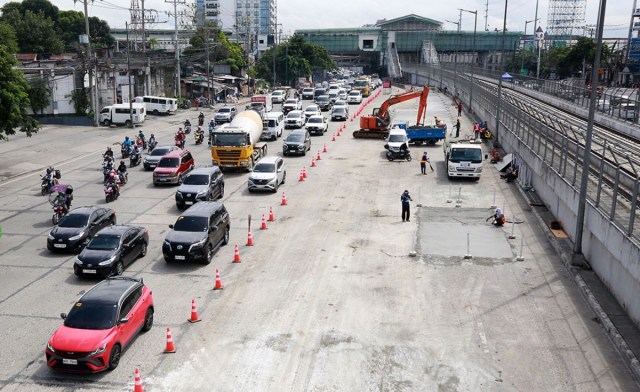
Cover photo from Business World 2024 article “Infrastructure spending improves“.


 The Society of Honor by Joe America
Dear JoeAm,
I would like to share with you an article I wrote for Dateline Ibalon ( https://dateline-ibalon.com), an online magazine that I co-founded.
Best, Raul F. Borjal
On behalf of Joe, thank you sir for sharing the link to your blog. One of our regulars here, Irineo Salazar now based in Munich is the son of Zeus Salazar from Tiwi, Albay.
I meant on-line magazine
Glad to hear it!
ahem, this is just a test run on ibalon’s why phil didnt have a singapore moment:
do we have to! I am one of those that abhors comparisons, been told many times filipinos are this and that, and always short on the mark. and never on target.
thanks, but no thanks, filipinos like me are happy to plod on along and have accepted our place in the sun. anything out of ordinary is blessing. we have our own moments, maybe not by singapore’s standard, but ours nevertheless.
good on singapore, they have achieved and earned their status.
and good on philippines too, for despite the fact it is an archipelago of floating islands with different cultures and subcultures, groups of people, and dialects, we are together despite our differences. most of the time. despite all the threats, within and outside, we still have our democracy and independence, our sovereignty intact. and that is achievement.
Come to think of it, we are on the same frequency most of the time, kb. I like how you expressed the comment above.
If you are personally satisfied and comfortable with the status quo, good for you.
My positive take to most kb’s comments is that we should not despair of feel defeated and that we should recognize our achievemnts. That is what I think.
thanks for your thinking and kudos for your thought.
I was testing to see how the writer, raul f borhal, would react to a grassroot. hopefully no harm done.
You are welcome and thanks.
Hello Raul. Sorry for my delayed response, just catching up on my reading.
Your article is a terrific summation of the historical and “government thinking” differences between the two nations. There are plenty of lessons there. My current interest is on Lee Kuan Yew’s approach to corruption. Two steps. One, pay government people enough to live well. Two, prosecute the corrupt mercilessly. The Philippines will not cure corruption without Step One, I think.
Hello, JoeAm. Thanks for the kind words. I have sent my article to Reps. Chel Diokno and Leila de Lima and Sen. Risa Hontiveros with a request to craft legislation that would institutionalize continuity in policy-making and project implementation across administrations. There are plenty of other legislative acts that can be made to reform our political and electoral systems. Hopefully, something concrete will come out of it.
Best,
Raul
Excellent. I hope they listen to you.
This would be great.
I feel you Raul.
Each President has a Philippine Development Plan and chances of continuity are iffy just because of shifting priorities ad infinitum.
PN Sail plans which is supposed to be Administration proof also looks like having a moving goal posts.
EO57 the one for maritime interagency coordination has had many vesions and the latest version, just erased the Coastwatch program by renaming it. Sure you have your own brand, but you fix what is broke,but we get broke because we also keep on fixing what aint broke. Those fixers must go.
Agriculture has the AFMA or Agriculture and Fisheries Modernization, like AFP modernization funding became a consolation prize and not a priority.
This is my first round of exploring direct democracy in the Philippines.
https://joeam.com/2020/10/12/institutionalizing-people-power/
Einstein may have a different saying about repetition, but that saying about insanity was proven to be fake news. Here is me, repeating myself.
https://joeam.com/2024/08/26/revisiting-the-institutionalization-of-people-power-onwards-to-direct-democracy/
hah, you scared me! I thought you said epstein as in jeffrey epstein whose files are soon to be released to the public. wonder if our joey nguyen being american is in the files! is sonny, your unc, there too? is mischa? the corporal?
Let us see.
joeam, I dont know about govt people being paid well if that keep them on the straight and narrow. eg. nadia montenegro, robin padilla’s staffer who was paid 100K a month. she resigned when caught smoking weeds in the cr.
then we have senators and congressmen who are also very well paid, live well, have govt cars for their use, and have access to miscellaneous funds to help constituents in need, but still habitually dirtied their hands and made numerous budget insertions. as well, amply paid govt appointees like ex dwph chief bonoan who is alleged to have taken part in the flood scam, and deped sec sonny angara who is now alleged to have participated in the scam.
school principals both private and public have made quick millions by enrolling ghost students year in and year out, and when threats were made to publicly name and shame them, the principals returned their loot, and were never punished. never had their day in court too.
I think, it is only the lower public servants like the support staff, drivers, clerks and office staff that are not so well paid as they go by class but they got benefits like bonuses, paid leave, etc. if promoted to the next class or level, their base salary goes up too.
no matter how much govt people (top level or lower level) are paid, if the opportunity to steal and grab more money is here, they’d most likely do it! they can never say no to suitcases full of money!
p.s. if we really want quick justice done, we may have to consider what the thieving school principals did as regards the enrollment of thousands of ghost students: the principals readily return their loot, and never face public scrutiny! they all remained unanimous and maybe got to keep their jobs too.
maybe, had zaldy co et al did the same and promptly returned their loot, there would be no big drama, no passport cancellation, and we shall all have a very merry christmas!
we need something like this one for how Thailand became a tourism juggernaut: https://youtu.be/7jS7aV568IA?si=F_R6GbBCQEZ03Yla
Thanks for that, Gian, glad you could drop by.
The Vietnam war jump started their tourism.
My filipino inggit instinct says, we had R and R tourism way before the Vietnam war.
As they say…what happens next is up to you.
I asked Gemini to check out the video and summarize it:
Then I followed up by asking what could be the lessons for the Philippines:
News from Germany: I saw actual package roundtrip tours to Bohol being offered over here recently. That already means that the Philippines is slowly becoming interesting for the segurista German market. Tour operators here often face cases if expectations do not meet reality, so they will not go to risky places. I can already see some stuff falling into place like the Creative Industries Act, Michelin stars reaching the Philippines etc etc – so what happens next indeed?
ppop needs to cross pollinate.
Francis Libiran x SB19
Kenneth Cobonpue x SB19
BINI members from Bohol/Siargao/Palawan or a province with
tourism potential should promote it in a natural way
Based on a recent 72-hour trial membership in a metrics platform for music pros, I found out that only 4 Filipino acts are in the global top 1000 according to their metrics available only to full members: Ben and Ben in the 600s, Cup of Joe in the 700s, and SB19 and BINI in the 900s. Taylor Swift is No. 1 on their list.
Jolibee took Katseye (Hybe group) for its US promos, not BINI whom they have for PH promos – that already says a lot about who is in what league. Though BINI will be in Coachella in April 2026 just like Katseye, while SB19 has a collab with global gaming company Honor of Kings and increased Asian presence especially in Japan and Taiwan, so the international route is just starting and has to be followed through.
BINI did have Roadtrip Adventures vlogs in collaboration with DOT, in Metro Manila, Batangas, Baguio and Bohol some years ago. SB19 had concert packages (hotel+transfer+concert) for its Philippine Arena concert earlier this year, BINI has it for their coming concert, both are great for foreign fans who don’t want to go through Metro Manila hassle and all. The foreign fans of both who go to PH (still a handful) are often influencers anyway and make vlogs about their trips.
Another video and how I believe Michelin lists can also affect the surroundings
I asked chatgpt to.summarize, analyze and its PH analogs
Below is a structured summary, analysis, and Philippine relevance of the video “How a Single Costco Changes Its Local Economy.”1. Summary of the Video
The video explains how the opening of a single Costco store reshapes the economy of the host community. Key points:A. Aggressive Land Use and Local Government Negotiations
Costco often negotiates with local governments for tax breaks, infrastructure improvements, and favorable zoning.
Cities accept this because Costco promises stable jobs, increased tax revenues, and consumer spending.
B. Massive Customer Draw + Regional Pull
A Costco becomes a regional retail magnet, pulling shoppers from multiple surrounding cities.
This creates:
Increased local traffic
More fuel purchases
More restaurants and small shops near the store
A boost in sales tax revenues for the host city
C. Impact on Small Businesses
Costco’s economies of scale allow extremely low prices.
This often forces small nearby retailers, hardware stores, and grocers into decline or closure.
The video notes that Costco is less predatory than Walmart, but still displaces businesses.
D. Employment Effects
Costco pays above-average retail wages.
It offers strong employee benefits.
However, job creation often replaces jobs lost from displaced small businesses.
E. Fiscal Effects on City Government
Cities often “compete” to host big-box stores.
The store becomes a stable revenue anchor, but the costs include:
Tax subsidies
Infrastructure and road expansions
Traffic congestion
Lost diversity in local business ecosystem
2. Deeper AnalysisA. Costco as an Economic Node (Cluster Theory)
A single large anchor tenant restructures the local economic geography:
It becomes a gravity center within the region.
Develops a retail cluster around it (fast food, gasoline stations, banks).
Shapes land values and housing demand.
B. Asymmetry in Government-Business Bargaining
Local governments:
Are often price-takers, desperate for jobs.
Lack negotiation leverage.
End up offering subsidies that outweigh long-term gains.
This mirrors:
Public-private partnerships where governments overpay.
Urban planning distorted by private interests.
C. Substitution vs. Real Economic Growth
The video notes that retail stores do not create new wealth; they reallocate spending.What Costco improves:
EfficiencyWhat it harms:
Local business dynamismThus, the net economic gain depends heavily on:
How cities manage land use
Whether displaced economic activity moves to higher-value sectors
3. Relevance to the Philippines
Costco doesn’t exist in the Philippines, but the dynamics are directly comparable to SM, Ayala Malls, S&R, Puregold, Landers, and other retail giants.A. Big-Box and Mega-Malls Already Play the Same Role
SM, Ayala, Robinsons:
Act as economic anchors
Pull consumers from nearby towns
Centralize retail into giant malls
Displace small sari-sari and groceries (e.g., SM Hypermarket effect)
This creates:
Monopoly tendencies
Dependence on 1–2 mall developers
Traffic and congestion around malls
Local economies become shaped by corporate mall developers rather than strategic planning.B. Local Government Overreliance on Mall-Driven Revenues
Philippine LGUs rely heavily on:
Real property taxes from malls
Business taxes
Jobs provided by mall ecosystemsThis produces:
Zoning decisions favoring malls over open spaces
Limited urban diversification
Concentration of economic power with a few conglomerates
Some mayors openly compete for malls—exactly the Costco effect.C. Impact on Micro-Retailers and Informal Economy
Like Costco’s impact on small U.S. retailers:
SM Hypermarket, Puregold, Landers, S&R reduce foot traffic to wet markets
24/7 convenience chains (7-Eleven, Alfamart) shrink sari-sari margins
Big-box stores make “mom-and-pop” groceries obsoleteThis mirrors the video’s theme:Efficiency increases, but diversity decreases.
D. Lessons for Philippine Development Policy1. Strengthen LGU Negotiating Power
Philippine cities should:
Demand community benefit agreements (CBAs)
Require impact studies (traffic, environment, SMEs)
Mandate ESG, green building, and worker welfare standards
2. Support SMEs Against Market Concentration
Policies:
SME price protection laws
Tax incentives for local producers
Digitalization subsidies
Cooperative purchasing to help small stores compete
3. Balance Retail with Local Production
The Philippines must avoid becoming:
A nation of malls
With no robust manufacturing, agro-processing, or innovation economy
Retail is a downstream activity.True growth requires upstream value creation.4. Lessons for New Towns (e.g., Cavite, Bulacan, Clark, Davao)
A single anchor tenant:
Can dictate land values
Attract supporting infrastructure
But also distort planning
This is relevant to:
New Manila International Airport (Bulakan)
Cavite–Laguna sprawl
Clark Green City
4. Final Insight
The video’s central message is highly relevant to the Philippines:
Large retailers and anchor tenants reshape local economies not by creating new wealth, but by redirecting spending and reconfiguring urban space.
For the Philippines, the key is to craft policies that:
Leverage the benefits (jobs, convenience, tax base)
While mitigating harms (SME displacement, congestion, land-use distortion)
And ensuring development aligns with long-term SDGs, ESG principles, and inclusive economic growth.
If you want, I can also produce: ✔ A Philippine policy brief✔ Comparison with Indonesia, Thailand, Vietnam✔ Integration with your ongoing SDG–ESG framework✔ A version tailored to your white papers and commentaries
@Joey,
Your lament of conglomerates looking for cheap labor is apparently, universal.
Costco maybe in retail but the pattern persists. Negotiate with LGU and offer or guarantee a percentage of local jobs, as stated in the chatgpt summary who is now well-versed in reading my mind LOL
All private enterprises big or small desire the lowest cost labor possible. Costco is great by the way. Costco is my main shopping destination. Excellent service, fair prices, happy and helpful workers due to , and most of all their lifetime satisfaction guarantee for nearly every product is legendary. Costco pays 21% higher salaries for starting workers and 87% higher salaries for workers with a few years experience than the minimum salary. No wonder all of their workers are so cheerful. Unlike rival Walmart which is a predatory business.
On negotiation with the local government… I say, why negotiate? If the local government, in the case of the Philippines an LGU, wants to increase their local economy and deliver jobs to their residents, it is incumbent upon the local government to SEEK OUT private partners, not the other way around. In the US and EU, it is normal for local governments to enter bidding wars with rival local governments in order to attract business and factories. In the US and most parts of the EU, local governments streamline licensing and approvals for people to start new businesses as well. Important as the main revenue for local governments in the US are use (sales) taxes and property taxes, and they can’t collect sales taxes and property taxes without attracting businesses, commercial tenants and private residents. The system in the Philippines of an overall national taxation scheme whereupon each LGU is allotted a portion is very detrimental in my view. AFAIK taxes from Manila and Calabarzon subsidize most of the country, even the very proud Cebu and perhaps even prouder Davao. This system is not conducive to creation of private enterprise, and skews towards reliance rather than resilience and independence.
Excellent insight, I might be wrong that the LGU negotiates with conglomerates, but that is what I observe. But often it involves land conversion open secret or not whether it is Villar, Ayala, Sys, Gokongwei
This means relocation and dislocation.
Some LGUs do open up negotiation with conglomerates, but so few in relation to the rest of the LGUs which are mostly poor and depend on their budget allotment. Which the local politicians pilfer a portion of to make side businesses despite their constituents being dirt poor. When you see very poor towns have mayors descended from some datu with a nice mansion and a business in let’s say, owning the sentro or having a small fleet of panel vans for deliveries, you may guess where that money came from. This happens a lot outside of Metro Manila and happens in nearly every town and small city I’ve been to.
But yes, sometimes citizens need to be relocated for the public good, like building a highway to connect to the transport corridor, or a factory that supports a thousand jobs for the few dozen families displaced. People should be properly compensated for their losses, and if they own the land, compensated for that as well. Most times though, the people who live on the land that is converted aka sold by the owner are squatters to begin with. They should be given compensation and incentive to move, preferably in an organized manner. For example, squatters that live alongside the eastern part of Cebu-Mactan Airport, of which there are thousands and thousands, were offered anywhere from 25-50k to move when the owners decided to sell the land to subdivision developers. Most took the offer. Some demanded more, but they don’t own the land in the first place.
I think reaching a greater level of public good by even the brightest, hardworking and most well-meaning leaders often involves hard choices that are bound to make some group(s) unhappy. The decision can seem utilitarian and without empathy. But the only other choice is to leave the status quo as-is. Which is how the Philippines got here in large part to begin with.
Fully agree. I don’t know the US system but over here there is a bit of an incentive for the German equivalent of LGUs (cities or counties) to attract both businesses and professionals, as both corporate and income taxes are distributed to local / state / federal with a 15% / 42.5% / 42.5% ratio.
There is also a ratio for what % of corporate tax is considered as earned on the territory of a city or county, so you don’t have all taxes of Karstadt (the big shopping center owner now pretty much in the red) go to its HQ city Essen, or BMW taxes go to Munich for their factory in Dingolfing. Aside from corporate taxes, the trade tax for SMEs actually registered at city hall goes to local, another incentive for attracting business.
Not a neoliberal who is totally against any subsidy, but the IRA in the Philippines encourages parasitical behavior instead of incentivizing flourishing places.
There have been similar arguments here against the capital city subsidies for Berlin (though the city is now recovering from decades of division and far from the “poor but sexy” noughties) and the now somewhat cut down “solidarity surcharge” for West German taxpayers to fund East German reconstruction.
The Cold War era “Zonenrandförderung” (a word Mark Twain would have “loved”) or edge zone funding given to areas close to the border with East Germany or Czech Republic was a totally different case, the support for West Berlin as well which was called the “trembling bonus” by its inhabitants, to keep them on that island surrounded by Communism. Or the subsidy to keep East Berlin looking shiny and modern as it was directly visible to West Berliners..
The US tax system is complicated on paper (with over 30,000 individual taxing authorities from municipality, to county, to state, to federal), but for most Americans taxation is relatively simple due to the Standard Deduction. Our system is a progressive tax where subsequent higher tax brackets are taxed only for the next dollar above the bracket, and the earnings in the lower brackets are taxed at that level. So the average accessed tax is much lower than the highest tax bracket even if the individual earns at a higher bracket.
For example, in California the baseline taxes for someone earning $100,000/year technically has a federal tax rate of 22% but actually pays an effective federal tax of 17.05% if the tax paid per bracket is averaged for the entire gross salary. Using that $100,000 example, such a person would pay:
• 17.05% Federal Income Tax
• 2.96% California State Income Tax
• 7.25% Municipal Sales Use Tax (VAT)
• 0.70% Property Tax on residential property value at time of purchase
So the average Californian earning $100,000 would pay 27.26% Combined Income Tax and VAT, and their municipality would tax their home at 0.70% of its property value at the time of purchase
Corporate Income Tax for businesses are 21% for federal and 8.84%, or 29.84% combined corporate income tax for California. So SME business tax is similar to for an individual income tax, though this system does effectively tax large enterprises way less.
The American system forces increasing responsibility for local issues assigned to local authority. The role of the state government is to step in to help when the locals mismanage things or when calamities happen. The federal government steps in to help when the state capacity is overwhelmed, which happens often in “Red” states due to them having no income tax, no property tax, or not having both and only relying on VAT. Places in the US that have bad local government have less taxes than here in California, and they need welfare from the taxes paid into the federal government from better governed states. Kind of like a bunch of Hungarys inside of the US in the form of Republican governed states. If DDS wants to make their own countries of Visayas and Mindanao, let them have at it. Without IRA most of their LGUs would quickly die.
In any case the American-Canadian system or Western European system both provide ideas. The IRA is sometimes more like trying to buy loyalty from whatever LGU. Which the strongest political leaders there promptly embezzle for themselves and to run their campaigns in order to entrench power to get more tax money. This is how SKs can buy nice cars, or mayors can build mansions despite their municipality not having any obvious driver of economy. The money from IRA is their economy and is what they are farming. Just totally broken. The only hope I can see from a common sense viewpoint is to have dedicated and honest auditors fan out and question everything to make sure tax pesos are not used improperly.
I asked chatgpt what the Philippines might be able to adopt from the USA, Germany and Switzerland (I chose the last one as it has aspects similar to the US system and aspects that are European) to incentivize local development and got this:
I also asked about LGPMS which Jesse Robredo started and how it evolved until today:
So maybe a mix of incentive-based stuff adjusted from different countries and fit to the Philippine situation (something the Philippines often does badly but has to learn how to do) and metrics based monitoring a la Robredo would be best for the Philippine system, but I will not ask chatGPT about that, I leave that to our human discussion..
P.S. I suspect that LGPMS may have degenerated into ritual in many a place, just like I am suspicious of Filipino firms that say they are ISO-certified as I have heard that is often also just a ritual in many places there, done for cosmetics.
P.P.S. could the disdain for “good governance” some Filipinos have stem from the way it might often be done on the ground over there, as a ritual?
I suspect that any good governance workarounds will be a heavy lift that face heavy headwinds. The existing structure provides local dynasties more than enough “guaranteed income” with which to further entrench their local power by giving enough ayuda to their supporters to maintain a base of support. Those local dynasties then will ally with other dynasties to preserve that power. I’m not sure what can be done aside from amending the Constitution along with transferring more true responsibility to the local level. It is highly telling that in most cases of calamity, local people almost never blame their LGU government, they don’t even blame God, but they will blame the president if they happen to not like the president, and excuse the president if they like the president.
Even in the US system of separation of power, which I view as “more” ideal, the Red states have figured out how to leech off of Blue states while keeping their constituents at a subsistence level of barely surviving. Humans don’t revolt if they are surviving, even if just barely. The level of fervor of support becomes even worse when it adopts some cult-like aspects that allow people to reach for confirmation bias while ignoring reality. People can’t ignore, however, the reality of personal suffering. For MAGA Americans, that suffering apparently are high prices across the board. For Filipinos who are fine with being layabouts in the far-flung provinces waiting for a remittance or ayuda, the tolerance level for suffering is much higher. While I think it is the utmost moral good to help people less fortunate, I have found that some people just can’t change when they are constantly helped. So if they don’t start bending towards what I want them to do, I stop helping.
Here is the lowdown.
Below is a clean, structured, and practical analysis of the Internal Revenue Allotment (IRA) system and the Mandanas–Garcia ruling (often called the Mandanas doctrine)—their pros and cons, fiscal, governance, and development implications, with additional insights relevant to Philippine realities.Internal Revenue Allotment (IRA): Pros & Cons
IRA = LGUs’ share from national internal revenue taxes (pre-Mandanas rule).Pros1. Predictable and Stable Source of Local Funding
2. Simplifies Fiscal Transfers
3. Supports Poorer/Less Developed LGUs
4. Promotes Local Governance
Cons1. Underfunded Mandated Services
2. “IRA Dependency” / Limited Local Revenue Generation
3. Formula Does Not Reflect Performance
4. Weak Link Between Development Needs and Allocation
Mandanas–Garcia Doctrine: Pros & Cons
Mandanas ruling (2022) expanded LGU share to all national taxes, not just internal revenue taxes.Pros1. Much Larger LGU Budget
2. Supports True Fiscal Decentralization
3. Allows LGUs to Innovate Based on Local Context
4. Could Improve Inter-Agency and Local Coordination
Cons1. Fiscal Pressure on National Government
2. LGU Capacity Gaps
Many LGUs lack:
This may lead to:
3. “Asymmetrical Development” — Rich LGUs Prosper, Poorer Ones Struggle
4. Risk of Expanded Corruption
5. Confusion Over Devolution and Roles
Synthesis: IRA vs Mandanas DoctrineIRA System (Before)
Mandanas Doctrine (Now)
Big Picture Implications for GovernanceWinners
Losers / Risks
Best Way Forward (Policy Improvements)1. Capacity Building for LGUs
2. Performance-Based Grants
3. Redesign the IRA/Mandanas Formula
Add factors:
4. Stronger COA & Civil Society Oversight
5. Clarify Devolution
If you want, I can also prepare:
✅ A side-by-side table
✅ A policy brief for legislators
✅ A governance roadmap for LGUs to maximize Mandanas
✅ An op-ed style analysis on whether Mandanas worsens or improves Philippine development trajectory
Just tell me which format you prefer.
I understand that the point of IRA and Mandanas decision is intended to give more decentralization. I guess it is true that is the Constitution’s intention, but that also means that the system as it pertains to distributing the nation’s wealth was set up to fail from the start.
Instead, IRA is more akin to the ancient datus handing out gifts and bribes to keep his followers and subordinate datus in line. Except in the distant past subordinate datus that were actively undermining while also hurting their own dependents were thrown out by the stronger datu who bore gifts, to be replaced after a power struggle. Here in the modern day the gifts which might be regifted to further lower subordinates in distant provinces are tax pesos gotten from IRA. All the while fueling the base of power of those distant mayors and politicians. Been to too many municipalities to recall where there is no meaningful local industry or source of revenue, except the mayor has a mansion and basically has the only business in town selling goods at the bazaar and having a lock on transport vans.
But even if the IRA is looked at in the most positive light, it is a system of subsistence and reliance, not a system that encourages entrepreneurship and enterprise.
I asked ChatGPT to summarize the Third Republic’s municipal taxation system and this is what came out: (Karl, my recommendation is for you to try this out also, as the detailed stuff is usually too much for most people to read)
The ChatGPT summary of how that changed during 4th and 5th Republics is as follows:
Still my impression is that the present Philippine system is the worst of both worlds, incentivizing local governments to do many things in any way they want (to the extent that Davao City for instance thinks it has the right to declare people persona non grata, which it doesn’t) but still totally depend on national money.
Thank you fo the suggestion. I will summarze.
It is often observed that during the crafting of the 1987 Constitution, new dynasties (and some old) took advantage of the necessity of their support to bring stability to the newly born Fifth Republic. They certainly took advantage all right to further entrench power. Why would they not when money is guaranteed? For similar reasons, that’s how flood control scams came about. The easy money is just too irresistible and power will start to be build to protect access to that “resource.”
A lot of the problems that the US faces today with MAGA are due to flaws in the US Constitution. Well the US Founders had actually thought, and discussed, that there would be a new constitution every 20 years in order to renew the civic life. At the very least they thought there would be amendments more often when the need arose. Well that didn’t happen for a number of reasons, one of which is the US Constitution has been viewed as a “holy document” that cannot be changed, rather than what the Founders intended. Maybe someday we Americans will figure it out. Maybe someday Filipinos will figure it out as well.
Is UBI a thing in the states? LCPL kept advocating for it.
That is like Conditional cash transfers. without the condition. Like cheese burger without cheese.(corny)
UBI is not a thing in the US. There are some very small UBI-like pilot programs that target different types of recipients that are funded by private money, but despite being referred to as “UBI” by the media, those are not UBI as it is not a government program. UBI interestingly is an area of obsession for both the far-left (further than socialist, almost communist) and the (now unmasked) far-right techbros (who want to replace all labor with robots and give UBI so people won’t revolt with pitchforks). Another data point on the increasingly relevant Horseshoe Theory. My guess is LCPL is obsessed with UBI because he’s online a lot and that’s what the fringe social media online that is pushed by Twitter algorithms always talks about. Those fringe types claim to be disabled (self-diagnosed), mentally ill (self-diagnosed), neurodivergent (self-diagnosed) and therefore it’s an excuse not to work and to be a societal leech. A lot of the most hardcore Bernie and Trump supporters are like this, which is why there is a cross-over vote. Some of these discussions have gotten insane, demanding UBI, advocating for free mini-mansions from the government even if current owner who own more than one house need to be killed, guilt-tripping empathetic people into donating to their “mutual aid” so they can buy iPhone Pro Max, pay for their designer purebred dog/cat, pay their rent and expenses, all so these people can just sit online claiming to be disabled and post all day.
The system that would work the best in the US is the system which post-war Europe made with inspiration from the New Deal through Great Society programs. Access to dignified work, while providing a social safety net to catch those who fall down so they may get back up again, and taking care of the children, elderly and disabled. Many European social safety net programs are closer to what FDR, Kennedy, and LBJ intended for the US, but never happened due to the White reactionary right-wing pushback starting with the Civil Rights Act of 1964.
The vast majority of Americans don’t believe in given people who refuse to contribute stuff for free. Americans however, even most MAGAs, believe in helping their neighbor if their neighbor fell down and hurt themselves. UBI will never work, as then too many people would no longer have an incentive to work and become societal leeches. It is better to encourage employment, strengthening social safety nets, and crafting policies that make livable salaries by pressuring businesses to not be too greedy.
Again I appreciate your insught on this
Just to add context to German package tours. The only ASEAN countries I have not seen so far in catalogues of the major tour operators here are the Philippines, Myanmar and Timor Leste. Even Laos appears in some of their tours, though mostly as part of a tour through other nearby countries as well.
Germans are notorious for not just complaining about their hotels etc (Spanish are very aware of this) but also suing their tour operators and getting partial refunds for trips that did not meet expectations raised by the catalog. Just a minor tour operator offering a Bohol tour means that they have found a way to at least minimize risks over there to a safe enough level. Predictability is key for being able to do that.
By now, insiders already say that the Philippines has the potential to be “the next Thailand”. What is holding it back has been discussed here at times.
Laos is known for exotic foods.
Here is a clean, compact synthesis of the discussion:
—
🇱🇦 Laos’ Exotic Foods & German Tourist Appeal — Clean Synthesis
Laos successfully attracts tourists through its exotic, forest-based, and traditional cuisine, especially dishes involving insects, wild herbs, and river-based ingredients. Night markets in Luang Prabang and Vang Vieng have become major tourism magnets, driven by curiosity, social media appeal, and the global trend toward authentic food experiences.
German tourists, in particular, respond strongly to this kind of food tourism. Germany has a culture that values:
Sustainability and organic ingredients
Eco-tourism and authenticity
Adventurous but ethical food exploration, including openness to insect protein
Because insects and “wild foods” are increasingly accepted in German supermarkets and food trends, Germans are among the most willing Europeans to try:
Fried insects
Ant egg soup
Riverweed snacks
Forest stews and traditional Lao dishes
They may hesitate with raw meats or ethically sensitive dishes (e.g., snake, dog, rat), but overall they enjoy Laos’ culinary identity and often seek it out as part of the travel experience.
—
🇵🇭 Relevance to the Philippines
This pattern shows that the Philippines can target similar markets—especially Germans—by promoting:
Kamaru (crickets)
Tamilok
Crocodile dishes
Curated balut experiences
Indigenous forest and river cuisines
Laos proves that authenticity, heritage ingredients, and well-presented exotic foods can become powerful tourism magnets for adventure-oriented Europeans, particularly Germans.
—
If you want, I can also produce an ultra-short version, a bullet comparison, or a policy-style note.
Had a “kamusta” catch up with a group of Filipina friends a few weeks ago. They are lower to solid middle class. All have finished college and most work in BPO. They mentioned that they are planning a trip to tri-country trip to Vietnam, Laos and Thailand. I asked, “why not Philippines, where there are many nice places to go?” The reply was that food, resort, accommodation pricing and transportation in the Philippines was not great, and they didn’t feel safe going as a woman-only group to far-from-city places in their own country. They also felt that the experience in Mainland SEA (they mentioned specifically Vietnam) looked more authentic and interesting as they saw it on social media compared to the Philippines. Well, if I didn’t have a soft spot for finding interest in the mundane things of daily life in the Philippines, I’d probably feel the same if I were a Filipino. Just an anecdote, but this isn’t the first time I’ve heard something like this.
Also, Philippines tourism advertising (the totally corny “It’s more fun in the Philippines”) campaigns definitely DO NOT match up with the actual experience once a visitor arrives. For most people living in Western countries, it is NOT fun nor easy to get around in the Philippines, especially on a time constrained vacation. Eco-tourists and backpackers, who are mostly young and have big allowances from their rich parents, may think differently and that’s great, but this segment is rather small. Haven’t been to Vietnam, but when I go to Thailand, it’s just simply nice there, no one’s trying to scam me out of paying too much for a cup of taho, the streets are not totally clean but not filthy like some parts of the Philippines, and the accommodations and transport is much better. Most importantly, tourists are there to spend their Dollars (or Euros). They expect good service that matches what they spend. I have a joke that a four star hotel in the Philippines is actually just barely a three star in the US, but charges more than four star American prices with lesser service. So why should most people go to the Philippines for vacation?
well, if foreigners are hunting for a placid and docile wife, they can rarely find their catch in the philippines. the women here have become westernized and not afraid to call off misbehaving men. women are no longer classified as beasts of burden, are hardy and can stand on their own feet, hold down a job even if jobs are hard to come by, and can pay their own way.
why would people visit the philippines! if they dare and are stout hearted, they’ll be faced with outdated infras with buildings that have seen better days, security maybe compromised with terrorism in the south like kidnapping and the like, thieving and the like, extortion and the like and there is overcrowding, traffic is awful. and the weather is to be endured and differently not a walk in the park with constant storms and flooding that strand travelers, and flights are often cancelled. there is rarely direct international connection. there is also woeful internet connection and power outages are common that left people stumbling in the dark. health care is very expensive and if tourists have no health insurance, they can die in waiting rooms.
philippines can be severely disorienting! one moment tourists are in the fashion mecca where people are better dressed, toing and froing the most modern of buildings that tower high up in the sky, and just round the corner after making a wrong turn, is completely another world, totally enmeshed in poverty with shanty towns and grotty leantos that house feral looking people who gawked at foreigners, and heir predatory smiles make foreigners uncomfortable.
but look on the good side: we have wonderful festivals and fiestas where almost everyone participates and make colorful memories all year round. we have people with ready smiles and will endeavor to accommodate foreigners even if they dont speak english like we do! they mangle english worse than us and speak tru their noses! funny that.
Thanks KB. All of the reasons you wrote here are exactly why I like the Philippines. To me the Philippines is both enjoyable and infuriating (sometimes at the same time). The easy going way of life is relaxing if someone isn’t in a hurry. Many of my friends are quite poor, but they are still grateful for what they have, and have hope for a better future.
One point of disagreement though. Even before Filipinas became more Westernized, I feel that they were never really docile and demure. Most Filipina wives I know rule their house with an iron grip, and most importantly with a smile. Haha.
Nice brightside points and no buts this time.
I don’t think Filipinas have become westernized. I think they have been holy terrors and totally lovable since the Spanish refused to supply condoms and they learned to run their families while “Dad” was out working or philandering. My wife learned her toughness by being poor, and dealing with it.
The rest I totally agree with.
“2024 arrivals: Around 5.44 million international visitors arrived, a substantial increase from 1.48 million in 2020, though still less than the pre-pandemic record of 8.26 million in 2019.
2023 performance: The tourism sector contributed PHP 5.3 trillion to the economy and supported 11.2 million jobs, though its contribution was still below 2019 levels.”
Tourism is a major industry in the Philippines. People who find diving or surfing fun put up with the inconveniences for the great water treats, or consider them a part of the adventure. There are a lot of beaches and quality resorts. There are also rustic ventures for the adventurous without much money.
The current tourism slogan is “Love the Philippines”. I’ve not seen ads so don’t know how that is presented.
Tourists come mainly from South Korea, China, Japan, the US, and Canada. I’ve seen Middle Easterners around as well, and Europeans.
As far as airports go, Cebu is excellent and NAIA is improving. Local airports are upgrading steadily. Ferry services are robust. National highways are wider. Filipinos are great at service. Tourism sites are being upgraded and managed better. But it’s a work in progress, for sure. Water sanitation in beach communities is an issue, and Manila road congestion. The Philippines is the Philippines, and I personally would not want it to be anyplace else.
The points you shared are all well and good, and should be commended. But I think there is room for more improvement. As-is the type of tourist and visitor that likes to visit the Philippines are more like eco-tourists or people who have more time to explore despite quirks and inconveniences. If you recall nearby Baja Mexico back in the day, it was an interesting place to visit but not really a great experience. For most people, visiting the Philippines right now is about the same or slightly worse than visiting Mexico back in the 1980s and 1990s. Most tourists want to experience something new that is a bit exotic, but still have all the Westernized amenities and convenience. That’s the secret of successful tourism. Thailand is great at this. From what I’ve seen, Bali is another example, though expensive. Vietnam quickly figured it out too. People like you and I are more patient and at least for me, I am easily amused and entertained. This mentality works great in the Philippines.
This is the DOT clip.
I’d like to see the research on that. I have no idea why the Philippines is popular in South Korea or Japan. Cheap I suppose. Nearby. English, easy. There ARE first class resorts.
I just asked ChatGPT the current yearly tourism stats for SEA countries, which I expect to be reasonable accurate, and based on them it seems the Philippines does have potential for way more tourism if certain things are improved..
– Thailand around 28 million
– Malaysia around 20 million
– Singapore around 13.6 million
– Vietnam around 12.6 million
– Indonesia around 11.7 million
– Cambodia around 5.45 million
– Philippines around 5.45 million
– Laos around 3.42 million
– Myanmar around 1.28 million
The data are indeed instructive and back Joey’s viewpoint. I mean, c’mon, Cambodia? The Philippines needs to build some temples, I suppose, or let tourists climb active volcanos. Or market itself to typhoon hunters. Damn!
One should not discount the grandeur of the old Khmer Empire. I don’t know if you’ve seen the various temples before, but it is awe inspiring. Also, I’m sad to say that the service and general genuine niceness of Cambodians is on a higher level than in the Philippines. While yes, I do think that most Filipinos are nice enough, unless one is part of the close friends/family group, I’ve always found that the “niceness” is not fully genuine. Not so in Cambodia.
I hope you are not guaging niceness on counting how many times you checked your pocket if your wallet is still there. LOL
I’ve never had my wallet stolen in the Philippines, though a few times had pickpocket groups use a pretty young girl to try to distract me while the boy tried to slip his hand into my back pocket. Well, I don’t keep my wallet in my back pocket, not in Europe and not in the Philippines. Like what I had learned with the gypsies in Europe before, I seized the boy’s wrist and smiled at the girl, then let them go.
I did get scammed once by a mabait looking lola. She looked so pitiful selling taho by the cup in the hot sun, so I bought her entire day’s worth kaldero of taho and felt quite proud about helping. Apparently I was given the “American price.” I was scolded by my local friend after that lol. I was in high school at the time, and something like that never happened again.
Well, that’s the point of my slightly sarcastic post. Cambodia has awesome destination sites for tourists, the Philippines has beaches. Palawan is shaping up as a destination island, multi-faceted. Boracay has had that allure for some time, although it went through a rough patch. Manila has a few old buildings and some history, but that is not a family visit. It is hard to crystallize exactly what the Philippines offers. I think there is something to the adventure spirit of volcanos, sea life, waterfalls, and jungles, but the unity is not there to make up tour packages. So girls it is, and I would only observe that that is acceptable in the Philippines because the girls see it as a path to a better life. Poverty is hard.
I tend to stay away from touristy places once they are over developed. I used to adore Puerto Princesa with its beaches, caves, mangroves and nearby forests. Ever since too many tourists went there I’ve avoided it. Same for Boracay, then in recent years, Surigao. I just have a huge allergy to obnoxious men chasing women around, dealing with prostitutes propositioning, which seem to be the main visitors as sadly there are not that many family groups. I’d rather go to some secluded mountain riverside or distant beach or tiny island with close friends, but I also recognize that doesn’t work for the vast majority of tourists who need to have a bit more structured experience due to lack of time.
I had a thought that even in terms of old buildings and a bit of history, there isn’t even that much of that to last a whole trip dedicated to the Philippines. There is only so much I can take of some docent rattling off the same “facts” about the revolution over and over again. So another negative to what usually attracts tourists.
What the Philippines does offer to me, and what I cherish, is the variety of “kwento” among friends whenever I visit, and some more kwento with new friends to be met. The Philippines is a country of stories,, telling stories and hearing stories. I wonder if there can be an angle on that when it comes to attracting tourists.
I’ve not seen the obnoxious men you mention, but I don’t visit bars, so maybe it’s there. I know expats generally gather at a local cafe here in town. I avoid them like the plague. Too judgmental for my liking. The Philippines is a little rough and ragged, I don’t mind.
I don’t think your wife would much appreciate you going to those places anyway lol. For me it is another opportunity to people watch and enjoy learning about a culture, warts and all. The life of an American can often feel like a rat race. It’s nice to slow things down a bit, which is what I appreciate in the Philippines.
Haha, I’d have my wiener on a platter. Well, she need not worry which is why we get along well.
Official Japanese outbound tourism statistics for 2025 YTD:
https://www.tourism.jp/en/tourism-database/stats/outbound/
This Japanese government website collected data from each Asian country’s government tourism statistics as well, which may be found in the Excel sheet linked on the page.
It says here 388,000 Japanese tourists visited the Philippines in 2024 vs 711,000 visits to Vietnam.
I was not aware that Vietnam is such a popular destination for Japanese, beating even Bali and roughly on par with Thailand. I have noticed a lot of Japanese-language vloggers though who vlog in Vietnam and speak quite good Vietnamese.
Tour operator which cites official Korean outbound tourism numbers for 2023:
https://jandectravel.com/vietnam-tops-southeast-asia-in-attracting-tourists/
3.6 million Korean tourists to Vietnam vs 1.3 million to Philippines.
Vietnam has also smartly used its historical connections to Korea (through the Ly dynasty prince who taught the Koreans how to defeat the Mongols, and founded the Lee family name).
Also, the people relevant to tourists speak English just fine in Thailand and Vietnam. Most Thais and Vietnamese understand and can speak broken English, just like the vast majority of Filipinos can only speak broken English. English is not a problem. In most cases there will always be a tour guide who will act as an intermediary. English can be a strength but if it’s one of the few things the Philippines leans on, it’s just not enough when it comes to attracting tourists.
When you retire have a travel agency startup.
Sadly I do not have the patience for customer service, haha.
More digging from me.
Great question. There are several interlocking statistical, structural, and cultural reasons why the Philippines is especially popular with tourists from South Korea, Japan, and other top visitor markets — plus some interesting anecdotes. Here’s a breakdown:
—
1. Key Statistics: Who’s Visiting the Philippines
In 2024, the Philippines recorded ~5.95 million international visitor arrivals.
South Korea is by far the top source market: 1,574,152 Korean visitors in 2024, or ~26.5% of total foreign arrivals.
Japan is another major market: in 2024, there were 444,528 Japanese tourists, a ~22.8% increase from the previous year.
In 2024 (Jan–Oct), Japanese visitors made up about 6.62% of total international visitors.
According to the Bureau of Immigration, total international arrivals in 2024 were ~14.73 million (includes more than tourism).
—
2. Why Koreans Love Traveling to (and Staying in) the Philippines: Analysis
Here are several factors that explain why the Philippines is especially attractive to South Korean tourists, students, and long-term visitors:
A. Education + English-Learning
A very large segment of Korean visitors come for English as a Second Language (ESL) programs.
English education in the Philippines is relatively affordable compared to Western countries, but with a high quality of English-speaking teachers.
The proximity of the Philippines to South Korea is a big plus: relatively short, affordable flights make these study trips practical.
According to the PIDS (Philippine Institute for Development Studies), Korea’s middle class increasingly sends students to the Philippines because of lower costs + cultural and geographic proximity.
There are structured “study tour” packages: English classes combined with tours and leisure (beach, diving, etc.).
So for many Koreans, a trip to the Philippines doubles as both a leisure vacation and an educational investment.
—
B. Cost and Accessibility
The cost of living in the Philippines is relatively low (compared to many Western or developed English-speaking countries), which makes extended stays (for study or holiday) more viable.
Flight connectivity and relatively cheap plane tickets also help. According to a Korean travel agency (Hana Tour), one of the reasons Koreans go to the Philippines is that travel is more affordable compared to other distant or more developed tourist destinations.
The Philippines’ tourism authorities recognize how powerful Korean pop culture (“K-celebrities”) is for drawing Korean tourists. For example, the Tourism Promotions Board ran Korean celebrity-focused familiarization tours.
—
C. Natural Beauty & Leisure
The beaches in the Philippines (e.g., Boracay, Cebu) are a big draw. Koreans often choose the Philippines for its “beautiful scenery and beaches” that are different from domestic options.
Tropical weather + island life appeal to Koreans looking for a relaxing break.
—
D. Cultural Affinity / Soft Power
There is a two-way cultural affinity: while Koreans come to the Philippines, many Filipinos are deeply into K-drama, K-pop, and Korean culture more broadly.
This “soft power” connection helps make Koreans feel more welcome; the familiarity helps, and Filipino tourism entities lean into that.
The presence of a Korean community in the Philippines (students, expatriates) also strengthens network effects: returning students, word-of-mouth, shared social ties.
—
E. Practical / Medical / Lifestyle Advantages
Some Koreans come also for medical tourism, because the Philippines is relatively cheaper for certain medical procedures.
For longer stays, the Philippines can be attractive as a retirement or second-home destination, in part because of cost, climate, and English proficiency.
—
3. Why Japanese Tourists Visit the Philippines: Analysis & Anecdotes
While the Korean case is more studied in terms of English education, Japanese tourism to the Philippines has its own dynamics:
The Tourism Promotions Board (TPB) in the Philippines treats Japan as a “very important market,” doing familiarization tours for Japanese travel agents to showcase Philippine destinations (Cebu, Bohol, Boracay, Palawan, etc.).
These tours are aimed at not just leisure tourism but generating sustainable travel packages, including community-based or eco-friendly tourism, which appeals to some Japanese travelers.
There’s also a perception of good value — the Philippines offers high “tourism bang” for what you pay, whether in accommodation, food, or experiences, especially compared to more expensive destinations. (This is more of an inferred analysis based on how TPB promotes and structures its packages.)
Anecdotally, some Japanese tourists are attracted by:
the combination of tropical scenery + English-speaking environment.
less crowded “offbeat” islands (compared to more commercialized destinations).
the novelty of exploring a “friendly Asian” country that’s somewhat less mainstream than Thailand / Bali for Japanese travelers who seek something different.
—
4. Challenges / Tensions (a Few Counterpoints)
It’s not all smooth sailing — there are some current or historical tensions and challenges worth noting:
The influx of Koreans (especially students) over many years has had social and economic impacts; some see this as creating “echo communities.”
As with many tourism-heavy flows, there are occasional issues around regulation of ESL schools, quality assurance, and transient students.
From the Philippines’ side, managing tourism growth sustainably (especially in coastal/island destinations) remains a challenge.
—
5. Anecdotes & Illustrative Stories
According to the Philippine Embassy in Seoul, in a recent year ~111,000 South Koreans came to the Philippines specifically for English classes or study tours, representing a large share of Korean arrivals.
A BusinessMirror article notes that Filipinos’ love for K-drama and K-pop also “makes Koreans feel at home” when they come here.
On Reddit (expat threads), you’ll find firsthand testimonies:
> “Mostly sa ila (Koreans) diri nag skwela, either to learn English or just to get an education … nag put up ang uban Koreans og businesses … restaurants, shops, resorts …”
In Cebu, some Koreans reportedly choose weekend trips: “they can spend the weekend in Cebu and go back to South Korea right away” — making short but frequent tourism cycles.
—
6. Broader Trends & Strategic Implications
The Philippines’ tourism strategy seems to leverage education tourism as a core part of its inbound market, especially for Korea.
There’s a “soft-power + economic complementarity” effect: Korean demand for English + lifestyle + tourism helps local Philippine economies (schools, resorts, transport).
For Japan, the Philippines’ strategy involves deepening relationships through travel trade, sustainable tourism, and curated packages — not just mass sun-and-beach tourism.
—
Bottom Line
South Korea: The Philippines is a top destination because of its affordable English education, proximity, beach appeal, cost of living, and strong cultural ties. Many Koreans don’t just vacation here — they also study, sometimes combine work or language learning with travel.
Japan: The appeal is more traditional tourism (beaches, islands, nature) but combined with value, curated travel experiences, and strong promotional efforts by Philippine tourism agencies.
If you like, I can pull up latest data (2023–2025) on tourist motivations (from Korea, Japan, etc.) to see which reasons are growing — do you want me to do that?
From my long time observation trends, a lot of South Korean and Japanese tourists are men who are partaking in the sex industry offerings. Just visit Mactan New Town or LCPL’s beloved Mango Avenue next time and you’ll find throngs of them. The sex industry in Angeles, Clark and Makati have shifted to Cebu. It’s an open secret for wealthier families in South Korea and China particularly for the fathers to allow their sons to go to the Philippines to “get their tip wet,” so to speak, before marriage.
Later, those men might bring their wives and children for subsequent trips. Which is great I suppose.
Generally South Korea and Japan are quite cold countries. For this very reason, South Koreans like to go to Jeju in their own country, or Japanese like to go to Okinawa in theirs, both places where it is much warmer.
A measure of success for tourism IMHO is whether or not families with disposable income can be attracted. On this part I think the Philippines is a laggard. I’ve heard many comments from non-Asian non-Filipinos with families I’ve met there that the Philippines was just one short leg on their overall Southeast Asia tour.
You really are a walking encyclopedia in more ways than ten.
That’s true, the Philippines does not get many family visits. A very insightful post that the Department of Tourism should attend to. My wife has a friend who married a Korean and he funds her gambling addiction, developed since marrying him. My wife is more sensible and buys jewelry, lol.
Marrying a “rich” foreigner is a ticket out of poverty for many poor families. I’ve found that sadly the provincial girls are not given an opportunity for education as even if they make it to SHS graduation, they are not encouraged to go to college. The expectation is still “find a man to support,” or to be pressured to become an OFW to support the family. If it works for them and no one is harming any other, then great for them, haha!
Families with children and retirees are probably the tourism target groups that have the most disposable income to spend. But both groups have certain requirements and expectations, and cannot just lazily explore like let’s say, college kids on a backpacking trip. To be honest, I’m surprised Department of Tourism hasn’t figured this one out yet, or if they have, did not target more aggressively. It is not uncommon for me to hear from Americans who did visit the Philippines based on the old “It’s more fun in the Philippines” campaign showing fantastic beach resorts came away unimpressed and even disappointed. The idea is to have repeat visitors and happy visitors spreading the word by mouth. Filipinos who have middle class means choosing to visit Thailand, Vietnam, Malaysia or Indonesia over another province in their own country is a big indicator of confidence in how one would get to the offerings and enjoy in a reasonably comfortable manner. I have to say though, there are many hidden gems in the Philippines that mostly only locals visit. I once passed through Zamboanga del Sur and heard about Lake Maragang, which has a small and charming self-built resort by a pristine lake in the mountains. The experience was quite nice, yet nobody except for Filipinos living in Zamboanga del Sur and Zamboanga del Norte had ever heard of it.
Yes, there is a lot of work to be done. My family’s visit to Palawan a few years ago was a good family adventure for three days. My son and I spent a week at a small beach resort on the north side of Cebu and had a great time snorkeling, swimming, and visiting Kawasan falls。And eating. The drive to and from was also entertaining. Well, there is no Universal City, but there are plenty of authentic amusements.
It is nice for people like us who have some more time and are adventurous. I wish the Philippines would look at things in more of a systematic view rather than ad-hoc and in isolation. Sometimes being acclimated to the reality on the ground also can create bias. For example, in your estimation the ferries have gotten better over the years (and I grant ferries have improved), but for me who visits occasionally the ferries and transportation in general is still a chore. Everything exists as a system, like an organism is really just a complex set of inter-reliant organs which in turn are a supporting ecosystem of cells. Better infrastructure would definitely unlock tourist destinations that I for example may enjoy because the nature of my trips mean I have more time, but for the typical tourist there needs to be a measure of reliability.
Those improvements are being made. The Naval terminal has been expanded and operates much like a small airline terminal. The Cebu ports are similar, some worn, congestion in the streets a problem. Ormoc is a little weird with the terminal a long walk from the ferries. Traffic on the streets is busy and loud. It’s all good for the cool traveler. 🙂
The lola must have heard that schools charge foreigners more, so she had a different segmenting strategy for foreigners. LOL.
This is why I mentioned German tour operators, as German tour package tourists are known to look for a sense of adventure while still feeling safe, it is a contradiction but that is just the way it is. The ONE small German tour operator I mentioned offering a Bohol tour means that risks could be somehow managed there, as German package tourists are notorious for taking tour operators to court if not satisfied. German backpack tourists, backpackers in general, or digital nomads, are a different case, the former like some degree of adventure and the latter are experienced in dealing with different countries, even having credit cards that can be used internationally without too high fees, eSIM offers for foreign countries and all that – they are not the average Joe or Hans.
I find Americans to be quite forgiving and understanding especially when visiting a non-US place. Perhaps due to the diversity of Americans, we are generally more tolerant and curious about new cultures.
Another issue that I don’t think the Philippines tourism doesn’t consider is beyond disposable income for spending, how much vacation time do people from visiting countries have? EU residents generally have more paid leave per year. Americans have atrociously few paid leave days each year, so we usually prefer fixed and structured tour packages that have predictable costs and timelines. This is not really suitable for an open-ended adventure, which the Philippines often turns out to be due to less than ideal transportation and collaboration of tourist venues. For young folks who backpack, eco-tourists, and more the more affluent, all whom have the money and time to explore, the Philippines is great. The Philippines is also great for retirees or people dipping in their toes to see if expat life would work out in the country. For working families, especially with children, it doesn’t work as well.
Thailand’s tourism industry is very organized. Major tourist sites are in contact and collaborate with each other. Even independent tour guides, like the guy I hired 25 years ago when going on an open-ended trek across Thailand and has since become a personal friend, are very organized and knowledgeable. When speaking to most “tour guides” in the Philippines, I have found them to be… less knowledgeable and on time. Sticking with the itinerary is very important for most tourist segments. In this regard the Chinese tourists are like American tourists with their fixed schedules, except the Chinese tourist agencies usually bring their own tour guides, employing locals only as drivers.
@Joey,
I really thought that you have been to Vietnam a lot to visit your grand parents or greatgrand parents home.
Ah no, my father and uncle are persona non grata to the Communist Party of Vietnam.
Most of my family on both sides already had pre-war roots in the US, and are US-based. Some like my father, uncles, grandfather went back to work on the project of democracy after the partition.
Besides, our ancestral lands in Bình Dương and Kon Tum provinces given by a prior emperor for services rendered (we are relatives but not main or junior branch relatives rather somewhat distant relatives) were stolen by the communists. Impossible to get those lands back as for example Bình Dương is now a major city. Our ancestral complexes do still exist though, and are taken cared of by extended relatives.
Personally, I don’t have any reason to visit Vietnam, though I have seen it from the border.
Thanks for clarifying.
(This comment seems more relevant under this post, as Karl and I started deviating the replies towards this topic.)
Certainly the Philippines strategy needs to be expansion, generally. One good thing about such a young country that lacks legacy infrastructure is one can just “build it.” Even the US, which is a young country by Western European standards, has a hard time building infrastructure as there are too many local right-of-way fights that muck up the process with lawsuits. The right-of-way situation in Europe is often worse. Countries like South Korea were able to build their fiber optic infrastructure so quickly, for example, because South Korea lacked even decent ISDN, DSL, and coaxial cable communications in the first place. Not so in the US to upgrade to fiber in our rural areas where there are thousands of miles of legacy copper telephone lines and coaxial cabling that were built using government subsidized bonds decades ago, and there is little appetite to provide the same government backing today until Biden’s infrastructure program, which Trump has shamelessly stolen credit for.
At some point, the national government (and in the US, state government) just needs to step in with a national strategy and pass revenant legislation to do it, with proper compensation to any property owners within the scope of the project and environmental studies of course. Red tape needs to be removed, and it can only be removed by higher authority, namely Congress and the President working in conjunction. Critical infrastructure is a matter of national security strategy.
If I were (again) appointed as a czar or advisor to the OP, I would advise thusly:
1.) Hub-and-spoke model of side-by-side road-rail infrastructure, with the hubs being the metros and spokes being the immediate provinces where subdivisions and population centers are. Highways need to be at least bi-directional 6-lane, possibly 8-lane to carry trucking and commuter traffic. Rail lines exist beside each highway spoke. Provinces separated by water should be connected by better and more RORO ferries, express passenger ferries, and “feeder ships” that are basically small container cargo ships to bring goods between islands. Air travel is great for people and express cargo, but air cargo is expensive and inefficient volume-wise compared to sea cargo.
2.) New “planned” cities need to be built at the ends of spokes, away from agricultural lands, but designed to support the factories, shopping areas, import-export zones that will be situated therein. Each new development needs to be self-sufficient for the basic needs of the population aside from importing goods and foodstuffs. This is greatly needed to preserve agricultural lands, which get gobbled up by subdivision and commercial development in a laissez-faire environment without direction, as we have already seen in Tarlac, most of Pampanga, and ongoing in Nueva Ecija.
3.) Special areas, like where raw resources will be extracted or processed, might not be suitable for people to live in but need a connection to the infrastructure network.
4.) It is inconceivable that the Philippines can’t do basic infrastructure like road building. Semi-provincial and provincial roads especially are often Mickey Mouse jobs. Potholes in the city take forever to be filled when I can call my city in the US with a complaint and the pothole gets fixed in days. My constant example due to being so obvious is that it shouldn’t have taken decades to expand the American built McArthur Highway. For harder infrastructure like longer bridges, the Philippines needs to learn from foreign helpers by being hands-on and engaged, not acting like an Arab oil sheikhdom which buys foreign services but learns nothing. Actually it might be worse in the Philippines as a lot of major infrastructure waits to be funded by some grant or loan by a foreign benefactor, like the CCLEX in Cebu. Please Lord do not use the PRC as a benefactor for infrastructure. National security issues aside, they will bring their own labor, lock the Philippines into predatory loans, and their contractors also have a penchant for building collapsing buildings and bridges by cutting the quality of building materials. Japan and South Korea are natural partners here, along with
5.) Focus needs to be how to tap into the vast pool of labor that is sitting idly in the provinces and in poorer parts of cities. The number of unemployed people is actually obscenely high. I don’t have a number or a study as there is a lack of studies to begin with, but most non-DEs would never notice. When one spends some time around these areas the problem is really obvious. Unemployed people are a waste of potential and a destabilization risk. Where do corrupt local dynasties in provinces and the Dutertes draw their power? It is from these disaffected idle people and their families who spend all day on their phones and social media because there are no jobs nearby. Perhaps some may argue that these people are lazy and could just go to the city to find a job, but that’s how the Philippines got concentration in Metro Manila to begin with along with the attendant problems that brings. Bring the jobs to them. Have foreign partners who want to build factories build the factories where the labor is, and connect it to the national infrastructure network.
Hi Joey thanks a lot and you can replace the ES or economic adviser or just replace Recto Lol.
My reply on my mobile froze so I abandoned my reply and switched devices.
Excellent points, I wanted to counter road building capabilities, but who am I kidding?
All these including Central Luzon develoment, we have discussed before, one way or the other.
About Japanese and Korean car maker expansion , it is happening though not as grand as you wished, but it is consistent with your start something but stay the course. Before Toyota had the Toyota crown as its attempt of a luxury vehicle way before Lexus was conceptualized. We could do the same. But again our road network is for cars and the narrow streets are for I do not know, walking? Parking? (sarcasm)
Road widening without removing the post because it is complicated, abandoned bridges, abandoned roadworks name it, it was shown in a docu series in the past few months.
I think the oft cited Tamaraw is oft cited because it exists as a handful of models locally assembled. Of course there are other car, truck and bus models assembled in the Philippines as well which we must not forget. However I guess my point is that the scale of production is quite small, with models dropping off over time. For example, the popular AFAIK Toyota Vios in its current generation is no longer locally assembled. Production moves to more “reliable” countries like nearby Malaysia and Thailand which produce a lot of cars sold in SEA.
Now by “reliable,” I think that can mean many things all at once.
I fully believe that the requirement of having a local joint venture partner is a big limiter on expansion into exports as the technology and manufacturing partner does not have adequate control. The Philippines already has sovereign power of her laws. Why not allow companies of friendly countries to set up shop and have full control over their own product? That’s how we do it here in the US, with many benefits in terms of high salary manufacturing jobs.
Inconsistent transport infrastructure, including roads, RoRo ferries and inadequate export ports is also a huge limiter.
Ability to recruit labor limits expansion as well, when labor lives too far away, or if they do migrate there, are living in not great conditions like shanties. This is why I believe that the Philippines should tap into vast pools of idle labor by strategically building factory developments in places that lack employment opportunity to complement the verticals (further increasing the value-added to finished products in the next door production line) and horizontals (feeding inputs into subsequent verticals). Of course, all this needs to be connected by robust transport corridors.
Lastly perhaps the biggest limiter is that the Philippines government itself seems to be happy with just attracting foreign companies that are interested in utilizing cheap Filipino labor, rather than thinking on a SYSTEMIC level that considers how success can build upon each success to be able to do bigger things later. A systemic way of thinking for example would be to build factory developments nearby labor, work with the local LGU or create a special zone that has the appropriate authority in order to house workers and give them access to amenities. Create favorable loan programs to encourage local consumption of the produced goods. Having a vision for eventual export markets. All this needs active government involvement, rather than as Irineo says, a senyorito mindset of waiting for some private entity to do it, or an ayuda mindset of waiting for a benefactor, like the CCLEX in Cebu. Laissez-faire is fine if that’s what Filipinos want, but laissez-faire seldomly creates optimal outcomes.
I explored the Vios and what is left in TMP Santa Rosa
Here is a clean, integrated synthesis of the entire thread, including the status of the newer Vios (DNGA/Ativ) and what remains in TMP Santa Rosa:
—
Clean Synthesis: TMP Santa Rosa & the Status of the Vios
1. What TMP Still Manufactures in Santa Rosa, Laguna
Despite global platform shifts, Toyota Motor Philippines (TMP) continues local manufacturing with three major products:
✅ Toyota Vios (current PH-generation)
Still manufactured in Santa Rosa.
This is the older, non-DNGA (“pre-Ativ”) Vios, which remains in local production even after completing its CARS Program target.
Some variants (like the 1.5L GR-S) have been discontinued, but production continues for the standard lineup.
✅ Toyota Innova (IMV-based)
Unlike some markets that shifted to a unibody hybrid Innova (Innova Zenix), the Philippines continues assembling the traditional ladder-frame Innova.
This model remains strong among families, taxi/fleet buyers, and provincial markets.
✅ Next-Generation Tamaraw (IMV-0)
Newly launched and now produced in Santa Rosa.
Supported by the TMP Conversion Factory, which builds multiple body styles (utility van, dropside, aluminum van).
Intended to strengthen local commercial-vehicle manufacturing.
—
2. Status of the New Vios (DNGA / Toyota Yaris Ativ)
The new-generation Vios, also called the Yaris Ativ or DNGA Vios, is NOT manufactured in the Philippines.
❗ Current status: Imported
The DNGA/Ativ model is available in some ASEAN markets but is not yet assembled locally.
For now, TMP continues selling the previous-generation locally made Vios.
❗ Hybrid/HEV version
Toyota has teased an electrified Ativ HEV, but there is no confirmation of local assembly.
If introduced soon, it will likely be CBU (imported).
—
3. Why TMP Hasn’t Shifted to the New Vios Locally
The Philippines’ shift to new architectures depends on:
Manufacturing economics (localizing DNGA requires major retooling),
Post-CARS Program planning,
Tax incentives for hybrids or local EV programs,
Market demand for entry-level sedans vs. crossovers.
Because of these factors, TMP has extended the lifespan of the older Vios platform for local production.
—
4. Big Picture: TMP’s Philippine Manufacturing Strategy
In summary:
Still Made in PH (Santa Rosa)
Vios (old gen, non-DNGA)
Innova (IMV)
Tamaraw (IMV-0)
Body conversions via TMP Conversion Factory
Not Made in PH
New DNGA Vios / Yaris Ativ
Hybrid Ativ / Vios HEV (if launched)
—
If you want, I can give you a forecast on whether TMP will ever localize the DNGA Vios/Ativ and what it means for PH auto industrialization.
I can provide insight specifically on Toyota/Daihatsu as I had worked for a number of years for TMNA (Toyota Motor North America, which handles operations in US, Canada, Mexico) and Toyota Motor Corporation (Japan) itself. Toyota structures each region with two subsidiaries, sales and manufacturing; for example for TMNA it is Toyota Motor Sales and Toyota Motor Engineering & Manufacturing North America. In regions that only have *assembly* operations, not *manufacturing* operations, the regional structure is unified, like Toyota Motor Philippines which handles both sales and assembly. When I was with TMNA I spent a lot of factory line visits in California, Kentucky, Canada, Mexico. One of the reasons I had a lot of opportunity to visit the Philippines was that while at TMC (Japan), on occasion I would be assigned for projects with Toyota Motor Philippines, including the old assembly line in Bicutan and the new one in Santa Rosa. I was also involved in some areas of the IMV and NBC/EFC platforms, and (more) involved in the modern DNGA (Daihatsu) and TNGA (Toyota) platforms. Toyota owns Daihatsu btw.
The main reason why the next generation Vios is not currently assembled in the Philippines is a matter of price, as the Philippines is a price sensitive market. The secondary reason is that Toyota has not yet decided to invest in the tooling for the Santa Rosa plant needed to switch over to the DNGA based Vios, from the previous NBC/EFC one. It may also be due to the Filipino joint venture partner, Metrobank, has not provided its commitment share. However it went, the Philippines is getting leftover parts to assemble the remaining last generation Vios. The goal should be to be at or near the leading edge, not to get leftovers, and that requires the Philippine side to put in effort as well since the constitutional and legal situation constrains the foreign company.
The difference between assembly and manufacturing is that assembly assembles manufactured parts into a final product. So the Toyota operations in the Philippines are still at baby steps. Essentially it is a CKD assembly plant that builds vehicles for local sales from imported parts. Good of course, but could be better.
If anyone remembers Delta Motors, they were Toyota’s original Philippines assembly partner which introduced the Toyota Indonesia Kijang, renamed to Tamaraw for Philippines. Delta went bankrupt in the mid-1980s (AFAIK due to a conflict with Marcos Sr.). The current Metrobank joint venture started shortly after in 1988. Delta Motors was founded in 1962 so now it being 2025, 63 years, is way out of timeline for what I shared about the specific South Korea auto manufacturing example to go from imports-to-assembly-to-manufacturing.
By the way, Toyota got its start again after WWII by partnering with General Motors and Ford. Toyota developed the Toyota Production System and the corporate philosophy of Toyota Way by sending its engineers to learn from Ford. Actually the old Toyota Fremont plant was a joint venture between General Motors and Toyota (now Tesla Fremont). South Korea’s auto industry as I shared started with joint ventures with Toyota, Mitsubishi, Mazda, Ford, General Motors, Chrysler as well. The difference between how the Japanese and Koreans approached their joint ventures with Americans is from the start they had an eye on future manufacturing, not assembly. In the Philippines, local assembly seems more of a way to reduce import tariffs. If there was no high tariff barrier for car imports, I’m sure the Filipino partner would rather just import and resell, like most other Filipino businesses do.
Honestly I’m not sure how to get around the constitional ban on foreign land ownership. Factory owners tend to strongly want to control the land upon which the factory is built, which is a major reason why Toyota chose not to expand the Fremont, California plant back then and built the current flagship North American plant in Kentucky. It was easier for Toyota to purchase land in Kentucky, and there was a large population that was available for work compared to California that has much lower unemployment (and less available workers). Yes, PEZA is an attempt to get around the constitutional restriction and is imperfect, but it is what is available. There needs to be government involvement to create new special economic zones where a well-thought complex of factories which support each others’ operations can be built.
Also, I hate to say it but PPP’s are not optimal. No PPP can ever replace the investment that a government’s sovereign power over creation of currency, securitization of bonds and loans. PPP is a way of thinking SMALL and letting others do the work. The Philippines government needs to start thinking BIG and do the work required.
I haven’t been to the Santa Rosa plant for years, but when I did visit I could identify rough strokes of how the operation could be expanded into full local manufacturing for domestic use and export sales. Toyota is a company that sets up operations for future expansion. The limiting factor has always been on the Philippines side.
Thanks for your insights,I.hope they are not in your NDA with Toyota half joke.
Heh heh, well, you are providing great kindling for my intellectual fire. Thanks for that.
My pleasure.
Nope, I don’t get into the specifics of projects that are under NDA. The NDAs have also expired, though professionalism dictates that confidentiality is still to be respected.
Ah, thanks for that Joey. Iknow we talked about Nguyen as the most common last name in Vietnam, and when Paul or pablo mwnrion you and Vietmam in one sentence, you did not correct him, I think. Now, I know.
Why was this reply placed here,? For sure, no one to blame but moi.
Paul was encouraging me to visit Vietnam, and I told him I had no reason to (yet).
Mainland East Asia, which Vietnam is culturally a part of despite being in Southeast Asia, was where surnames were first used, in contrast to most cultures that had only mononyms (used nowadays as “first” or “given” names).
In Vietnam like most of Mainland East Asia, the surname started off as the tribe later clan name (mostly), place name, or a name adopted from the family god, objects like implements or instruments, etc. “Nguyen” means lute (a plucked string instrument), but it is also a clan name. Nguyen, in its Mandarin form from the ancient state of Ruan in modern Gansu in Northeastern China, so the Nguyen clan might have originated from there.
East Asian clans were not necessarily blood related. It was possible to adopt someone into a clan, upon which the adopted clansman takes on the clan name. During the time of Vietnamese kings and emperors, it was common for supporters of the new dynasty whether commoner or nobles of the previous dynasties to adopt the new dynasty’s clan name. Both sides of my family were middle nobles with titles that translate into something like “baron” or “count” or “marquess.” Probably more like marquess since the Nguyens were March lords on the frontier with Khmer and Champa. Petty nobles were like warriors who had rendered noted service to the king/emperor and are the equivalent of landed gentry in Europe. High nobles were limited to being those who were of the dynasty main branch or junior branch. Since I don’t have a compound surname of “Nguyen Ton-That” (for females “Nguyen Ton-Nu”), my family is not part of the main or junior branch, but are what is called in European nobility “collateral relatives.” Interestingly I once dated a Nguyen Ton-Nu, and her family was opposed since I was not high-ranking enough, which doesn’t even matter anymore as the Republic of South Vietnam had abolished all aristocratic titles.
But yes, most Nguyens simply descended from commoner clansmen of the Nguyen dynasty.
You mentioned externa greatness vis-a-vis domestic greatness.
Does Jollibbee fit the bill?
Here is a clean, concise synthesis:
—
Jollibee’s Long-Term Chances in the U.S. (Clean Synthesis)
Hardee’s closures signal a major shift in the U.S. fast-food market, and they actually improve Jollibee’s long-term prospects — but they also serve as a warning.
—
1. Hardee’s decline opens opportunities for Jollibee
Hardee’s has quietly closed many stores due to weak sales, outdated branding, and franchise struggles.
This benefits Jollibee because:
Closed Hardee’s stores create ready-to-use drive-thru locations
These sites are in regions Jollibee wants to enter
Real estate becomes cheaper and more available
This directly supports Jollibee’s 350-store North America expansion plan.
—
2. The U.S. market favors unique chicken brands — Jollibee’s strength
Hardee’s struggled because it lacked differentiation.
Jollibee offers:
Signature Chickenjoy
Filipino-style spaghetti and peach mango pie
A joyful, identity-driven brand
Americans are shifting toward fried chicken specialists, and Jollibee fits this trend better than Hardee’s.
—
3. But Hardee’s fall shows the risks of U.S. franchising
Hardee’s decline was fueled by:
Weak franchise operators
Poor quality control
Aging stores that weren’t upgraded
These are warnings for Jollibee as it launches U.S. franchising.
If Jollibee picks poor franchisees, it could face the same issues.
—
4. Overall Long-Term Outlook
Positive but execution-dependent.
Strengths:
Strong U.S. sales performance
Clear menu identity
Growing mainstream awareness
Access to better real estate due to Hardee’s contraction
Risks:
High U.S. labor and real estate costs
Need for strong franchise partners
Competition with Chick-fil-A, Popeyes, and Raising Cane’s
—
Forecast
3–5 years: 150–180 U.S. stores
5–10 years: 250–350 stores (their target)
Long term: Potential 500+ if franchising is disciplined
Jollibee won’t be the next McDonald’s or Chick-fil-A, but it can become a major national chicken competitor and the first Filipino brand to break through at scale.
—
If you want, I can produce a short executive brief or a 1-paragraph conclusion.
This may be controversial, but Popeyes and Raising Cane’s are vastly superior to Jollibee in terms of service, experience, and taste. I mean, America did invent fried chicken after all. I do enjoy going to Jollibee though because the crispiness of the fried chicken is very good. It’s also convenient that Red Ribbon usually has a tie-in with Jollibee located in the same building. I never liked Filipino spaghetti, just like I never liked the similar Japanese Naporitan (Napolitan). Both Filipino spaghetti and Japanese Naporitan have the same origins, from American GI’s sharing their excess rations with the locals. I suspect most Americans are ambivalent and don’t go to Jollibee because they absolutely love Jollibee, but because the Jollibees (at least near me in Los Angeles) have been very smart with opening nearby public transportation so they get a lot of walk-in customers that way.
We eat Jollibee regularly. I’ve come to like the sweetened spaghetti, and the meaty crispy chicken is terrific.
Hey, I resent that Joey! hehe I so love the spaghetti, that the only thing I looked for in McDonald’s in italy since there was no Jollibee there in the 90s and they do not serve mc Spaghetti. From your advice maintain the Filipino flavor and this is the Filipino flavor to match our taste.
Sweet spaghetti is a matter of taste, like most Filipino foods which were adapted from non-Filipino origins and then “made Filipino.”
Offerings that cater to the regional taste is smart business, like in your McDonald’s example.
My personal taste is I don’t like overly sweet foods, and I don’t want to get diabetes hehe. Judging from customers’ orders at Jollibee in Los Angeles, although spaghetti and rice are offered, the only people who seem to order that are recent Filipino migrants. Their children, most Fil-Ams, and other Americans who visit Jollibee usually substitute the spaghetti and rice for fries. Speaking of fries, whoever Jollibee’s fries supplier is in the US, the fries are quite crispy and good too.
Is the side impact tech of Toyota, reversed engineered from Volvo?
Or the so-called Engineered like no other, Lamborghini?
I tested the side impact in one of my accidents and it worked. I am still alive.
Toyota did not adopt Volvo’s Side Impact Prevention System (SIPS) tech, though Ford’s side impact passive protection is based on Volvo’s SIP as the result of an engineering alliance with Volvo in the late 1990s. Toyota’s Supplemental Restraint System (SRS) was independently developed in the late 1990s. I’m not sure about the overall quality and safety of Volvo anymore, as they are now owned by Geely Motors (China).
Many thanks again for that Joey.
I now go to friendshoring which is also one of your recommendations.
Below is a clean, comprehensive, and strategic analysis of the Philippines’ friendshoring potential WITHOUT amending the Constitution, covering whole-of-industry opportunities—not just defense.
—
The Philippines as a Friendshoring Hub (Without Charter Change)
A practical pathway under existing constitutional and legal constraints
Friendshoring = multinational companies relocating or expanding operations to politically aligned, stable, and trusted partner countries.
The Philippines is already benefiting from this trend—but the potential is far larger if the country optimizes what is already allowed under the Constitution and current laws.
—
I. Why Friendshoring Fits the Philippines Naturally
Even without charter change, the PH has the key fundamentals:
1. Geostrategic location
Positioned between East Asia and Southeast Asia
Key maritime routes
Democratic alignment with US, Japan, EU, Australia, South Korea
2. Large, English-speaking workforce
Strong in BPO, IT, maritime labor, nurses, engineers
Filipinos are perceived as reliable and culturally compatible with Western firms
3. Allies seeking diversification from China
Japan, the US, South Korea, Taiwan, EU firms are actively moving operations to friendlier countries. PH is a natural candidate.
4. Constitution does not restrict most industries needed for friendshoring
The restrictions mainly affect:
Public utilities
Land ownership
Mass media
Most industrial manufacturing, IT, logistics, R&D, medical, and creative sectors are open to 100% foreign ownership already under the Foreign Investment Act, Public Service Act amendments, and CREATE Law.
—
II. High-Potential Industries for Friendshoring — Fully Possible Under Current Law
1. Semiconductors and Advanced Electronics
The PH already supplies 10% of global semicon IC assembly.
Friendshoring demand: diversification away from China/Taiwan.
PH advantages:
40+ years semicon experience
Existing industrial zones
100% FDI allowed
Strong Japanese, American, and European presence
Gap: power reliability, logistics cost.
2. Automotive and E-mobility Supply Chains
With Toyota, Mitsubishi, and Isuzu entrenched, PH can expand into:
Wire harnesses (PH is #4 globally)
EV parts (battery enclosures, electronics, sensors)
ASEAN regional export hub
No constitutional barriers; incentives exist under CREATE and EV Law.
3. Medical Devices and Pharmaceuticals
Growing demand under US/EU-Japan alliances.
PH strengths:
FDA reforms
Strong BPO-healthcare domestic ecosystem
Trained nurses and health tech workers
Allowed: 100% foreign-owned labs, manufacturing, logistics
Restricted: none.
4. Cloud, AI, Cybersecurity, and Digital Services
Digital economy is already PH’s biggest non-OFW export sector.
Friendshoring fits well due to:
English proficiency
US corporate ties
Strong data privacy regime
100% foreign ownership allowed.
5. Renewable Energy Manufacturing and Green Supply Chains
After PSA amendments, foreign firms can own RE infrastructure.
Friendshoring demand: diversification of solar/wind components.
PH opportunities:
Solar panel components
Inverters, mounting systems
Offshore wind service hubs
6. Agritech and Food Processing
Japan, Korea, and Australia looking to diversify agri-imports.
Allowed: 100% foreign ownership in processing.
Constraints: land ownership—but agritech firms can lease up to 75 years.
7. Shipbuilding, Repair, and Maritime Services
PH already hosts one of the world’s largest shipyards.
Potential:
Japanese and South Korean friendshoring of repair yards
Maritime engineering services
Container manufacturing
Constitution: does not restrict shipbuilding ownership.
8. Aviation MRO (Maintenance, Repair, Overhaul)
High-growth friendshoring segment due to:
Abundant skilled technicians
Lower cost compared to Singapore
Allowed: 100% FDI.
—
III. Defense and Dual-Use Industries (Without Charter Change)
Defense manufacturing can scale without constitutional amendments by using:
Industrial zones
JV structures
Government-to-government (G2G) offsets
Technology transfer
Case examples possible:
Radar assembly
Small UAV production
Missile parts (electronics, guidance)
Naval systems integration
Japanese, Australian, South Korean firms are open to PH partner industries.
—
IV. Key Reforms Needed (Within the Constitution)
These reforms require no constitutional amendment, only legislation or executive action.
1. Reduce cost of power
The biggest killer of manufacturing competitiveness.
Solutions:
Accelerate renewables
Offshore wind
LNG stabilization
Competitive retail electricity access for industrial zones
2. Logistics and inter-island infrastructure
Friendshoring needs reliable:
Ports
Cargo movement
Inter-island roll-on/roll-off systems
Cold chain
Maximize PPPs under the current legal framework.
3. Workforce upskilling
Through TESDA, CHED, DICT:
Semicon engineering
Robotics
AI and cybersecurity
Welding and maritime tech
No charter change required—only budget priority.
4. Industrial parks outside Luzon
Davao, Cagayan de Oro, Subic, Clark, Cebu can host new clusters.
FDI is already allowed; what’s missing is:
Power access
Permitting speed
Customs efficiency
5. Stronger rule of law and anti-corruption systems
Friendshoring countries prioritize:
Predictability
Fairness
Contract enforcement
Reforms possible under existing laws:
Ease of Doing Business Act
E-governance
Anti-red-tape executive orders
—
V. Why Constitutional Change Is Not Necessary for Friendshoring
1. Most friendshoring industries are already liberalized.
Manufacturing—fully open
IT and BPO—fully open
Renewable energy—liberalized
Semiconductors—fully open
Logistics—largely open
Shipbuilding—open
Medical devices—open
2. Land ownership restriction is NOT a deal-breaker
Global industrial hubs like Vietnam and Thailand also don’t allow foreign land ownership.
Long-term leases (50+25 years) are acceptable for multinational factories.
3. Public utility restrictions no longer block most critical infrastructure
Many sectors (telecom, transport, logistics, energy) were reclassified as public services, not public utilities, allowing foreign majority control.
4. What investors really want is predictability
More than charter change, investors want:
Stable policies
Non-discretionary incentives
Reliable energy
Zero corruption
Fast permits
—
VI. Strategic Sectors the Philippines Can Lead in Within 5–10 Years
With intentional policy and no constitutional changes, the PH can become an ASEAN leader in:
Semiconductor assembly and test
Wire harness and EV electronics
Medical device exports
Aviation MRO
Naval and ship repair
Renewable energy component manufacturing
AI-enabled business services
Cloud and cybersecurity outsourcing
—
VII. Summary: The Philippines’ Friendshoring Advantage Without Cha-Cha
Friendshoring DOES NOT require constitutional amendments.
The key is optimizing:
incentives
industrial zones
power cost
logistics
governance
workforce skills
The friendshoring wave is already happening.
But PH can multiply the benefits by systematically positioning itself as:
a democratic, reliable, secure, English-speaking, strategically located hub that allies trust.
—
If you want, I can also prepare:
✅ A policy paper version
✅ Sector-by-sector action plan
✅ Friendshoring opportunities by country (US, Japan, EU, Korea, Taiwan)
✅ Alignment with SDGs/ESG, PDP 2023–2028, or Tatak Pinoy
Tell me which format you need.
Big limiter to foreign investment is the issue of land ownership.
The Philippines needs to find a legal way around this in the constitution, figure out how to amend the constitution to allow foreign ownership of land, or the local Filipino partner needs to put up the bulk of the investment for the joint ventures. “You can’t have your cake and eat it too.” Hard problems require hard to swallow solutions. Perhaps when under the Spanish and to a lesser extent Americans, Filipinos felt dispossessed of their control over their own sovereignty. It is no longer a problem, at least within the US-created international legal order. If some entity, Filipino or foreign, misbehaves, appropriate legal remedy can be exacted according to the law, including on any control over land.
The Philippines is a poor country. The fear of colonialist dominance is what keeps the Constitution “as is”. I’d imagine if 100% ownership were allowed, China would swoop in and become a dominant landowner here, and gain considerable domestic leverage. The Philippines is not a strong country. It can’t compete globally. It can succeed domestically at its own pace and way.
China is already getting around the 100% ownership ban by sending agents to pose as Chinese-Filipinos or working with willing local accomplices. Protecting internal sovereignty in my view is really a job for the security forces and the courts. But yes, any “upgrade” needs to address domestic success first before expanding to external success like exports and such. A big mistake I think Filipino leaders often make is focusing on external success, when there isn’t a strong internal foundation to expand from.
I have a thesis where National security is everyone’s job, but in a maritine themed piece.
Yes China almost bought vast farmland legally during the time of GMA, glad it was stopped, or was it? I will see if I could dig in fast.
Hey Karl I had a thought about how the Philippines can learn from the PRC’s grayzone tactics in their use of the “little blue men.”
As we know, most fisherfolk are quite poor as what they catch during plying their trade is what they earn. Seafood easily spoils, which cuts into profits, especially without refrigeration.
I wonder if the PN and PCG can explore having a program wherein fisherfolk are given favorable low-interest loans to purchase better fishing boats, then receive a baseline salary for helping with patrols/reporting to supplement their fishing income. This would help out fisherfolk a lot, give them agency, and create an incentive for them to feel more invested in the area of maritime sovereignty. I had read somewhere, I forgot now, that using traditional bangka a fisherman cannot stay at the fishing grounds on outlying shoals for that long. With more modern fishing boats, they can.
Employ other fisherfolk to help manage fisheries like rehabilitating mangroves which serve as fish and shellfish hatcheries. In addition as we have seen reported from Ilo-Ilo, mangrove rehabilitation also helps mitigate typhoon storm surge and flood damage. Mangroves can also filter out local waters to help clean up the ocean for nearby beach resorts, and the mangroves can become attractions themselves for guided tours cruising through the mangrove forests.
Thanks let us look at the current situation.
Great question. There are several Philippine programs (national + local) that support small-scale fishermen — including modernization of boats, livelihood support, and efforts to level the playing field between municipal (small) fishers and larger/commercial operators. Here are some of the key programs, plus challenges. (If you like, I can focus on very recent 2023–2025 programs.)
—
Key Philippine Programs Supporting Small Fisherfolk
1. DA-BFAR Capacitating Municipal Fisherfolk Program (Upgraded Boats)
The Bureau of Fisheries and Aquatic Resources (BFAR) is distributing 62-foot FRP (fiber-reinforced plastic) boats to municipal (small-scale) fishers.
These bigger, upgraded vessels help small fishers reach farther or richer fishing grounds, increasing their capacity.
The program also emphasizes building fisherfolk cooperatives or associations so they can run projects sustainably (as enterprises).
2. LAYAG-WPS (Livelihood Activities to Enhance Fisheries Yields & Economic Gains from the West Philippine Sea)
A BFAR initiative to modernize fishing in areas near the West Philippine Sea.
Under LAYAG-WPS, selected fisherfolk associations receive 62-foot FRP vessels, and even a 21-meter steel-hulled ringnet vessel with modern fishing gear.
Also includes post-harvest support: training, livelihood inputs, to reduce losses and improve earnings.
To support fisherfolk governance, they’ve launched a web-based platform called BUDYONG, which helps municipal fishers engage with policy and BFAR’s national council.
3. KBBM Program (“Kadiwa ng Bagong Bayaning Mangingisda”)
Launched in 2025, this is a convergence program between DA-BFAR and the Philippine Coast Guard.
It’s more than just livelihood: the program gives fuel and ice subsidies to fishers.
Also provides market linkage by buying fish directly at sea: via a “food boat” (or fish carrier) — this helps reduce post-harvest loss and increases fishers’ income by bringing buyers closer to where fishers are.
The “food boat” has capacity to carry up to ~20 metric tons per week, and has facilities to produce slurry ice onboard to preserve catch.
4. Livelihood Distribution (Boats to Mindoro Fisherfolk)
In Occidental Mindoro, BFAR is distributing 62-ft fiberglass vessels to fisherfolk associations, including smaller “auxiliary” boats.
These come with accessories like electronic communication devices to improve safety and efficiency.
5. BFAR Bicol Technology Aid
In the Bicol region, BFAR awarded P2.3M worth of “technology aid” to fishing communities.
This included 21 units of modern fiberglass canoe-type “casco” boats for local fisherfolk.
6. DTI–USAID “Fish Right” Program
This is more focused on supply chain development and livelihoods rather than just boats.
It links organized fisher groups, supports adoption of responsible fishing practices, and provides Shared Service Facilities (SSF) equipment (e.g., for processing, consolidation).
This helps fisherfolk generate more value from their catch (value-adding), not just catch more.
7. Policy / Governance Support
According to support measures, BFAR provides technical assistance (gear, construction), marketing support, post-harvest facilities, and training & capacity development for municipal fishers.
There are also efforts to strengthen surveillance, monitoring, and regulation (especially to protect small fishers from illegal or overfishing by larger ones).
On the community level, there’s Bantay Dagat — volunteer sea patrol groups that help enforce laws in coastal waters.
—
Challenges & Gaps
Scale vs Need: While BFAR is distributing modern boats, the number of small fishers is large, and not all will be reached quickly.
Post-Harvest Losses: Even with modern boats, if there’s no effective cold chain or market access, fishers may still lose value.
Competition / Encroachment: There are ongoing issues where commercial fishers enter municipal waters, which undermines small-scale fishers.
Sustainability: Ensuring that these modern vessels are used sustainably (not overfishing) is a policy challenge.
Capacity Building: It’s not just about giving boats — fishers need training (operation, maintenance, safe navigation) to maximize benefit.
—
If you like, I can pull together all major (2023–2025) government programs for small fisher modernization (boats, tech, finance) and map them by region (Luzon, Visayas, Mindanao). Do you want me to do that?
Good question. BFAR (Bureau of Fisheries and Aquatic Resources) has a number of key programs. Here are some of the major ones, plus their objectives and highlights:
—
Major BFAR Programs
1. FishCoRe (Philippine Fisheries and Coastal Resiliency Project)
A multi-year project (co-funded by the World Bank) to improve fisheries resource management and strengthen coastal communities’ resilience.
Focuses on sustainable and science-based interventions, institutional capacity building, law enforcement, and ecological rehabilitation.
Supports livelihood diversification: e.g., integrated multi-trophic aquaculture (IMTA), sea cucumber, abalone, sea urchin nurseries, offshore mariculture, and post-harvest facilities.
2. BFAR-SAAD (Special Area for Agricultural Development Program) – Fisheries Component
Targets poor and remote fishing communities that haven’t received much support from other programs.
Key components: social preparation, food production & livelihood, marketing assistance & enterprise development, and program management.
Vision: uplift fisherfolk above poverty line through community-based enterprises.
Currently in Phase 2, with significant focus on marginalized fisherfolk.
3. EPSDP (Enhanced Philippine Seaweed Development Program)
Aimed at boosting the seaweed industry in the Philippines.
Covers R&D for seaweed farming techniques, disease management, strain improvement, and value-added products.
Production support: helps seaweed farmers scale up, improve quality, and expand.
Post-harvest: improving drying, storage, and processing of seaweed.
Marketing: strengthens value chain, helps farmers access markets, both local and export.
They maintain 9 seaweed tissue culture labs across the country for quality seedlings.
4. National Aquaculture Development and Management Plan (ADMP) 2025–2030
Launched by BFAR to guide the development of the aquaculture industry in a sustainable, equitable, and climate-resilient way.
Goals include: improving seed stock quality, reducing production costs, diversifying aquaculture products, improving post-harvest infrastructure, and strengthening governance.
5. Fisheries Development Program
Provides livelihood support to fisherfolk: fishing gear, aquaculture inputs, post-harvest infrastructure, market development.
Market matching through agri-aqua fairs.
6. Research & Development (R&D)
Through BFAR (in coordination with NFRDI), they run R&D programs to improve fisheries technologies.
Examples: hatchery production (improving fry/fingerling quality), aquaculture systems research, aquaculture modernization, multi-trophic aquaculture, ecosystem-based fisheries management.
Fisheries Biotechnology Program: focuses on genetic improvement, health management, nutrition, and other biotech interventions.
Salt industry R&D: in collaboration with NFRDI to revive and improve salt production.
7. Fisheries Regulatory and Law Enforcement
BFAR supports enforcement against illegal, unreported, and unregulated (IUU) fishing.
They also use multi-mission offshore vessels (e.g., MMOVs) to patrol Philippine waters.
They work with local councils (Fisheries and Aquatic Resources Management Councils, FARMCs) for community-based management.
8. Fisheries Scholarship Program (FSP)
Provides college scholarships to fisherfolk children and industry leaders.
Two types:
Fisherfolk Children Educational Grant (FCEG) — for children of marginalized fisherfolk
Fisheries Industry Leader Grant (FILG) — merit-based.
9. BASIL (Balik Sigla sa Ilog at Lawa)
Although not covered in all sources, it’s mentioned in BFAR regional reports as a program for inland waters (rivers & lakes) restoration.
Focuses on rehabilitating freshwater ecosystems, improving inland fisheries. (Based on Caraga report.)
—
If you like, I can pull up all the current BFAR programs (2024–2025) in a detailed list, including budgets, geographic coverage, and recent results — do you want me to do that?
Great question. The Bureau of Fisheries and Aquatic Resources (BFAR) in the Philippines has launched a number of innovations across fisheries management, aquaculture, and law enforcement. Here are some of the key BFAR innovations (recent and ongoing), along with their impacts and challenges:
—
Key BFAR Innovations
1. Integrated Marine Environment Monitoring System (IMEMS)
BFAR is using a real-time, ICT-enabled monitoring system to track Philippine-flagged fishing vessels.
The system integrates licensing, surveillance, and communication, helping enforce regulations and combat illegal, unreported, and unregulated (IUU) fishing.
It uses coastal monitoring towers and stations whose data feed into a national data center.
2. Patrol Vessels / Multi-Mission Offshore Vessels (MMOVs)
BFAR has developed its own class of patrol vessels (e.g., BRP Datu Cabaylo, BRP Datu Bankaw) to enforce fisheries laws and protect Philippine waters.
These vessels help in maritime surveillance, especially to prevent illegal fishing in the Philippine Exclusive Economic Zone (EEZ).
3. Integrated Multi-Trophic Aquaculture (IMTA)
In BFAR Region 2, they are promoting IMTA, where you farm finfish, shellfish, and aquatic plants together in one system.
This “polyculture” approach is more environmentally sustainable: the waste from one species can feed another.
It also diversifies the income for fish farmers (not just finfish but seaweed, bivalves, etc.).
4. Locally Formulated, Cost-Effective Aquafeeds
BFAR (in collaboration with the Philippine Rural Development Project, PRDP) is developing cheaper, locally made feed for aquaculture in Caraga.
They are leveraging local soybean production to reduce dependence on imported feed ingredients.
This helps lower production costs for fish farmers, making aquaculture more accessible.
5. Modern, Durable Fish Cages
BFAR Region 2 installed high-density polyethylene (HDPE) fish cages at Magat Dam.
These cages are more durable (can last decades) compared to traditional bamboo or wood cages.
They can hold a very large number of fingerlings (e.g., 144,000 tilapia per cage), increasing production capacity.
6. Five-Year National Aquaculture Development Plan
BFAR launched a 5-year plan to advance Philippine aquaculture (sustainable, climate-resilient, inclusive).
The plan includes goals like: improving seed stock quality, reducing production costs, promoting green energy in aquaculture, and building resilient post-harvest facilities.
7. Large Milkfish Hatchery
BFAR XI (Region 11) supported the launch of one of the Philippines’ largest milkfish hatcheries.
This helps increase broodstock capacity and fingerling production.
It’s also a public-private partnership (PPP), showing how innovation + investment can scale aquaculture.
8. Community-Based Fisheries Enforcement
BFAR supports Bantay Dagat, community-based sea patrol groups that monitor and help enforce fishing regulations.
This helps in managing coastal resources, adding local participation in conservation and law enforcement.
9. Diversification of Fisherfolk Livelihoods
As part of its resilience program, BFAR is building cold-storage facilities and climate-resilient infrastructures.
This helps fisherfolk not only fish, but also store catch, process, and find alternative income during lean periods.
10. R&D and Science-Based Fisheries Management
Through the National Fisheries Research and Development Institute (NFRDI), BFAR invests in R&D for better hatchery systems, automation, and biosystems.
Their research includes use of Internet of Things (IoT) and AI in aquaculture to modernize productivity.
—
Impacts & Challenges
Impacts:
Strengthened enforcement against illegal fishing through better surveillance.
More efficient and sustainable aquaculture (IMTA) reduces environmental footprint.
Lower production costs via local feed formulation.
Increased production capacity (e.g., durable fish cages, large hatcheries).
Better resilience for fishers (cold storage, diversified livelihoods).
Science-based policy and planning via R&D.
Challenges / Risks:
High cost and maintenance for monitoring infrastructure (towers, data centers).
Technical capacity: farmers may need training to operate IMTA systems.
Scaling local feed production might face supply chain constraints (e.g., consistent soybean supply).
Financing PPP projects (like hatcheries) and ensuring they benefit small-scale fishers.
Governance: ensuring that community-based enforcement (like Bantay Dagat) is well-supported and coordinated.
—
If you like, I can put together a full, updated list of BFAR’s innovations (2023–2025) with data, funding, and evaluation of success — do you want me to do that?
I said purchase and I should have said lease.
Good question. Yes — during Gloria Macapagal-Arroyo’s presidency, there were very serious concerns and reports about Chinese agribusiness firms seeking to lease or use large tracts of Philippine agricultural land. Here’s a breakdown of what happened, why it was controversial, and some of the outcomes and debates. (If you like, I can also link to primary documents or academic sources.)
—
What the Attempt Was About
1. Major Land-Lease MOUs with Chinese Agribusiness
In 2007, the Philippines government signed a memorandum of understanding (MOU) with Jilin Fuhua Agricultural Science and Technology Development Co., Ltd., a Chinese company, to lease 1 million hectares of Philippine agricultural land.
The plan was to plant hybrid rice, corn, and sorghum.
The envisaged investment was very large — reportedly US$3.87 billion.
The lease was supposed to be for 25 years, with the option to renew for another 25.
2. Other Large-scale Chinese Deals
Another deal: the Agriculture Department of China’s Guangxi Zhuang Autonomous Region (ADGZAR) was supposed to lease 40,000 hectares.
There was also mention in peasant movement reports (Kilusang Magbubukid ng Pilipinas, KMP) of 200,000 hectares going to Beijing-based groups (e.g., Beijing Hualian Group).
In total, critics said Arroyo’s government was planning to lease around 3 million hectares to foreign agro-corporations; this number comes from peasant groups.
3. Legal and Constitutional Issues
Under the 1987 Philippine Constitution, there are strict limits on foreign ownership of land.
The MOU with Fuhua was criticized for being vague and ambiguous, particularly about whether the land being leased was public (“public domain”) or private land.
Critics from civil society (peasant groups, legal experts) raised alarms about food security, agrarian reform, and national sovereignty.
4. Political and Public Pushback
These land-lease deals sparked strong pushback from peasant groups (e.g., KMP) and other civil-society organizations.
According to NewsBreak (GMA), there was a spotlight on the fact that such land agreements could affect 10% of Philippine agricultural land.
Because of the backlash, some of the deals were suspended. Arroyo’s administration reportedly froze at least some of these land-lease contracts.
5. Motivations from the Philippine Side
The government (specifically the Department of Agriculture) framed part of this as a strategy to “develop” idle or undeveloped agricultural lands.
They argued that the foreign investment could bring in capital, modern agricultural technology, and infrastructure needed to boost productivity.
6. Outcome / Legacy
According to analyses (e.g., New Mandala), many of the big-ticket Chinese agribusiness investments under Arroyo never fully materialized.
The political controversy contributed to greater scrutiny of foreign land deals in the Philippines, especially regarding land sovereignty and agrarian reform.
Beyond land, the Arroyo-era had other contentious deals with China (e.g., joint energy exploration).
—
Why This Was Especially Controversial
Food Security: Critics worried that if foreign (especially Chinese) firms controlled large swathes of Philippine farmland, they might prioritize export-oriented crops or biofuel rather than local food staples, undermining food security.
Sovereignty: Leasing large tracts of land to a foreign country raised fears about loss of control over national territory.
Agrarian Reform: The Philippines has long-standing problems with land distribution. Giving big parcels to foreign capital was seen by many peasant groups as bypassing or undermining agrarian reform goals.
Legal Risks: The ambiguity in contracts (e.g., whether the land was public or private) raised potential legal issues, especially given constitutional restrictions on foreign land ownership.
Economic Risks: There was risk that local farmers would be marginalized or displaced, or that profits would flow out of the Philippines without sufficient benefit to rural communities.
—
Assessment
This was not just a “small proposal” — the scale was very large (1 million ha for one deal, plus others), which alarmed many.
While framed by the government as a development opportunity, many civil society groups saw it as problematic for social justice, agrarian reform, and national interest.
The fact that many deals did not fully proceed suggests that resistance (public, legal, political) was significant and had some effect.
—
If you like, I can pull up academic studies or articles that analyze these deals in depth (economic, legal, geopolitical) — do you want me to do that?
Well China is a huge agricultural importer as they lack land for farming. Despite China’s vast size, most of China is actually desert or mountains. China has prioritized their farmland for cereal crops like rice, wheat, corn, but lack land for everything else. Btw, one of the PRC’s interests in taking over the Philippines either literally or through puppets is to transform large parts of the Philippines into a giant farm. Also the fisheries. This is what CCP die-hards talk about all the time on internal Chinese social media, and such jingoistic nationalism is tolerated, even encouraged.
Anyway, I have my doubts that even if the Constitution is amended to allow factory scale industrial farming to feed the local population, there would be no domestic investors, at least ones that would take it seriously. Farming is a low-margin profit industry. Therefore it is very important for the government to have a bigger and better agricultural policy, possibly by amalgamating land into agricultural collectives where smallholders still hold their own titles but now have access to capital and efficiency of scale. It won’t happen overnight, or happen like magic, which is the usual Filipino expectation before inevitably becoming discouraged because it’s too hard. Hard things take hard work to accomplish. It needs a plan and steady execution that has an ability to course correct when new lessons are discovered and learned.
The current Agri sec background is industrial fishing, he has had his share of critics and supporters.
Here is my chat gpt balanced take.
Great questions. Yes — the background of the current Agriculture Secretary matters a lot, and industrial farming/fishing can make a dent, but whether it helps or hurts small farmers is very much a matter of how policies are designed. And land amalgamation (or consolidation) can be a tool for win-win, but it also carries real risks. Let me unpack both parts, and then suggest how reform might balance the interests of rich and poor. 1. Does Industrial Farming & Fishing Make a Dent — Especially Under the Current Secretary?
a) Who is the Current Agri Secretary and Why His Background Matters
The current Agriculture Secretary is Francisco “Kiko” Tiu Laurel Jr.
He comes from a deep-sea fishing tycoon background: he was president of Frabelle Fishing Corporation, which is involved in deep-sea fishing, aquaculture, processing, canning, etc.
Because of this, critics might worry that his appointment favors large industrial fishing concerns; on the other hand, his experience could help drive modernization in fisheries.
b) What the DA’s Current Strategy Is
The Department of Agriculture (DA) under its “OneDA” reform agenda has four pillars: Consolidation, Modernization, Industrialization, and Professionalization.
There is already a deliberate push for farm and fisheries clustering and consolidation — F2C2 program.
The goal of this clustering is to help smallholders pool resources — land, labor, capital — to achieve economies of scale, improve access to modern technology, and better integrate into value chains.
According to DA statements, these efforts have made some impact: improved financing access, more private sector “big brothers,” mechanization, infrastructure, and digitalization.
c) But There Are Big Challenges
Land fragmentation is a persistent problem: the average farm size has dropped significantly over the decades.
According to PIDS (Philippine Institute for Development Studies), farm consolidation (i.e., bringing small fragmented plots into more efficient units) is critical to reach commercial scale.
However, consolidation is not risk-free. Without safeguards, it can concentrate benefits in the hands of richer or more powerful actors.
There are also institutional/legal constraints: for example, the Comprehensive Agrarian Reform Law (CARL) imposes ceilings on landholding and has stipulations about social function of land, which complicates large-scale accumulation.
d) So, Is Industrial Farming Already Making a Dent?
Yes, to some extent. The clustering and consolidation programs show that DA is trying to leverage industrial-scale economies to lift productivity.
But not fully or uniformly. The reach of these programs is still limited, and many small farmers and fishers remain marginalized or unable to benefit meaningfully unless power imbalances and resource access issues are addressed.
2. Land Amalgamation / Consolidation: How to Make It a Win-Win Between Rich and Poor
Land consolidation (or “amalgamation”) — when done well — can benefit both small farmers and bigger agribusinesses or investors. But there are big caveats. Here are strategies + principles that could help make it more equitable, plus risks to watch out for.
a) Principles for Equitable Land Consolidation
Community Ownership & Cooperatives
Rather than just selling their plots to big investors, small farmers can pool their land into cooperatives or cluster business enterprises. DA’s F2C2 program envisions this.
Cooperatives give smallholders greater bargaining power, shared access to machinery, shared risk, and collective access to markets.
Contracts + Transparent Agribusiness Arrangements
Use Agribusiness Venture Arrangements (AVAs) that are clear, fair, and regulated: small farmers can partner with large players who provide capital/tech, but must maintain good terms (profit-sharing, autonomy, exit mechanisms). OECD review notes such arrangements in PH.
Contracts must safeguard farmer rights and avoid exploitation.
Supportive Infrastructure and Services
Consolidation must be paired with investment in rural infrastructure (roads, irrigation, storage, post-harvest, processing) so that gains from consolidation don’t just go to yield, but also to value-add. PIDS notes that fragmented farms in PH were often neglected after reform, lacking infrastructure, extension, and financial services.
Provide extension services, training, and technology transfer to small farmers so they are not left behind when mechanization is introduced.
Inclusive Financing
Use public and private financing to support small farmers’ participation in clustering: credit, grant, or matching funds so they can invest in machinery, inputs, and shared facilities.
Encourage impact/inclusive investors who are willing to prioritize development returns, not just profit.
Land Rights Protection
Make sure land consolidation does not lead to dispossession. Safeguards should protect tenant farmers, agrarian reform beneficiaries (ARBs), and ensure they have meaningful participation and share in benefits.
Use legal frameworks and transparent processes to avoid “land grabbing” or forced consolidation that disadvantages smallholders.
Governance and Accountability
Encourage participatory governance in clustered farms: farmer councils, board representation, periodic auditing.
Government (DA, DAR) should monitor consolidation to ensure it doesn’t simply benefit big players at the expense of poor farmers.
Graduated or Phased Consolidation
Start with pilot clusters in regions where smallholders are organized, then scale. Use lessons to adjust policy.
Incentivize consolidation initially through subsidies or support, but gradually transition to market-based cluster business.
b) Risks and How to Mitigate Them
Risk: Concentration of Land and Power
Without safeguards, consolidation could lead to larger landowners or corporations dominating, pushing out smallholders.
Mitigation: Strong regulation, co-op models, transparent contracts.
Risk: Loss of Land Rights
Small farmers may be coerced into giving up land, or their titles may be overshadowed.
Mitigation: Protect rights legally, involve DAR, require informed consent, and ensure alternative livelihood/support if farmers exit.
Risk: Social Displacement
Consolidation might disrupt traditional communities, displace smallholder farmers, or worsen inequality.
Mitigation: Social impact assessments, community consultations, benefit-sharing mechanisms.
Risk: Environmental Degradation
Industrial-scale operations may use intensive chemical inputs, damage biodiversity, or degrade soils.
Mitigation: Promote sustainable practices, eco-certification, and regenerative agriculture within clusters.
Risk: Dependence on Private Capital
If clusters depend too much on private investors, small farmers may lose autonomy or become contractually captive.
Mitigation: Balanced co-ownership (farmer co-ops + private), transparent AVAs, legal protections.
c) Why This Could Be a Win-Win
For small farmers:
Access to mechanization, inputs, markets, shared infrastructure → higher productivity + potentially higher income.
Increased bargaining power via cooperatives or clusters.
Risk reduction via collective action.
For wealthy/agri-industrial players:
Access to land in consolidated form makes investment more efficient.
Easier scaling, lower transaction costs, better ROI on mechanization and processing.
Stable supply chain from organized smallholders, which can reduce cost and risk vs dealing with fragmentary production.
For the state/government:
More efficient agricultural output → potentially more food security, export capacity.
Better use of public funds (infrastructure, credit) when coupled with consolidation.
Potential poverty alleviation if smallholders benefit, not just big players.
3. The Role of the Current Secretary (and Why His Background Helps and Raises Concern)
Given Laurel Jr.’s experience in industrial fishing and agribusiness, he could push strongly for modernization, scale, and private-sector participation, which aligns with DA’s industrialization pillar.
But his private-sector background also raises concerns about conflict of interest, especially if consolidation benefits the rich or if policies are skewed toward large industrial players.
Potential Positive Leverage:
Use his network to attract investments into clusters, cooperatives, and infrastructure.
Encourage public-private partnerships (PPP) in farming and fisheries in a structured way.
Mobilize capital for mechanization, cold chain, processing, which smallholders alone can’t afford.
Checks and Balances Needed:
Transparent policy-making, where small farmers are consulted.
Clear regulation on clustering and AVAs to prevent exploitation.
Government must ensure that consolidation policies are inclusive, not just pro-corporate.
4. Strategic Recommendations (for an Equitable Reform)
If I were advising a pro-small-farmer reform coalition (or even the DA), here’s what I would push for:
Strengthen F2C2 Implementation
Scale up the clustering/chaining program aggressively.
Identify priority areas (geographic clusters) where small farmers are organized and willing to cluster.
Institutionalize Co-ops / Farmer-Owned Business Entities
Provide legal, financial, and technical support to help smallholders form true cooperatives or community business enterprises.
Make co-ops eligible for grants, matching funds, or concessional financing.
Regulate Agribusiness Partnerships
Introduce a strong regulatory framework for AVAs: mandatory farmer representation, benefit-sharing, exit options.
Periodic audits to ensure fair practices.
Land Rights Protection Safeguards
Guarantee that consolidation does not lead to dispossession: each farmer’s land rights must be respected or fairly compensated.
Use inclusive land valuation and fair compensation if buy-in is required.
Sustainable Intensification
Encourage ecological agriculture as part of consolidation: regenerative practices, integrated pest management, soil health, agroforestry.
Provide training, certification, and incentives for green practices.
Public Infrastructure Investments
Invest in rural roads, irrigation, storage, processing hubs, cold chains — ideally in the same clusters.
Ensure that these investments are co-designed with farmer groups so they meet real needs.
Monitoring and Accountability Mechanisms
Set up a public-private-farmer governance council to oversee consolidation outcomes.
Track metrics: smallholder income, yield, land ownership changes, environmental impact.
Education and Capacity Building
Support farmer education (agri-technology, cooperative management, business).
Invest in extension services, both public and via co-ops, to support modernization.
5. Conclusion
Industrial farming and fishing can make a meaningful dent in Philippine agriculture under the current administration, but it’s not a silver bullet. Its impact depends heavily on how inclusive and well-regulated the modernization efforts are.
Land amalgamation / consolidation holds potential for a win-win — increasing efficiency and productivity while improving small farmers’ incomes — if done right. Without careful design, it can exacerbate inequality instead.
The key is balanced policies: use industrial scale to drive productivity, but embed social protections, community ownership, and fair contracts so that smallholders benefit, not just the rich.
If you like, I can put together case studies from other countries (e.g., Vietnam, Thailand, Korea) where land consolidation or clustering worked for both small farmers and big agribusiness. Do you want me to do that?
“Yes, to some extent. The clustering and consolidation programs show that DA is trying to leverage industrial-scale economies to lift productivity.”
I’ve been arguing for “agribusiness” over cooperatives for years, so this is encouraging to read. The rest is speculative but does provide good counsel. I put the Ag Secretary in the Marcos list of good hires.
Unfortunately, recent news shows that even good hires get replaced sometimes they do not even have to step on anyone’s toes.
I think the BIR head showed promise, but maybe he broke a promise?
“The friendshoring wave is already happening.
But PH can multiply the benefits by systematically positioning itself as:
a democratic, reliable, secure, English-speaking, strategically located hub that allies trust.”
This is one of the Marcos priorities and is underway. He deserves big credits for focusing on international relations, always “selling” the Philippines as an opportunity for other countries, and seems to be actually using the positioning AI recommends.
Junkets of past presidents were questioned because it was a slow burn or too soon feel the results. Results do matter and Marcos deserves credit.
Actually junkets were questioned because some bring the whole family like FP Duterte
One more of your limiters as I understand it.
Short answer: Not necessarily.
In the Philippines, most economic zones and factories do not hire a majority of residents from the immediate surrounding communities, though many do employ a significant number of locals. The pattern varies by region, industry, and skill requirements.
Below is a clear breakdown.
—
✅ 1. What usually happens in PH economic zones
Typical hiring pattern
30–50% local residents (from the same city or municipality)
50–70% come from neighboring municipalities or migrants from other provinces
Most factories draw from a regional labor pool, not just nearby communities.
—
✅ 2. Why nearby communities are not the majority
a. Skills and qualifications
Factories need:
machine operators
welders
industrial technicians
engineers
QA specialists
Local barangays may not have enough of these skilled workers.
b. Shift work discourages local-only hiring
Factories run:
3 shifts (24/7)
weekend work
Workers often come from places with existing culture of industrial work (e.g., Laguna, Cavite, Batangas, Bulacan).
c. Factories aim for the cheapest and most reliable workforce
Workers are often willing to relocate from:
Bicol
Eastern Visayas
Mindanao
because they accept lower wages or have fewer alternatives.
d. Transport infrastructure
Some ecozones provide shuttles that pick workers from:
distant towns
major highways
transport terminals
not necessarily the barangay beside the zone.
—
✅ 3. Exceptions: Zones that DO hire many locals
✔ Carmona, Cavite
✔ FPIP Batangas
✔ LIMA Malvar-Lipa
✔ MEPZ Cebu
In highly industrialized municipalities, local hiring can reach 60–70% because:
local governments run TESDA programs
residents already have factory experience
commuting from far areas is costly
—
✅ 4. Impact on nearby communities
Positive
steady employment for some locals
growth of boarding houses, eateries, tricycles
increase in municipal revenue
Negative
nearby communities may feel “left out” when most workers are outsiders
traffic and congestion
pressure on housing and water supply
rising cost of living
—
✅ 5. Policy reforms to increase local hiring
a. LGU–TESDA “Skills-First” pipeline
Let factories pre-signal needed skills; barangay and LGU training matches them.
b. Local hiring quotas (soft quotas)
Some LGUs already use incentives:
tax breaks for 30% local hires
faster permit processing
c. Barangay training scholarships
Target the barangays directly beside economic zones.
d. Transport rationalization
Improve last-mile access so locals can take factory shifts easily.
—
Bottomline
Most ecozones and factories in the Philippines do NOT hire a majority of the people who live beside them.
Local hiring tends to be significant but not dominant, and depends heavily on whether nearby residents possess industry-relevant skills.
If you want, I can give: 📌 Examples per region (Calabarzon, Cebu, Clark, Subic)
📌 List of ecozones with the highest local hiring rates
📌 Policy brief on how to maximize local benefit from ecozones
“In the Philippines, most economic zones and factories do not hire a majority of residents from the immediate surrounding communities”
Selection and placement of manufacturing and business activity needs to make sense, and take into account workforce availability, resources, inputs, access to infrastructure.
A lot of decisions to place stuff in the Philippines doesn’t make sense to me. Cannot just go “hey there’s some empty land here in the middle of nowhere” and build there with no supporting elements. Organic growth of old barangays may have been done this way, but it does not work for modern processes.
Also, not thinking ahead injects inefficiencies and risks. For example: there should be a complex of factories which support each others’ own processes. There should be some form of housing with supporting services and amenities for the workforce. There should be connection to infrastructure to get goods and people in and out. All the above supports the whole system. In order words the method of thinking needs to be changed from a singular thinking to systemic thinking.
I think Clark’s new green city is the most advanced effort to think systemically, but there are real-world issues to deal with. I’m not sure how it’s going, especially with collapse of Dennis Uy’s empire. In short, you are right, people are aware of it, but there’s a reality to deal with.
There also seems to be a lack of confidence. As Irineo has pointed out many a time, failure is often used as a cudgel in the Philippines rather than a learning opportunity. A lot of the great things prior Americans have done have actually been done with little experience, but with an ability to course correct when problems crop up. I find that the Philippines has a hard time with the course correction part. It is better to build on existing things rather than tossing everything aside and starting anew.
I’m hoping for a visionary government that implements my rough ideas, which is not the result of any amazing thinking or training but are rather just simple common sense. Unlike other countries, the Philippines has many friends, the US foremost among friends, but there is also Japan, South Korea, and to a lesser extent the EU. I’m certain friends are willing to encourage their companies to invest, if the environment for investment exists. The problem is that environment does not really exist at the moment in a form that allows scale.
Exactamondo.
Confidence is an interesting emotion. Easy to lose, easy to gain. A few wins and, pow, confidence!
I have a BCDA /EDCA article lined up.
BCDA was a good idea because it was supposed to fund AFP modernization, but as I said funding became a consolation prize. During the time of GMA a 5 billion yearly was the luckiest run sometimes it is even less than 3 billion. Ramos promised that one day internal security will be turned over to the Police, that did not happen, Mamasapano happened.
Now bases are dispappearing then a stop gap would be EDCA in which critics said it paints a bullseye. Heller, our geography is already a bulls eye. let us deal with it without rolling over and playing dead.
Since the porcupine strategy is already lined up for another writing commitment, I used hedgehog in my lined up article here and googled replacements for cabbage and salami metaphors. Better than the Oppossum strategy that only works in Pro-wrestling.
I think economic zones require transportation and land as priorities over the technical skills of the neighborhood. I doubt that will change. They are important priorities.
Thanks Joe, indeed they are.
This is the head scratcher among head scratchers. The Binay Cayetano conflict, exacerbating the pre-existing Taguig-Makati rivalry.
Below is a clean, high-level synthesis of the entire thread about the Makati–Taguig tension, the subway projects, and future scenarios, presented as one coherent narrative.SYNTHESIS — Makati vs Taguig: The Subway Issue and the Continuing Territorial Tension
The long-running Makati–Taguig territorial dispute continues to shape major transport and urban development decisions in Metro Manila. The latest developments — Taguig securing the contract for its portion of the Metro Manila Subway (MMSP) and Makati stepping back from its own subway plan — illustrate how deeply the boundary battle still affects infrastructure planning.1. The Trigger: Supreme Court Ruling on EMBO Barangays
The Supreme Court’s final ruling awarding the EMBO barangays (including Guadalupe, Pembo, Rizal, Comembo, etc.) to Taguig permanently altered the geography and political dynamics between the two cities.Effects of the ruling
This unresolved tension continues to influence decisions.2. Makati’s Subway Project Collapses
The Makati City–Infradev subway project became unviable after the SC ruling:
Makati now has no active subway construction and must redesign from scratch if it continues.3. Taguig Surges Ahead With the National Subway
In contrast, Taguig’s position strengthened.
Taguig’s infrastructure momentum contrasts with Makati’s stalled plans. **4. Is This a Continuing “Battle”?
Yes — the rivalry persists on multiple fronts.**Political tension
Neither LGU wants to appear weak. The EMBO transfer remains sensitive.
Taguig’s gains give it stronger leverage; Makati continues to defend institutional identity.Infrastructure tension
Economic competition
Taguig strengthens its claim to being the next dominant CBD.
Makati risks losing future business expansions to Arca South/BGC.
In short: the dispute is no longer courtroom-based, but it continues through infrastructure, land use, and economic competition.5. Future Trajectories (Condensed)
From the detailed scenarios earlier, the direction is clear:Most Probable Path
Makati and Taguig pursue separate, uncoordinated transit projects.
Combined forces of MMSP, NSCR South, TOD, and new territory make Taguig the primary southern NCR hub.
Less Likely
The most realistic outcome is continued fragmentation, with Taguig gaining advantage.6. What This Means for Metro Manila
BOTTOM LINE
The Makati–Taguig dispute is not over — it has simply transformed.
Instead of courtroom battles, the conflict now plays out in infrastructure, investment, and urban development.
Taguig, propelled by national projects and new territory, is emerging as the stronger transit and economic hub. Makati is recalibrating after the collapse of its subway plan and may need a redesigned transport system to stay competitive.
If you want, I can also synthesize this into a policy brief, timeline, or business impact summary depending on your needs.
Instead of lining this up for another blog topic, I will get this out of my chest with the help of Chatgpt regurtitation.
Here is a clean, well-structured synthesis of the entire thread — tying together:
You can use this as a finished commentary, policy analysis, or op-ed foundation.SYNTHESIS OF THE THREAD
Recent developments in the Philippine courts — particularly the Supreme Court’s decision affirming the forfeiture of Lt. Gen. Jacinto Ligot’s unexplained assets, and the Sandiganbayan’s rulings on Maj. Gen. Carlos Garcia — reveal a powerful legal doctrine: ill-gotten wealth can be recovered even after the official’s death, even if hidden under spouses’ names, heirs, or nominees.
This strengthens the state’s ability to reclaim public funds regardless of political timing.
These cases highlight an uncomfortable truth: public office does not permanently shield anyone from accountability, not even their heirs. Once an official leaves power, the law can be used against wealth that is grossly disproportionate to legitimate income.Implications for Former and Current High Officials
This doctrine applies to everyone, including former President Rodrigo Duterte and Vice President Sara Duterte.
His political strength shields him today, but once he steps down, unresolved allegations from the Marcos Sr. era and any new issues may resurface. Forfeiture cases do not require criminal conviction—only proof that assets lack lawful explanation.
As Vice President and former DepEd Secretary, she faces heightened scrutiny. Existing controversies—confidential funds, COA findings, and past Davao procurement issues—may become legally actionable after she leaves office. If allegations by Senator Trillanes about large deposits or joint accounts with her father are proven, she faces potential exposure to plunder, graft, or forfeiture actions.
Trillanes’ claims of large transactions involving Duterte and Sara, allegedly sourced from political financiers or illicit channels, have not been fully adjudicated. But if future investigators obtain bank records or AMLC data, the same precedents applied to Ligot and Garcia could apply to him and any assets transferred to family.
The Real Problem: A Political System Where Power Erases Consequences
Yet even as these legal tools grow sharper, history shows a cyclical pattern:
This cycle persists because:
Thus, accountability often lasts only as long as the political alliance that supports it.Will the Cycle Remain Vicious?
Not inevitably — but breaking it requires something the Philippines has rarely had:
Not selective prosecution, but institutionalized, equal accountability.
Ombudsman, DOJ, COA, AMLC, Sandiganbayan — shielded from political interference.
Cases that finish in 2–3 years, not 20–30.
As long as supporters defend their chosen leaders no matter what, politicians will not fear consequences.
Conclusion
The Ligot and Garcia cases show that the law, on paper, is stronger than ever at piercing hidden wealth and recovering assets. In practice, however, real accountability remains trapped in a political cycle where each administration selectively prosecutes, pardons, or protects.
The Philippines stands at a crossroads:
The legal foundation for ending impunity is there.
What remains missing is the political courage — and a public that demands it.
If you want, I can turn this synthesis into any of the following:
✔ a 1-page op-ed
✔ a policy brief
✔ a speech-style paragraph
✔ a more academic synthesis with citations
✔ a longer historical perspective from Marcos Sr. → Duterte → Marcos Jr.
Just tell me which format you want.
Terrific summation. The awareness is out there among citizens and pinks/liberals in the Legislature. The courts are a problem. As well as a woefully weak PNP and DOJ in investigations and case-building. The Alice Guo sentence, life in prison, stands out as signaling a possible change in national attitudes. There is now an anti-dynasty law in the works as well.
The outrage fatigue got a stimulant boost, which is a good thing.
is this good or bad?
https://www.bworldonline.com/top-stories/2025/11/18/712758/vehicle-sales-flat-in-october-despite-rising-ev-demand/
Looks like the sales slump is mostly caused by high interest rates for loans, which is bad.
Anecdotally I’ve been told by more than a few people that their goal was to buy a SUV-like vehicle (SUV, crossover) due to seeing Americans prefer driving these vehicles. Well too many SUVs or crossovers is bad for road congestion, wastes a lot of gas, and is more dangerous to pedestrians. Most Americans for example only need the equivalent of a subcompact (B-segment) or city car/kei car (A-segment) for work commute, but Americans prefer to buy crossovers, SUVs and trucks. It’s an aspirational thing. And Filipinos on social media still look a lot to the US for aspirational goals.
I have a Hyundai Creta an SUV crossover, not because I saw an American AD, maybe my wife saw one. hehe
The Creta is a nice car, though she probably did not see an American ad. Our equivalent here is the Hyundai Kona which is slightly more expensive though still affordable.
Btw, when I was working for Hyundai Motor America (US) and Hyundai Motor (Korea), they sent me as part of the (large) team to explore options for making a factory in Indonesia. This was some years before any deal with finalized with the Indonesian government. The Hyundai Creta sold in Philippines is made at Hyundai’s mega factory HMMI in Cikarang, Indonesia. HMMI is wholly owned by Hyundai (including the land on which the mega factory sits), which gives Hyundai more control over investment direction and options. As a result, Indonesia became Hyundai’s biggest factory for Southeast Asia. There can be some things for the Philippines to learn from this. There has to be a way to get around the 100% ownership and land ownership rules, otherwise it would be very hard for the Philippines to become a force in manufacturing. It does not give confidence to the foreign partner who is investing most, or in some cases all the money, yet only controls a minority stake in a joint venture and cannot have full control to make decisions on their own business operations.
This was after your Toyota days?
I have worked for many companies across many industries as a consultant. I often joke I never had a real job, which is somewhat true since I work for myself and am not salaried. My average time on post were project-based, and were from 3 months to 1 year sometimes slightly more. Hard to become stagnant this way. The lifestyle also gifted me with large chunks of time to myself where I can travel or engage in other projects.
You used your gifts well.
Let us continue this in my Agriculture installment .
@Joey, this is to continue our China buying land topic.
Here is a new, tighter, more integrated synthesis of the whole thread — China’s desert greening, China’s food-security strategy, and the Philippines’ own trajectory toward import dependence — combined into one coherent big-picture narrative.🌏 Clean Synthesis: China’s Greening, Global Food Security Strategy, and the Philippines’ Future1. China’s Greening: Ecological Success, Agricultural Limits
China’s large-scale desert reversal programs—Loess Plateau restoration, Three-North Shelterbelt, Kubuqi greening, and Grain-for-Green—are major ecological achievements. They:
But greening does not convert deserts into major new farmland. Water scarcity, fragile soils, and climate constraints prevent large-scale agriculture.
Bottom line:
China’s greening protects existing farmland but cannot create enough new arable land to achieve food self-sufficiency.2. China’s Food Security: Permanently Import-Driven
Structural constraints—shrinking farmland, urbanization, water shortages, and rising meat consumption—mean China must import massive quantities of food:
Even with greening, China cannot feed 1.4 billion people alone.
Thus China’s food security strategy is global, not domestic.3. China’s Global Strategy: Control Supply Chains, Not Just Land
China uses a multi-layered approach:A. Imports at scale
Cheaper, stable, diversified.B. Overseas farming contracts & 99-year leases
Mostly in Africa and Southeast Asia; politically difficult in Australia and the Philippines.C. Equity stakes in agribusiness
Control the companies rather than the land.D. Global logistics dominance
Ports, storage, cold chain, shipping routes.E. Agri-tech (vertical farming, lab proteins, seawater rice)
Buffers domestic shortages.
China’s actual goal:
Not to own foreign land, but to own or control the entire food supply chain.4. China and the Philippines: Agribusiness but Not Large Land Leases
China attempted PH farmland deals during the Arroyo era, but:
stopped them.
So China prefers:
The Philippines is not a target for mass land-leasing like Africa.5. The Philippines: Headed Toward Deeper Import Dependence
This is the parallel with China — but with different causes.
PH agriculture faces structural fragility:
Thus the PH increasingly imports:
This dependence is growing, not shrinking.
The future resembles Japan, South Korea, and Singapore:
Food security through imports, not domestic production.6. The Divergence: China Is a Buyer; PH Is a Dependent
China has capital and planning power.
The Philippines has fragmented land, weak institutions, and lacks capital for outward agricultural investment.
Thus:China → import-driven by choice + global strategyPhilippines → import-driven by structural necessity7. The Big Picture
China’s desert greening is an ecological triumph but cannot overcome fundamental agricultural limits.
China’s long-term food security will rely on global supply chains, imports, contract farming, and overseas logistics dominance—not domestic land expansion.
The Philippines, facing its own land fragmentation, aging farmers, high production costs, and climate risks, is following a parallel path: becoming increasingly import-dependent for key staples.
The difference is that China shapes global food flows, while the Philippines depends on them.
If you want, I can now produce:
🔹 a single-paragraph “executive summary,”
🔹 a geopolitical angle (China-PH food dependency risks),
🔹 or a future forecast up to 2035 for PH food security.
The more I dig in to china’s food and water problem, I see the world feeding China trend to continue for a long time.
As if PH is not short of food and water security problems.
Yes, China is dependent on agricultural imports for anything not rice. Everything else like soybeans, wheat, sorghum, vegetables, fruits, meat and dairy products need to be largely imported. There is just not enough arable land. It is one of the reasons why the PRC plan under Xi has been to take over Vietnam, Cambodia, Laos, and the Philippines. Wars are often though to be political, but wars have always been about resources. I did share this before, but I’ll share it again:
https://www.wearethemighty.com/intel/6-wars-the-chinese-think-theyll-fight/
Note that control of Vietnam and the Philippines is the second item of priority after Taiwan. By control, it is control of resources by domination rather than friendly trade. Top of list of those resources happens to be agricultural land, forestries and fisheries. Vietnam is well aware of this. I wonder if the Philippines is as aware.
I think the Philippines, as a national agenda item, does not think about this, even as they see their seas overtaken and the pro-China political bloc angling for power.
I hope it does not get to the point of another “Pulang Araw.”
My dad lectured or wrote that we had or have too many wars and that includes the war on poverty etc.
When he talled about Maritime Domain awareness he did not talk about radars, AIS, etc he talked about pollution, etc my dad had assymetric thinking.
After Pnoy stopped the leaase of a tenth of agricultural lands to China, which deserved more back stories in the present time and recent past,like when POGOS where kicked out only to stop further outrage just because they were caught. Social media maybe dirty, but it is how we manage our “stress” and grains, stones and chaff stuff.
I didn’t know your dad but it is not out of the ordinary for general and flag officers, especially those trained at a US-style military academy, to think of the overall picture. Most American military officers by the time they get their first star are already thinking systematically. For example, it is the generals and admirals in the US that constantly raise alarm about Global Warming and its potential affects on US national security. By national security they not only mean destabilization and wars around the world they need to pay their subordinates’ blood to, for which they carry the moral and psychological burden, but also issues that may affect Americans at home like food insecurity, changing climates causing internal and incoming migration, lost of natural resources like fisheries, farmlands, forests and the like. I’m sure your dad thought about things in a similar way.
Thanks
I often open up to you landfill mining.
Not a quick fix because of the cost, but consider the calculus, algebra, etc.
Does cost really outweigh the benefits.
You recover resources, you find ways to clean them up and use them. You recover land find ways to maximize them for food security by vertical farms, indoor fishing etc.
In this space I have wrote about this a gazillion times.
Teade wars, currency wars, war and peace, farewell to arms pride and prejudice,.
It is written.
Since it is written, I worked on this Chines narrative and put it side by side with some known strategists.
Perfect — let’s integrate Robert D. Kaplan into this comparison, then synthesize the full discussion of WATM, Friedman, Hayton, David Kaplan, Henry Kissinger, and Robert D. Kaplan. 1. Robert D. Kaplan
2. Comparison Table Including Robert D. Kaplan Analyst / Source Perspective on Chinese Future Conflicts Method / Lens Realism vs Aspirational WATM Article 6 wars across Taiwan, South China Sea, India, Japan, Mongolia, Russia Chinese state narrative Aspirational; propagandistic; aggressive George Friedman Multiple conflicts possible; constrained by geography, demography, alliances Geopolitical forecasting; systemic patterns Realistic; structural limits emphasized Bill Hayton Maritime disputes, regional tensions; legal-historical lens Regional analysis; historical claims Realistic; highly constrained by international law David Kaplan Operational feasibility; escalation risks Intelligence, military capability Realistic; emphasizes risk and limits of execution Henry Kissinger Strategic patience; historical context; influence without overreach Diplomatic / historical Realistic; cautious, stability-focused Robert D. Kaplan Geography and history shape constraints; China’s expansionist options limited by terrain, logistics, culture Historical-geographical analysis Realistic; ambitious narratives tempered by geography 3. Synthesis of Thread: Comparing Perspectives
4. Key Takeaways / Integrated Assessment
Conflict / Theater WATM Friedman Hayton David Kaplan Kissinger Robert D. Kaplan Taiwan High Possible High Complicated Possible, but prefers diplomacy Possible, geography limits amphibious options South China Sea High Possible High Complicated Low-moderate Possible, but constrained by reefs, coastlines, regional actors India (Arunachal) High Low-Moderate Low Difficult Low Low, terrain and logistics difficult Japan (Senkaku) High Low Low Difficult Low Low, proximity to U.S. complicates Mongolia High Very Low Very Low Impractical Very Low Very Low, terrain and limited strategic incentive Russia High Very Low Very Low Impossible Very Low Impossible, logistics + nuclear deterrence
✅ Conclusion:
If you like, I can create a single “integrated map/visual” showing the six theaters of conflict and each analyst’s predicted likelihood, which would make the comparison immediately clear.
Do you want me to make that map?
Disclosure.
TSOH article FB sharing made is the Main reason I was asked to write for the Maritime Review, my dad was secondary, and I am very thankful to Joe and the rest of TSOH. I am still learning.
To continue what we were discussing before, I do agree that eventually landfill mining will become a thing. It is eco-conscious and less wasteful. But for now the cost of labor to sort through rubbish is too high, astronomically high and economically unviable. Perhaps this will change with more advanced sorting robots that can recognize different materials faster than a human can. Currently sorting robots are not that skilled and require pre-sorted inputs for the most part. In any case, when the Philippines looks at a solution the opportunity cost must be taken into consideration. I really doubt that even when humans can create a circular economy that is more resource-efficient, the Philippines would be able to afford those robots anyway. The Philippines should weigh the cost, and for a long time into the future, the cost of extracting, processing and refining the raw materials the Philippines has will be much cheaper and simpler.
As for vertical farming and indoor fish farming. This is mostly a Silicon Valley obsession. Indoor farming and fish farming costs orders of magnitude more than using agricultural land and near-shore fish farm placements in a smarter way. I mean, I do hydroponics for fun, and my koi pond is connected, designed in a way that I rarely need to add inputs or remove waste. But even a near perfect system is not perfect. The filtration and nutrient retention offered by Mother Nature’s design will always be superior. The Philippines need no such indoor vertical farms. The Philippines just needs to put a stop to the destruction of the most fertile agricultural land. There was always an assumption in the Philippines that even if the ag-lands in Luzon were destroyed, new lands can be opened up in Mindanao. Well, preserving what exists is much easier than striking out blindly to find something new to replace what is already proven. Honestly I’m just appalled the government let all the lands in Tarlac and Pampanga get destroyed by development, with Nueva Ecija in the process of being destroyed. What next? Isabela is going to get destroyed too, maybe.
Your inputs and insights are valuable.
QC is telling Makati and Taguig: Go ahead and quarrel while we rise to number 1.
https://www.abs-cbn.com/lifestyle/food-travel/2025/11/20/tingnan-quezon-city-may-bagong-park-at-open-green-space-1506
https://tribune.net.ph/2025/11/21/quezon-city-generates-p133-trillion-in-2024-gdp
Another round of DOTR programs.
I probed further and asked the practicality of cable cars and sky trains or just another nice to have.
The reason seems valid: It is ideal for hills.
Chicken and egg, build it and will they come.
will logistics companies throw away their trucks?
Great question. There’s a lot going on in the DOTr (Philippines Department of Transportation)’s transport plan, and not everything is just about “cars or trucks” — some of the rail, cable-car, and “sky train” proposals are part of a bigger shift. But your concern is valid: how do these fit into a transport strategy that still seems very road-and-truck centric when it comes to cargo?
Here’s a breakdown of what the DOTr is planning (or studying), what the “cable car / sky train” parts are for, and some analysis of how this aligns (or doesn’t) with cargo / people movement priorities. What DOTr’s Current Transport Plan Includes
Why Cable Cars and Sky Trains?
Given your concern (“car-centric people movement, truck-centric cargo movement”), why is DOTr investing in what might seem like “gimmicky” rail / cable systems?
Here are some possible rationales and trade-offs:
But What About Cargo? Is the Plan Really “Truck-Centric”?
Your concern that cargo movement remains too reliant on trucks is valid, and the plan does reflect a mixed picture:
Risks / Challenges & Criticisms
My Assessment (and What This Means for Your Concern)
If you like, I can check the latest (2025) publicly available DOTr master plan documents (or recent transport infrastructure investment plans) to see which of these projects are most likely to be funded / implemented, and how credible the shift away from car/truck-dominance really is. Do you want me to do that?
I just recalled it was Gregorio Honasan who initiated NLUA and his Reform groyo coined the mantra: Our dreams will never die.
With the way things are going, It will remain a dream.
Here’s a fully synthesized version of your NLUA thread, rewritten in a polished, op-ed style suitable for publication or commentary:The Dream That Refuses to Die: Honasan and the National Land Use Act
Gregorio Honasan, a figure often remembered for his military exploits and political maneuvering, carried a lesser-known but far more consequential dream for the Philippines: the National Land Use Act (NLUA). For decades, this proposed legislation has promised to bring rationality to how the nation uses its land—protecting watersheds, securing farmland, guiding urban expansion, and mitigating disaster risk. Yet, despite passing the House multiple times over successive administrations, the law has repeatedly died in the Senate, blocked by entrenched interests and political inertia.
The NLUA is not just another policy. It is the framework that could prevent the Philippines from repeating the same mistakes every generation: building on floodplains, converting prime agricultural land into shopping malls, and flattening hillsides without regard for environmental or human safety. Today, the consequences of this legislative void are visible everywhere—in worsening floods, chaotic urban sprawl, and shrinking food security.
Why does the NLUA fail, time and again? The answer lies in power. Real estate developers and extractive industries fear restrictions on where they can build or mine. Political dynasties resist any measure that limits their control over local zoning. And while technocrats, environmentalists, planners, and farmer groups support the law, their voices are fragmented, lacking the financial and political clout of their opponents. Presidents may mention NLUA rhetorically, but without certifying it urgent and pressing the Senate, the bill languishes. Public awareness is low because land-use policy, unlike sensational issues, rarely captures headlines.
Honasan’s old mantra from his RAM days—“Dreams never die”—carries bitter irony here. The dream of NLUA refuses to die because its necessity is undeniable, yet it also refuses to live. The country remains trapped in a cycle of short-term interests overruling long-term planning, and the cost is not abstract; it is measured in lost harvests, destroyed homes, and lives disrupted by disasters that could have been mitigated.
Now, as climate change intensifies storms and floods, as urban sprawl swallows farmland, and as local governments struggle with overlapping and inconsistent zoning, NLUA has never been more urgent. This is no longer a technical debate. It is a matter of survival, governance, and national resilience.
Honasan may be gone, but his dream lives on—awaiting the political will and societal pressure necessary to finally become law. If the Philippines is serious about protecting its people, its environment, and its future, it must act before the dream drifts further into legislative limbo. The National Land Use Act must stop being a dream deferred and start being a law realized.
If you want, I can also add a punchy, memorable lede and tighten it to a 600–700 word op-ed ready for newspapers or online publication, with hooks and a call to action that hits policy-makers directly. This would make it more media-ready.
Do you want me to do that next?
Edgardo Angara’s legacy: the Agriculture and Fisheries Modernization (AFMA) — background, current status, outlook
Below is a concise, sourced briefing on Angara’s role in AFMA, what the law set out to do, how implementation has gone, and pragmatic directions for the future. 1) Background — Angara and the law
2) Key provisions (high level)
3) Current status — what happened after AFMA
4) Major challenges that limited AFMA’s impact
5) Recent policy moves & ongoing reform effort
6) Outlook — pragmatic priorities to complete Angara’s vision
Angara’s AFMA remains a foundational policy framework; to realize its promise now requires focused, realistic actions:
7) Short summary / takeaway
Edgardo Angara’s AFMA (RA 8435) was a landmark law that rightly reframed Philippines agriculture and fisheries as sectors needing modernization, technology, and social protection. Three decades on, AFMA’s legal architecture remains the reference point, but implementation gaps — financing, institutional fragmentation, value-chain weaknesses and climate threats — have limited its full impact. Completing Angara’s vision now means pairing the law’s original modernization agenda with stronger finance, value-chain investments, institutional streamlining, and climate resilience measures.
If you want, I can:
Which of those would be most useful?
https://www.youtube.com/watch?v=opBkAj8niW0
nice discussion by former NEDA chief on how he saw and sees the challenges and opportunities
Thanks, Gian!
Again from chatgpt who thinks she already knows my interests.
Here’s a summary of the video Risks, Opportunities, and Ideas for the Next 10 Years (YouTube ID:
opBkAj8niW0), featuring Karl Kendrick T. Chua:Risks, Opportunities, and Ideas for the Next 10 Years (Karl Chua) Key Themes
Why It Stands Out for You
Given your work on developmental/regenerative themes, the video is particularly relevant because:
Wow, how fast does it take a computer to watch a video? I’m gobsmacked. Thanks for the summary as I don’t watch videos.
I view it as uplifting that people in government are thinking in these applied concepts. It needs durability though. Implementation and tracking and keeping at it.
My pleasure.
Dropping this here.
https://www.abs-cbn.com/news/business/2025/12/8/ph-gov-t-looking-into-converting-some-condos-into-retirement-homes-2147
That’s a great idea, as is encouraging OFWs to reacquire citizenship. The condo firms could also get a boost if the Philippines went into global medical care, targeting especially the US market.
I hope all the agencies concerned will be in concert with partnershop with developers.