Why Philippine Education Still Struggles After 500 Years of Reform
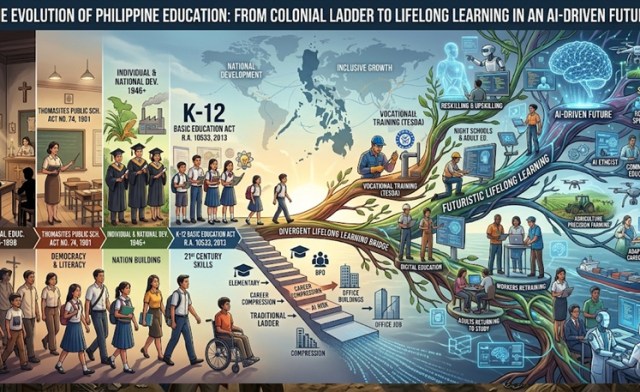
And Why the Future Requires a Permanent Parallel Learning System
With a New Labor Reality: Why High-Demand Fields Stay Empty While “Good Jobs” Quietly Disappear
By Karl Garcia
The history of Philippine education is often narrated through successive waves of reform. Spain institutionalized formal schooling. The American era expanded mass public education. Independence widened access further. Democratic governments constitutionalized educational rights. The K–12 period sought alignment with global standards. Each generation inherited the promise that schooling would remain the most reliable ladder toward stability, dignity, and upward mobility.
That promise was never entirely false. Millions of Filipinos improved their lives through education. Teachers, nurses, engineers, accountants, seafarers, entrepreneurs, civil servants, and skilled workers emerged from classrooms that families funded through sacrifice. Literacy rose, universities multiplied, and learning became one of the most deeply valued aspirations in Filipino society.
Yet the persistence of dissatisfaction reveals a harder truth. Parents worry about cost and uncertain returns. Employers complain of skill gaps. Teachers carry excessive burdens. Students fear underemployment or irrelevance in rapidly changing industries. Workers in previously stable professions now worry about automation. In recent years, new anxieties emerged around coding, analytics, and artificial intelligence, where some now feel they trained for jobs already being transformed by the very technologies they were told to master.
These frustrations may appear separate, but they stem from the same structural dilemma: the Philippine education system remains optimized for a world that is linear, stable, and sequential—while real life is increasingly disrupted, nonlinear, and adaptive.
The Limits of the Linear Model
The dominant architecture of Philippine education assumes a standard progression: childhood entry, uninterrupted yearly advancement, graduation in youth, then transition to work.
For many students, this path works. But for millions of others, life diverges from the template.
Some leave school due to poverty, illness, caregiving duties, disasters, migration, or family crisis. Others work early and need second chances later. Persons with disabilities often encounter environments not designed for them. Adults seek reskilling after industries change. Workers displaced by automation need new competencies mid-career. Parents return to study after raising children. Informal workers need credentials without abandoning income.
These realities are not marginal exceptions. They are increasingly normal features of modern labor markets and social life.
Yet institutions still often treat nontraditional learners as afterthoughts. Alternative Learning Systems (ALS), night schools, ladderized programs, modular courses, and second-chance pathways exist—but they are frequently underfunded, fragmented, stigmatized, or viewed as remedial substitutes rather than equal pillars of national development.
This is where Philippine education repeatedly falls short: it expands access, but too often only within one narrow template.
Why High-Demand Fields Stay Under-Supplied
There is a recurring paradox in many developing economies: the very sectors most essential to long-term survival—food systems, healthcare, engineering, maritime capability, industrial trades, and core STEM disciplines—are often the least populated.
Meanwhile, less foundational sectors may attract larger flows of talent because they offer faster visible returns, clearer ladders, cleaner working conditions, urban concentration, or stronger prestige signals.
Students respond rationally to incentives. If agriculture appears stagnant, many avoid it. If engineering underpays, many hesitate. If medicine overburdens and undercompensates, many migrate. If manufacturing lacks clear progression, many reroute elsewhere.
People do not simply choose professions. They choose ecosystems. They ask:
- Can I earn enough?
- Can I grow?
- Will society respect this path?
- Is the future visible here?
Educational demand is downstream of ecosystem credibility.
This is why nations can simultaneously say they need more scientists, farmers, nurses, welders, and engineers—while structurally steering youth somewhere else.
When “Good Jobs” Quietly Disappear
At the same time, sectors once seen as dependable middle-class escalators can become unexpectedly unstable.
For years, many Filipino families followed a rational formula: pursue office work, BPO roles, administrative careers, migration-linked professions, or technology-enabled services. These offered income faster than many traditional sectors.
That logic was not foolish. It reflected the economy at the time.
But now another shift is underway. Some of the supposedly safe sectors are being reorganized by AI.
In contact centers, shared services, and back-office industries, the first assumption was that automation would mainly replace repetitive frontline work. Yet many middle-layer functions are exposed first:
- Quality monitoring
- Performance scoring
- Report generation
- Workflow auditing
- Scheduling optimization
- Compliance checks
- Basic supervision analytics
Why? Because these jobs often sit between raw activity and managerial decisions. They summarize, classify, monitor, and report. Those are exactly the kinds of pattern-recognition tasks software increasingly performs well.
So while the public imagines robots replacing entry-level workers first, reality can be more ironic:
The first casualty is often the promotion ladder above them.
The Silent Compression of Middle Layers
This disruption is not always dramatic mass unemployment. Often it appears as organizational flattening.
Traditional structures looked like:
Agent → Senior Agent → QA → Team Lead → Supervisor → Manager
AI compresses parts of that chain into dashboards, alerts, and automated analytics. What once required several people may become one system interface plus fewer specialists.
That matters socially because middle layers were not just jobs. They were aspiration pathways. They represented escape from stressful frontline roles into more analytical and respected positions.
When those ladders narrow, workers do not experience the shift as neutral restructuring. They experience it as blocked mobility.
Why Students Feel Betrayed in the Age of AI
The same structural rigidity helps explain frustrations around coding education.
For years, students were told that learning to code guaranteed employability. Families invested in IT degrees, bootcamps, and technical programs believing they were buying entry into a durable future. Then AI tools arrived that could generate code, debug scripts, and automate routine tasks in seconds.
Some concluded that coding education had become worthless.
But what really changed was not the value of learning—it was the value of specific routine tasks. Higher-order capabilities such as systems thinking, architecture, product judgment, domain integration, data reasoning, and AI supervision became more important.
The market moved upward while many institutions were still training at the lower layer.
This is the same recurring pattern: schools prepare students for yesterday’s visible jobs while technology reorganizes tomorrow’s real demand.
From Schooling System to Human Capital System
If the Philippines wants to overcome centuries of recurring mismatch, reform must go beyond curriculum revisions or adding more years of schooling. It must rethink education as a lifelong national capacity system rather than a one-time youth pipeline.
That means recognizing a strategic principle:
Nonlinear learning is no longer exceptional. It is normal.
A state built only around uninterrupted youth schooling will continuously generate exclusion. A state that embeds permanent parallel pathways generates resilience.
This requires elevating ALS, adult night schools, modular certification tracks, workplace learning, disability-inclusive education, and mid-career reskilling into a co-equal subsystem of national development.
Not stopgaps. Not charity. Not remediation.
Core infrastructure.
A National Parallel Pathways Framework
The Philippines should establish a dual-track model.
1. Linear Track
The conventional pathway: structured schooling from childhood to early adulthood. This remains important and should continue improving.
2. Parallel Track
A permanent subsystem for those whose lives do not follow uninterrupted progression.
Both tracks should lead to equivalent nationally recognized credentials. The distinction is schedule and delivery—not dignity or status.
Institutional Roles in the New Economy
Department of Education
ALS, literacy recovery, foundational competencies, flexible secondary completion.
TESDA
Technical credentials, industry certification, modular employability pathways, rapid reskilling.
TESDA’s planned Taguig training center focused on digital and industrial skills reflects where the future is heading: institutions that adapt at the speed of labor-market change.
CHED
Credit recognition, adult degree completion, stackable higher education.
DOLE and DTI
Labor forecasting, employer incentives, SME-linked training ecosystems.
LGUs
Community learning centers, local scholarships, transport support, co-financing.
Private Sector
Continuous workplace learning rather than one-time hiring filters.
What the Labor Market Actually Rewards
Every economy reveals what it truly values not through speeches, but through:
- Wage structures
- Promotion ladders
- Hiring behavior
- Public respect
- Stability signals
- Training investment
If critical sectors remain thinly staffed while previously safe ladders quietly collapse, the issue is not laziness or poor choices. It is systemic incoherence.
People respond rationally to incentives. They move where returns are visible, dignity is preserved, and futures seem real.
Why This Is the Next Real Reform
Philippine education has spent centuries trying to perfect entry systems for the young. It now needs to perfect re-entry systems for everyone else.
That shift is urgent in an age where technology changes jobs faster than generations change.
No degree earned at 21 can permanently secure a 45-year career anymore. Skills must renew. Workers must pivot. Adults must learn repeatedly.
A nation that does not normalize second chances will become economically brittle.
Conclusion
After five centuries of reform, the Philippines still struggles because it often treats education as a one-time sequence rather than a lifelong adaptive system.
The country now faces a double challenge: high-demand sectors remain under-supplied, while some once-reliable middle-class pathways are being compressed by automation.
These are not separate crises. They are symptoms of the same outdated architecture.
The future requires a broader system where traditional schools remain vital, but are joined by permanent parallel pathways for workers, adults, displaced learners, and those whose lives did not fit the standard schedule.
When that happens, education stops being a narrow ladder climbed once in youth—and becomes a durable bridge citizens can cross many times throughout life.


Thanks, Karl. My late ninong, who was a Career Counselor at the Jesuit Santa Clara University and Stanford University, told me when my first born reached college age and was accepted at SCU: “Ah, now she is going to college to learn how to communicate and assert herself.”
My teacher in high school in the Philippines told our senior class during one of his enlightened moments: “What we teachers are trying to do is teach you to LEARN HOW TO LEARN.”
I thought that both pieces of advice were very profound and helpful. When I encounter young folk who use the inadequacies for the formal education as excuses for their failures, I remind them of those two goals of formal schooling – “communicate and assert yourself” and “learn how to learn.”
Thanks for your inputs CV
The demands of the work place are changing so rapidly that I don’t believe one can expect educational institutions to hold students’ hands and guide them through it. Best they can do is build foundations like virtue, critical thinking, ability to communicate and assert themselves, etc. etc. When that daughter of mine graduated from high school in the early 2000s, the hottest field was Computer Science, especially software programming. By the time she graduated 4 years later, Computer Science graduates were no longer in demand.
Many educated unemployed make the mistake of taking on debt and going back to school, buying into the sales pitch of schools that additional education will better prepare them for the new job market. When they finish those courses, they find themselves no better off but this time saddled with more student debt.
Of course I am sure there are exceptions. If I were in that boat and did not have parents financing further studies, I would try to “earn while I learn” i.e. have a job and go to school at night…just in case the extra schooling doesn’t work.
Love this article. It presents that education is aimed at a puff of confetti fired into the air, and unlikely to land for a few decades. My son ignores my advice to form a rock and roll band where the future is more certain. Instead he’ll trundle off to a good university to spend four years at least learning of life, love, and maybe more music. It’s of no matter until he decides to marry. Then he’ll attach to the panics of needing a paying job. I’ll move more into the earth, as in gardening, not caves. Although caves do register louder and louder as pragmatic.
Love your comment. Thanks.
joeam, congrats! your son is entering young adulthood and it is rite of passage for them to go to university. his job now is to find himself and what he wants to be, what suits him best to be a contributing member of society and as such, he will now veer more toward society and his own peers. if you have given him good grounding, that foundation will stay with him, though it will be sorely tested and tempered in his new environment.
young adults who failed to find themselves and ended up lost and aimless, some ended up lonely and isolated, that’s according to psychoanalysts.
university is exciting, mark zuckerberg the founder of facebook meet his friend and business partner at university, who happened to be a classmate and they share the same geeky passion. as well, the founder of giant tech firm atlassian that is now worth close to a trillion, neil brookes and farquhar, both attended the same university, were in the same class and best of friends, both passionate about the same thing: apps and technology.
at university, your son will learn not only to be an individual, he will also learn to be part of a team and pulling his own weight. he will learn to think fast on his feet, but also know when to refer to his team.
in philippines, many parents have trepidation sending their kids to universities where there is possibility of them being radicalized. apparently, our universities are not doing enough to stop radicalisation.
one such parents realised their worst nightmare when their alumni daughter apparently become recruit and was caught in the crossfire between npa and government forces. having already lost her to npa cause, the parents declined to claim her body, and npa would just have to bury her.
Thanks for the observations, K. JoeJr has good grounding, a mix of motherly sternness, fatherly conceptualizations, his own quality brain, and a personality correctly assessed by his classmates as “most likely to make the class laugh.” He’ll be fine. And he’s ripping on his guitar at the moment.
**The future requires a broader system where traditional schools remain vital, but are joined by permanent parallel pathways for workers, adults, displaced learners, and those whose lives did not fit the standard schedule.
When that happens, education stops being a narrow ladder climbed once in youth—and becomes a durable bridge citizens can cross many times throughout life.**
I don’t think this describes the Philippine situation accurately. When I was an employee here in the US back in the 80s, there was already talk of needing to re-invent oneself in the work place and fairly often too. Remember, manufacturing was being exported overseas. Writers spoke of people ending up in 5 different careers during their working life. It was not unusual for laid off or fired workers to go back to school to update their skills and hopefully get back in the work force. A common mistake, in fact, was to assume that you get what you pay for, i.e. if you spend a lot of money (meaning take out student loans) on additional education like by going to Stanford Univ., you will get a good offer. That often did not work out.
The Philippines turns out a lot of graduates every year at all levels of schooling – traditional 4 year colleges, nursing schools, medical schools, engineering schools, vocational schools, etc. etc. I don’t think the problem is schools adapting to the work environment. It is the work environment not being big enough to provide jobs for graduates. I believe there are schools in the Philippines that train you for jobs overseas, right? That is the problem our policy makers need to figure out a solution for.
One under rated progeam is the alternative learning aystem, a TV commercial where a single mom graduated at an old age after allowing her children to graduate may be a good example. Those who fail to earn a high school diploma can still vecime a lawyer at 50 or 60.
The others, hopefully still a work in peigress
the new senate shakeup has given reason for students to rally:
https://newsinfo.inquirer.net/2233388/benguet-students-rally-vs-joel-villanueva-heading-senate-education-panel?utm_source=(direct)&utm_medium=gallery
A welder is one of the highest paying jobs antwhere but not everyone wabts to be a welfer even if they could.
Tesda is the main techvoc institution,if thatbis what you are asking
AI Overview
Many Filipinos actually do become welders. In fact, the Philippines is one of the world’s top exporters of skilled, TESDA-certified welding professionals to countries like Australia, Japan, and the Middle East.
However, there is a common reluctance among many young Filipinos to pursue the trade due to several systemic and cultural factors:
Because of this, many prefer to work abroad where their skills command a premium. For those interested in the trade, the government offers certification tracks through the Technical Education and Skills Development Authority (TESDA).