The Philippines is a Catholic nation. Make it official.
Analysis and Opinion
By Joe America
Many nations these days are trying to figure out who they are. Oddly, the Philippines knows, but won’t say so.
The Philippines is a Catholic nation.
Through and through. You know it every time you climb into a cab and the driver says his quick prayer before taking off. You know it when the nation shuts down for a week for Easter. You know it by counting churches and seeing the joyous millions cheering Pope Francis. You know it by reading history.
It’s been tough for the Church though. Scandals here and there. The weight of liberal thinking breaking down families in favor of freedoms, or selfishness, it’s hard to tell which.
I think the Catholic Church should demand to be more prominent in who the Philippines is, as a nation. I arrive at this conclusion, not through prayer or spiritual soul searching, but through reason.
The Philippines is held back by corruption, entitlement, and patronage. The dynasties serve themselves first and the nation if it is convenient or useful. So the Philippines today is a place of little drive for success, where success is measured by wealth, health, security, and the joys of self-achievement. The dynasties are in control, and incompetent.
I’ve previously proposed that a peoples’ coalition be formed to bring the Philippines in out of its feudal dark ages. The coalition:
- Pinks
- Liberal Party
- Akbayan
- Makabayan
- Nationalistic citizens in dynastic areas
Now I’m adding the Catholic Church to the coalition to move the effort directly to the center, with left and right components, and the shared vision of a Philippines that is capable and globally significant. That is honest, wealthy, resource spectacular, and productive. That is providing uplifting futures for all Filipinos.
Well, it will take some give and take to make this happen.
For one thing, as has been discussed in blog comments, Makabayan is too extreme at the moment to fit in with a center/normal nation. They would have to drop their support of rebels and opposition to alliances to fit within the coalition vision.
National pride comes from the heart. From the spirit. Elevation of the Catholic Church to prominence as the designated official religion of the Philippines would give the nation a pride and a moral character that would stand out globally as distinctive. As purposeful.
Other religions would be considered brother and sister faiths, completely welcome and unrestrained under the Constitution’s freedom of religion policy. But the nation would become decidedly Catholic in laws and celebrations. No death penalty, no abortions, no divorce. Political holidays out, religious holidays and celebrations in. Senator Hontiveros and others of liberal persuasion would have to ask which is more important, a divorce law or a functioning nation that is competent, compassionate, and prominent in a global arena that cannot be trusted. A nation that takes pride in its distinguished, disciplined character. That knows itself clearly. That is not defined by others.
In my coalition vision, liberalism for liberal’s sake is done. It is too chaotic and undisciplined. Too divisive. It robs people of their purpose. It doesn’t give them purpose.
Purpose is an anchor. A clarity. A commitment. A unifying drive.
Competence is desperately needed in the Philippines. And family values. And national moral character, and strength through direction.
It’s right there. Right here. Right before our eyes. See it. Embrace it. Live it.
_______________________
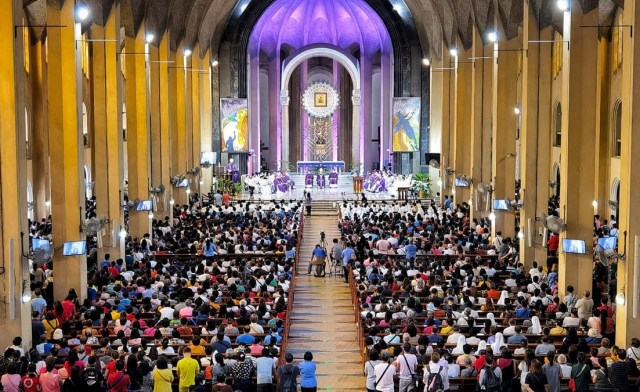
Photo from The Roman Catholic Archdiocese of Manila article “CBCP encourages faithful to return to churches for Sunday Masses“.
Comments
181 Responses to “The Philippines is a Catholic nation. Make it official.”Trackbacks
Check out what others are saying...-
[…] Can the Catholic Church be a part of the coalition?: THE PHILIPPINES IS A CATHOLIC NATION. MAKE IT OFFICIAL […]
-
[…] Can the Catholic Church be a part of the coalition?: THE PHILIPPINES IS A CATHOLIC NATION. MAKE IT OFFICIAL […]


 The Society of Honor by Joe America
YES! The Catholic Church (with due respect for other religions) and People’s Coalition! Away with political dynasties! We must together strive and never lose faith in Truth and Justice! THANKS as always, Joe America! G. H. Abad
Sent from Yahoo Mail for iPhone
Thank you, Gemino.
Have you noticed Joeam that when some politicians are cornered and the Catholic Church steps in, they always remind people of separation of church and state. Maraming pasaway sa politika. I love your vision, having one central religion and everybody is welcome. BTW, I am a Catholic and I would not change my religion because of ambition. Thanks for this post Joeam.🥰
I enjoyed this one a lot. Glad you agree.
Thank you.
I don’t know what the history is between DU30 and Rep. Abante, but I really liked their interaction in the Quadcom hearing last night. I know he’s not Catholic, Baptist was what he said. but he talked about the Adulterous Woman that Jesus saved. here in KJV (in honour of i7sharp): “Now Moses in the law commanded us, that such should be stoned: but what sayest thou? This they said, tempting him, that they might have to accuse him. But Jesus stooped down, and with his finger wrote on the ground, as though he heard them not.” He said this in Tagalog and Abante concludes his sermon with what Jesus told the woman “Go and sin no more” to which DU30 says “I won’t kill anymore” to which Abante laughed and the fat dude behind DU30 laughed, everyone laughed. And I’m thinking i’ve heard that Pharisee story so much cuz its popular but I have never seen it used like that where two old men bonded in laughter over it, and Abante and DU30 kept at it, and at the end of the hearing or when they did motion to suspend it, DU30 again pulled his stunt he did in the Senate urging everyone to stay and continue. and everyone laughed, and finally Abante talks and DU30 listens to him that he should go home, saying something like because its coming from you I will listen. and everyone laughs again. There’s a common language in Biblical stories that all Filipinos understand, and like that interaction above they can be used to diffuse tension.
I don’t know who the fat guy is probably one of DU30’s lawyers, but you can see one of the pages/waiter is laughing too.
Also, as experiment , Joe, what if DepED focuses on these three books teaching these starting in kindergarten to high school. just those three.
Joe, I was thinking about this this morning. and I guess the push back will be minimal given the stats. but Catholics are prone to crusades too so to quelch that, there has to be focus on more Bible studies cuz how can you talk to Protestants like Rep. Abante if you’re not well versed in Bible stories. similarly Muslims would react like in Israel, so one thing Muslims and Christians have in common is Mama Mary. so increase knowledge of Mary and Jesus (even Joseph) cuz all them are in the Quran, just not seen as divine. but if you can have common stories, like Catholics reaching out to Muslims to hear more about Miriam and Isa, thats how you cross bridges (pun intended).
.
here’s more on that Israel law, didn’t keep up with it don’t know how it went really…
“Called The Basic Law: Israel as the Nation State of the Jewish People, the legislation essentially defines Israel first and foremost as a Jewish state.
Among its 11 provisions, it describes Israel as “the national home of the Jewish people” and says the right to exercise national self-determination there is “unique to the Jewish people”.
It also reiterates the status of Jerusalem under Israeli law, which defines the city – part of which is claimed by the Palestinians as the capital of a future state – as the “complete and united… capital of Israel”.
Controversially, the law singles out Hebrew as the “state’s language”, effectively prioritising it above Arabic which has for decades been recognised as an official language alongside Hebrew.
It ascribes Arabic “special status” and says its standing before the law came into effect will not be harmed.”
=====================
So along with your Catholic idea, maybe also parallel it with English as the state language.
I’ve had that article written for a month but kicked it back for other postings. On English. It will run Monday.
As for Bible studies, that is wholly up to the Church. Your writings actually inspired this article. We should seek our own way, not follow the paths of others. The Philippines should flaunt its character, nurture it, use it. Build a big-ass cathedral. Invite Pope Francis back to officiate and bless the groundbreaking. Put historic churches on the tourism paths, along with history. Make celebrations bigger, not smaller. If rites are the way rather than intellectual readings, leave it alone. Enjoy it. Find peace with it.
https://en.wikipedia.org/wiki/The_Way_(2010_film) You ever seen that film with Martin Sheen about Camino de Santiago, if the Philippines does something similar inter islands, we won’t have to do CAP Marines, Joe, just string ’em up ready for pilgrimage church to church sites to sites, I know they already do that there eg pilgrimage sites, but national scale and funded (hell maybe OVP right now can do this, get donations instead of gov’t budget 😉 ).
If rites are the way rather than intellectual readings, leave it alone.
That’s a good point too, Joe. symbols. keep it Jungian. but Catholics have to reach out to Muslims and Protestants more so than now. both Muslims and Protestans are all about reading their books. so theres gotta be some reading at least.
Yes, maybe the Church should have ambassadors to other faiths, rather like countries do. And vice versa. Find the commonalities, joint celebrations, etc. Build faith as an experience found only in the Philippines.
That’s an excellent idea, LCX. My passion in Europe is visiting cathedrals. I’ve been to Santiago de Compostela, sat in the cathedral being whole, walked the narrow streets exchanging love with the ghosts there. Ate some shrimp. Got one of the best photos of my life there, a pair of muddy black soldiers boots and a rose. Well, it means a lot to me.
Instead of It’s more fun in the Philippines , it’d be Go find God in the Philippines!
That’s also a good idea, but more subtle than hard marketing.
Scale up icons too, Joe. paintings to wooden sculptures, etc. elevate to art. like Santa Fe Mexico, make Bohol the seat of this and that, and maybe Sequijor as alchemy capital. theres that spiral staircase in Santa Fe that was built by some mysterious carpenter and to this day it still stands, so elevate craftmanship to myth and legend too. when people think Catholic art, they should think Philippines. connect it to karl’s universities do more Catholic art. Michelangelo, etc. etc. even the gigante-gigante stuff. make tourists come over to be awed and inspired. i’d like to see quality stone metal art too: https://en.wikipedia.org/wiki/Pericle_Fazzini
uy, I seriously doubt you’ll find god in philippines. but you’ll find congested airports, slums galore in suburbs, thieves and pick pockets and dirt poor people, stressed and traumatized, escaping from floods and holed up in evac centers, maybe blaming god for the never ending floods he sends their way, that they may soon have to build an arc similar to noah’s.
but if you do come to philippines looking for god, bring motsa moolah with you. and dont believe that things in philippines are cheap, they can be very expensive, and one misstep may cost you your life.
but if you really wanna find god, take a break and look deep inside you. you are created in his image and likeness. and if you care to listen, he’ll show you the way, the truth and the light. and you dont need a passport and entry permit to do that.
. . . god dwells in you and me, god is living in my heart, he and I are on . . . and so goes the hymn at mass in church.
but come to the philippines anyway, we have much to offer. and be adventurous, you might just find what it is you were looking for.
that’s very similar to this, kb:
Absolutely. The Catholic faith is rich with art and icons that excite and challenge us to be engaged, and whole and wholesome.
my baptist friend warned me that catholics are given to idolatry, that catholics worship statues and craven images, etc. and attributed them much powers and devotion, while at the same time, maybe distancing themselves and disregarding pleas from disadvantaged people that truly need help.
I dunno if this guy’s just bs’ing on twitter, but if this is legit, St. Joseph’s a pretty good carpenter.
the way I practice catholicism these day is probly aberrant. love thy neighbor, jawol! charity too, and that probly constitute the most of catholicism. to me it is geared towards our fellow beings, not to do things to them we dont want done to us. sounds okay to me. except there are always insinuating circumstances that are maybe exception to the rule. gray areas, ika.
and where does the christian god comes in? he who so love people to be miserable and for them to give up all their riches on earth just so they can go to heaven, to deny themselves the pleasures of being alive, and to forever sacrifice themselves just so others can enjoy what they denied themselves, nah, too much for me. and if the christian god is not happy with me and my choices, that’s his problem.
in the meantime, love they neighbor ako specially those lovable ones, others are so hard to love, that I want to cut off their heads ala inday sara, haha.
but seriously, like what I habitually do in the ‘ber’ months, it is for observing and following our age old tradition. except my tree is getting smaller, the decorations meager and the parols are not that many but brighter and just as chirpier. in case of there is fire, I wont be mourning. I have not lost much.
as for charity, I give, because it is demanded by the spirit of christmas, and give more than I should. I often raised eyebrows when beggars ask for pamasahe and give them not only for pamasahe, but enough for them to be able to buy a hot meal and maybe a pack of cigarettes. and before they can thank me, I’m gone, skulked away with my biometrics intact. they should thank god and their lucky stars, and not me. I was only doing the abominable christmas spirit a favor.
as for charity, I give, because it is demanded by the spirit of christmas,
kb, do you give reprieve for your relatives still outstanding in debt during these months?
not if they continue to hide and stay out of sight. reprieve can only be had if they come in the spirit of christmas, then we’ll celebrate, drink and be merry, and then, we’ll talk in plainest of business language – just so they know in the simplest of terms that I have long written off what they owed me.
This is sound policy, kb. Jewish prophets were always railing against rich Jews over this, encouraging loan and debt forgiveness. as for me though, I say treat them like John Baptist. https://en.wikipedia.org/wiki/Salome_(1953_film) “Salome went to Herodias to ask her advice on what the gift should be, and Herodias told her to ask for the head of John the Baptist on a platter. Salome obediently asked Herod for this grisly gift, and, though the Bible says Herod was grieved, he honored his promise. John was beheaded in prison, and his head given to Herodias’s daughter” metaphorically, cut ’em off.
Faith is in the heart, and yours beats fine, K. Everything else is optional.
thanks.
Candidates still seek Iglesia ni Kristo endorsement during election banking on their bloc voting mandate real or imagined.
I like what Cardinal Sin did politically and the others he inspired.
Big Catholic universities still exist like UST, Letran, DLSU, Ateneo and it is open to all faiths even their k to 12 system. If this is possible in one sector it could be done to other sectors.
Thanks again for the valuable insights.
Thanks for bringing up the Universities. They are definitely needed, and should be upgraded to international competitiveness. My opinion, under the concept proposed.
That would be the right path and course. We must not be contented with top 100(plus).
I agree with your premise and all the accompanying substantiation but elevating Catholicism “as the designated official religion of the Philippines” may not be doable under the present Constitution (1987 version) which prohibits the State from endorsing a particular denomination as an official religion.
The link below goes into the nitty gritty of the prohibition. Article II, Section 6 of the 1987 Constitution and Article III, Section 5 of the Bill of Rights explain why the designation of an official national religion is unconstitutional:
https://www.respicio.ph/bar/2025/political-law-and-public-international-law/the-bill-of-rights/freedom-of-religion/separation-of-church-and-state
I asked my browser’s AI to tell me what can churches legally do during election. Here is the answer: “Churches can educate their congregations about political issues, encourage voter registration, and invite candidates to speak, as long as all candidates are included. However, they cannot endorse or oppose specific candidates or political parties.” When asked, “What priests and pastors as private citizens can and cannot do during election?” The answer is: “Priests and pastors, as private citizens, can participate in political activities, endorse candidates, and express their opinions on political matters. However, they cannot use their church’s resources or position to endorse a candidate or engage in political campaigning on behalf of their church.”
The link below enumerates the “Pastoral Guidelines on PH Elections” which mirror some of the AI answers:
https://usa.inquirer.net/95210/pastoral-guidelines-on-2022-ph-elections
Thank you, JP. Although I enjoyed reading this, especially the cases cited, I was disheartened by the way the laws were written in the finest liberal tradition to bar the Philippines from becoming a vibrant Catholic nation respecting the faith of 82% of the nation’s citizens, and charting its own destiny. I also scratch my head in wonder as INC and Quibiloy, and even local priests, climb into bed, so to speak, with dynastic leaders who are political.
Well, the way around it is to make enough noise such that new laws are written around the edges, the same way the 100% foreign ownership is danced around, until such time that the Constitution is re-written to recognize that religion is a strength, not a cancer, and the Philippines would be healthier and happier being honest with its religious character.
My approach is really not political. It is not a political act to give the people a voice in the face of dynastic abandonment of the Constitution’s banning of dynasties. It is an opposition to blatant abuse of the Constitution, gathering up all groups who are fed up with how leaders serve themselves first and the people if it is convenient. Well, there are laws against revolution, too, I suppose, but not really loud protests, from which a religious awakening just might occur.
So the choice becomes, continue to abuse and oppress Catholics, in favor of dynasties, or free them up to celebrate who they are.
ahem, dynasties are mostly catholics and attend sunday mass, they’re mostly at the front row, the seats designated to them. some dynasts sponsor the rebuilding of churches brought down by typhoons and earthquakes, their names on the plaque that says it was them who donated this and that part of the rebuilt churches.
imelda marcos often goes to baklaran church and was even pictured going there, in her wheelchair and dressed in black. sara duterte’s kids were baptised in catholic church in dabaw.
Yes, this is a bit of rumple in my stiltskin, the fact that dynasts are front row Catholics. Between you and JP, there’s a lot of cold realist water being splashed on my plan.
There is nothing wrong, though, with calling the Philippines what it really is, and not even pretending it is anything close to a Western democracy or an East Asian democracy for that matter. As Senator Sotto is the greatest advocate of a certain form of Christianity and dynast, I propose to define the political system of the Philippines as a Sottocracy. With Vico Sotto, it can evolve. A system that pretends to he modern but isn’t stays stuck. The Philippines hopefully passed the stage of 1521 style datus and rajas during Duterte’s term.
Between you and JP, there’s a lot of cold realist water being splashed on my plan.
Dynasts use the Church, and the Church use dynasts, that’s how its always been , Joe. trickle down theory, Paul started it. the question you’re posing i think is important. a fine proposal one I hope you keep on chugging along with, unlike Makabayan which you dumped upon light push back (I’m a Bernie guy, and even after Joey made fun of my dude, I’m still a Bernie guy, cuz of stick-to-it’ness, I was pro Makabayan too, too much leftist hate here). Fight for this one, Joe. Can the Church be compelled to better the lot of D&E? and fuck yeah, they should. use their magic and sacraments to change outlooks. how, i dunno. but the Church just needs to go deeper, the priests and the monks, but my money’s with the monks (if I can find these dang folks in the Philippines). copy the Indian, Thai models, have more monks. Jains too, thats a good example to follow. European and SE Asian Catholicism convergence is found here only in the Philippines, lay people and monk relationship. but the monk movement i don’t think ever took root in the Philippines, but it can still. I’ll focus here. you focus on the politics of how to get this done, Joe. Pincer manuever. resist the cold water!
Catholic monks used to be badass, I think in the Philippines they can still be.
ps.— that’s not cold water.
those are not filipino monks, ours wear cassocks.
I think its the same tradition, kb.
Thanks for the encouragement. I shall soldier on.
I think part of the solution is to assist in forming a national conscience. For it to happen, the Roman Catholic Church needs to teach their flock on how to develop one that is grounded on morality. It has the network, the reach and numbers to make a difference in changing the PH governance calculus.
Excellent. That’s definitely the way to go. Heck, the political initiatives can be a subset of that.
jehova’s witnesses are very active in that regard, they go house to house ready to engage any filipinos willing to give them the time of day, giving free leaflets, books and snippets of the christian bible, as well as leaving their contact numbers and email addresses for anyone to contact them. they also have regular symposium where all is invited with free coffee and cakes afterward.
the baptists are moreso, their sunday meets last longer and there is classes after hours, deacons and deaconess readily available for questions and answers in both english and filipino, then there is vegetarian banquet for all, the mind and body both fed.
charismatic christian churches are even more appealing with their healing sessions, rock like venues, bright lights and music. and of course, sermons from their enlightened leaders and visiting influencer personas whose internet followers are in the thousands if not millions.
There was a lot that happened when the USA took over, and it turns out that part of history is sparsely researched:
1) Large friar estates were auctioned off to rich Filipinos in the early 1900s. Let’s not forget that even the likes of Rizal were like franchise holders who paid rent to friar orders and, in turn, had sharecroppers working their leased estates. That class became full large landowners then.
2) the Aglipayan or Philippine Independent Church grew 1898 and onwards as the Catholic hierarchy in the Philippines remained predominantly Spanish controlled.
3) the USA at that time was ambivalent about Catholicism, that was long before Kennedy.
4) still they eventually decided to cut a deal with the Vatican to replace the church hierarchy in the Philippines with Filipinos as quickly as possible to stem the growth of the Aglipayans whom they feared as potential new revolutionaries.
5) the religious orders scrambled to replace their Spanish personnel with other nationalities.
One has to know that the orders had changed from pioneers to huge way to comfortable landowners and rent-seekers disliked by most Filipinos within three centuries.
That those who benefitted from the fire sale of church land were to be the new rent-seekers was probably foreseeable.
(BTW, the INC was founded in the 1910s, after all that happened and is another story)
thanks, Ireneo! it does look like these monasteries I’m Googling are all new. like this one: https://en.wikipedia.org/wiki/Our_Lady_of_the_Philippines_Trappist_Monastery and I remember that there was a nunnery that Cory Aquino went to in Cebu i think. Do you know of any really old Spanish era monasteries still in operation? or all went in that fire sale?
No idea as history on this is weirdly sketchy. We might as well ask Dan Brown. Possibly the strong anticlerical strain in original Filipino nationalism made most historians ignore all that. Let’s not forget that many revolutionaries and First Republic leaders were freemasons.
Though the schools were not touched, even as their teaching personnel became non-Spanish quickly. Ateneo got Jesuits from New York state, and there is the story (don’t know how true it is) that the “Arneow” accent in speaking English is due to them. Maybe the established elites who went to private schools also had stuff to hide. Imagine striking it rich with the fire sale of church properties yet still sending your kids to Catholic schools? More reason to keep quiet.
All points well-taken, PiE; very perceptive.
Imagine striking it rich with the fire sale of church properties yet still sending your kids to Catholic schools?
Ireneo/sonny, I’m wondering now this morning whilst I sit here trying to hammer out a quick blog in support of Joe’s proposition/proposal IF this fire sale can be reserved. under all the stuff Joey talked about re CARP and farm fields going to subdivisions. and to protect nature reserves. bring back the Church.
That might be very hard to do. It is relatively easy to find out how much the USA payed for the Philippines to Spain at the Treaty of Paris. I haven’t found anything detailed so far on how much land the USA bought from the Vatican or confiscated and then indemnified them. Much less to whom it was sold. I believe that this all took place between 1901 (Aguinaldo’s surrender) and 1907 (Philippine Assembly elections), meaning under the Military Governor.
I wonder if Philippine archives have anything on this. This is about how a lot of the dynasts got even more established. Maybe the DoD archives have declassified material as I believe the Philippine military government was under the War Department.
https://en.m.wikipedia.org/wiki/William_Howard_Taft#Philippine_years
“..Taft wanted Filipino farmers to have a stake in the new government through land ownership, but much of the arable land was held by Catholic religious orders of mostly Spanish priests, which were often resented by the Filipinos. Roosevelt had Taft go to Rome to negotiate with Pope Leo XIII, to purchase the lands and to arrange the withdrawal of the Spanish priests, with Americans replacing them and training locals as clergy. Taft did not succeed in resolving these issues on his visit to Rome, but an agreement on both points was made in 1903..”
IF this fire sale can be reserved. * reversed (but I guess reserved works too, lol)
Americans had a lot to do with the establishment of dynasties in PH.
“The system of family dynasties has its roots in U.S. colonial rule when initially voting rights were only granted to Filipinos with property and education, allowing the landed aristocracy to attain a monopoly of power in the provinces. The United States also put in place a Congressional system that allowed families to establish local fiefdoms rather than fostering competition through an electoral list system.”
https://factsanddetails.com/southeast-asia/Philippines/sub5_6f/entry-3904.html
@Irineo, Stanley Karnow (IN OUR IMAGE) provides the journalistic narrative for these transactions – clear documentation from RCC archives as to who possess verifiable titles & other provenances; former Sec of Education Edilberto de a Pena curated a book containing the transactions of the Philippine Friar Lands; I recall the Tagalog provinces under the Catholic friars featured prominently. Twenty million dollars changed hands from US treasury to the title owners. As to the “Arrneow” accent Sen Raul Manglapus would be one of the propagators of that.
submitted to Joe.
Again it is Irineo and not Irineo. The German clerks per Irineo keeps on typing Ireneo as well.
Ireneo’s like sonny’s PiE for me , karl.
Got it. Last time to bother you with that.
That’s true, but with Trump’s election, the Philippines looks like a more stable democracy than the US, and certainly several democracies globally are looking wobbly or shookt. There is a stability to Philippine democracy as, institutionally, it keeps running in its muddled way through all the clown shows on the fringes. So I don’t think it is pretense at all. Just institutions fighting through inept leadership.
So it seems, Joe; the dots & dashes are all there. Up to the listener’s decoding system.
Good way to put it.
As you said, there are work-arounds the hurdles. As an Honor Society, we need to be honorable in our approach(es) and careful not to be eaten by the system we are trying to get rid of. That means we have to use tools that are constitutionally and legally sound. This is not the end of the road, it is the beginning of a clean, good fight towards having upstanding leaders.
How can the dominant religion of PH, short of being recognized as its official religion through legislation, can assist in the civil societies’ goal of fighting to get honest, honorable and respectable elected in office? Through the spread of positive propaganda. You say, wait, propaganda are bad. No, propaganda by itself is neutral, it is its usage that makes it bad or good. We learned about the yin and yang principle and Jung’s shadows. Propaganda also have duality, there are good and bad propaganda.
Filipinos used to be regarded as the most sophisticated intellectuals in SEA but are now being derided due to perceived low level of political awareness. We need to reclaim our past glory and positive propaganda can help.
Leni Robredo’s loss in 2022 is rooted in the fact that out of the Roman Catholics’ 86 Dioceses, she only won in 18. This was seen as the waning of the political influence of Catholic Church in PH. It was seen as the result of its decades long neutrality, inaction and silence. They are not giving up though.
“To kick-start that transformation, Caritas Philippines, the social action arm of the CBCP, is launching a “good governance” program… 71 dioceses resolved to create a “good governance ministry” at the parish and diocesan level… The sweeping good governance initiative will also include campaigns against misinformation and historical revisionism, officials say, as well as post-election accountability programs that monitor whether elected officials deliver on promises. Another goal … is to influence politicians and produce good governance champions”
https://web.archive.org/web/20220629165724/https://www.csmonitor.com/World/Asia-Pacific/2022/0629/Catholic-nation-The-Filipino-Church-rethinks-its-role-in-politics
caritas philippines ought to consult with the pope coz its action is seemingly bordering close to the sin of vanity: holier than thou, godlier than god.
the synod talks about good governance and how do they explain that when a high ranking church official showy in all his vestiges of power officiates makoy’s internment at libingan ng mga bayani! give holy communion, the blessed hostia and the body of christ, to the widow dripping in jewels gotten from stolen wealth? while church bells are ringing high and low at her birthday.
That sounds like a Church that believes there are better ways to govern, and would likely be wholly responsive to a national initiative that believes that, too. And positive propaganda is what I call “marketing”, haha, and ideas can be marketed.
I agree with your insights. This is timely and relevant.
I always find Catholicism as a great source of humor. I will die a Catholic but while still here I am enjoying the ride. Last week, after the US election, my sister revealed she preferred Trump because he is the lesser evil and that liberals abort 7m yearly including “9-month olds”. That’s her only argument and I assume her ultra-conservative organization’s as well. The next day in the news, Pope Francis visited Italy’s most prominent abortionist.
I brought this up because of the potential that some under the church’s big tent will fuck up any coalition’s greater-good agenda and insist on their lesser-evil dogma.
Thanks for the reflections, hunch. If I may call you hunch. Well, Catholicism is filled with people, God’s fallible vessels, so it is bound to be of some amusement to the satirical, cynical, and ghosts of Mark Twain and George Carlin, and maybe even Dolphy. But those believers of lies and other oddballs are the tattered fringes of a well worn cloth, and it is the central core of faith that I think remains sound and worth something. Denial of its broad reach into the lives of Filipinos seems weird to me, and a bit nonsensical.
NB: The Catholic hierarchy uses principle of subsidiarity to manage communications & maintain heads-up information between Vatican & the rest of the world.
All Catholic bishops are vetted by the Vatican (final approval by pope). They in turn are required to visit the pope once every 5 years.
Hmm.. on one hand, the Philippines is very Catholic in terms of ritual and knowing the Bible pretty well, but it also:
1) is known for what Fr. Jaime Bulatao, S.J. called split-level Christianity, actually pretty much what Martin Luther accused Catholicism of in a time when Italian political families saw getting one of their own into the Papacy as part of their politics, and Popes had mistresses galore.
2) Biblical stories and maxims are applied wrongly and totally out of context, the alleged Pacquiao statement that he never had an affair with the wife of a neighbor at least funny, quoting “thou shalt not covet thy neighbor’s wife”, and lawyers also skew reason over there.
3) after 1986, a lot of urban professionals became Born Again / Evangelical. Singers too, the born agains in Philippine showbiz had their own concert a month or so ago. A lot of OFWs join INC. That a lot of Igorots are Anglican due to the USA is older. So is Islam in the South.
Indonesian Pancasila state ideology managed to include different kinds of believers from Hindus in Bali, the Muslim majority and more recently even the (mostly Chinese-Indonesian) Christians. Let us look at how some countries manage Church-State relations:
A) France has total laicism, meaning total separation of Church and State. Turkey also had it or still has it in theory even as that has changed with Erdogan
B) Germany has a closer relationship with Catholic and Protestant churches as well as the Jewish and Muslim central committees consulted in drafting legislation. No work on Sunday except for transport etc has been in the Constitution since 1919.
(What Carlos Celdran did, God bless his soul, would have gotten him a suspended sentence at least in Germany, as there are laws here protecting ANY house of worship from insult. Though like with laws against insult here, many cases are dismissed or given suspended sentences.)
C) Lutheranism was the state religion of Sweden until 2000.
D) many Christian countries have a https://en.m.wikipedia.org/wiki/Concordat or several, basically state treaties between them and the Vatican, governing relations. The Vatican and Portugal, for instance, agreed in 1940 that Church marriages could never get divorced.
(Reminds me of the exception in the Philippines to no divorce that Filipino Muslims married according to the Sharia – the Turkish interpretation I believe which is the most liberal – can be divorced according to the Sharia)
E) Malta has Catholicism as its State Religion.
No real idea of what the Philippines could do, but all this is definitely food for thought.
The Philippines need not emulate anyone, I think, as it comes to faith. There is a style to it here that I used to think shallow for its ritualistic patterns rather than deep soul searching over this verse or that. But now I see it as a lifestyle that connects people with their guiding light, and each other. It’s perfect, for here.
Yes, the connection. I have felt that when going to Church in the Philippines, especially the morning masses before Christmas, it is something very different. Probably also the reason why Filipino communities abroad prefer Filipino masses with Filipino priests, or lacking that cheer every Filipino priest who passes by from Rome studies. It is not the same as Catholicism in Latin Europe and very different from Catholicism in Germany, that’s for sure.
What probably rooted Catholicism so deep in the Philippines was the friars living in the villages, learning Filipino languages, and teaching things in local terms like kalooban and kapwa for the Tagalogs, for example. They were highly respected figures even as Rizal mocked the friars of his time, who had come via ship and Suez canal, losers compared to those of centuries before who had a trip of half a year from their home and knew they might never make it home. And had to face native tribes who could potentially kill them. It is documented that this moxie was respected by a number of tribes in Northern Mindanao when they were converted.
What probably rooted Catholicism so deep in the Philippines was the friars living in the villages, learning Filipino languages,
I think you’ve just inspired me to another blog, Ireneo. but since I don’t know much about this world, though interested in it. and sonny’s pointed me out to Carthusians and Big Sur Camaldolese monks over here. but having read Anathem, i think i can pull it off in support of Joe’s Catholic proposal. let me see if I can carve out some time tomorrow Saturday. this is interesting. thanks.
Just check out these two rebels to see how deeply Catholicism became part of the fabric of Filipino culture:
https://en.m.wikipedia.org/wiki/Tamblot in 17th century Bohol was still for a return to the native gods, while
https://en.m.wikipedia.org/wiki/Hermano_Pule in 19th century Laguna was for more Filipino representation in Catholic lay organizations
Remnants of Hermano Pule’s group started the first “colorums.” Lapiang Malaya in the 1960s was probably the last colorum group. They mixed Christianity and native religion.
As for friars, those orders I know to have operated in the Philippines were Franciscans (responsible for Bicol), Dominicans, and Benedictines. Jesuits were there on and off.
thanks! while i was researching karl’s universities in the philippines, i’d not known there was competition on whos the oldest university in Philippines, cuz in Cebu it was already a given San Carlos was the oldest. some Cebuanos even saying it was Magellan’s priest that set it up, and i was like I’m pretty sure that’s wrong, lol. right next door in Kamagayan is the oldest and biggest prostitution den (for locals). which i’m sure have roots during friar days them being first customers maybe.
https://en.wikipedia.org/wiki/Colegio_de_San_Ildefonso,_Cebu_City
“The royal decree of King Charles III of Spain banishing the Society of Jesus from Spain and the Spanish dominions reached Manila on May 17, 1768. Between 1769 and 1771 the Jesuits in the Philippines were transported to Spain and from there deported to Italy. The Jesuits surrendered the San Ildefonso to Spanish civil authorities in 1768, thus closing the institution.“
University of Santo Tomas run by the Dominicans was founded 1611, is older than Harvard U. UST is the Pontifical University chartered by the Vatican.
I’m not reading anything on original site, sonny. but if indeed its the same site as the current campus above, then I think just archaelogically 1595 beats 1611, but this Pontifical University vs. grammar school by Jesuits is another issue all together. so let me Google some more where the original San Carlos/San Ildefonso site was.
okay, sonny, looks like its not even the original site. so this is just more Filipino “I was first here stuff”. there’s no connection.
sonny, but then again, if the previous site was in fact the Jesuits’ and they ended up moving from that original site due to damage from WWII, then it might still hold water. WWII being the variable. otherwise there would be continuity. so am back on the fence, sonny.
this is probably not germane (I learned this word recently during the Quadcom hearing Rep. Barbers always asking if a question was germane when folks interrupted, lol) to Joe’s blog. but if there was a Camino de Santiago set up in the Philippines then we’ll need to get the history of sites and people clarified, like that whole Pedro Calungson as PBA basketball iconography stuff.
the friars are long dead and gone but their legacies remain and perpetuated throughout the ages.
there was an edict passed long ago that mandated that all filipinos were to be baptised to the catholic faith and given christian names like pedro and maria right after baptism. they were no longer to carry names their old names as malusog or maliwanag as accorded by their local custom.
the friars were mostly responsible for catholic education of early filipinos. similarly, after the friars demise and centuries later, most primary school children in public schools throughout the philippines received catechism based on catholic dogma. henceforth, most filipinos today are predominantly catholic.
You know anything about monasteries and monks there, kb? like which ones over there are most prominent today? like actual ones where they are tending farms and or distilleries or just studying living life of mind. night and day just thinking about God.
I got to page three. Maybe I should press on a bit. I also struggled with James Joyce even though my first ex wife said he was brilliant.
beggin’ your pardon, corporal. I dont want to talk about catholic monks or priests in the philippines. having sworn obedience to the pontiff, their loyalty belongs to the vatican, not to philippines. they can be recalled anywhere in the christendom as seen fit by the pontiff. like the highest ranking cardinal bishop luis tagle of the philippines. after saying the blessed imperata, the prayer for urgent help coz damn it! we are being hit by massive typhoon again and the accompanying flood that comes with it. then the good cardinal goes traipsing to vatican, again. yeah, the pope sends his prayers kuno, lord, deliver the philippines from sakuna, amen. oh, and the pope sends some relief aid as well.
@Joe, i don’t know if you have the physical book, or ebook, but there should be a Calca 3 which is an appendix about Hylaean flow (Plato’s forms but operationalized). that’s where you should start.
@kb, I thought these monasteries thus monks were generally left alone, but priests were the ones moved around to give sacraments and be the first to eat lechon at Filipino functions/fiestas around the world.
I have the e-book, that has the appendix, so I’ll start there. Thanks.
@Ksmbahay, as a Filipino Catholic I’d like to put some context to your observation; I needed to say this – I’ve known & followed some aspects of Cardinal Tagle’s clerical trajectory from Imus to Manila, SE Asia, Chicago & on to Rome. I came to realize that his ascendancy no longer answers only Filipinos but also the need of the Catholic Church globally. His expertise & character is much needed in service closely as confidant of Pope Francis and Pro-Prefect with him in the Dicastery he serves. I surmise that he went to Manila to check the needs of his former constituency back home then flew back satisfied that necessities were covered.
the highest ranking cardinal bishop luis tagle of the philippines. after saying the blessed imperata, the prayer for urgent help coz damn it! we are being hit by massive typhoon again and the accompanying flood that comes with it. then the good cardinal goes traipsing to vatican, again. yeah, the pope sends his prayers kuno, lord, deliver the philippines from sakuna, amen. oh, and the pope sends some relief aid as well.
Luis Antonio Tagle – Wikipedia
reading this reminded me of Thunderheart with Val Kilmer, Ireneo. you ever seen that movie? really good. ghostdancers were somewhat a millenarian movement. there were two of them in Nevada and Badlands region. probably the same movement starting out west first then made it back to Dakotas later on. the Comanches and Apaches had something similar down towards NM Texas , Geronimo was a baybaylan too, same with leaders of Comanches.
The Philippines need not emulate anyone, I think, as it comes to faith. There is a style to it here that I used to think shallow for its ritualistic patterns rather than deep soul searching over this verse or that. But now I see it as a lifestyle that connects people with their guiding light, and each other. It’s perfect, for here.
I agree with this assessment, Joe. Allow me to suggest a timeline useful to Filipino Catholics like me, one of the 1.2 billion+ in the world:
70AD The destruction of the Herodian Temple in Jerusalem by Titus & the Roman legions; 34AD, Jesus Christ resurrected, appeared & stayed with His mother Mary, the 12 apostles and other Jewish disciples of Jesus; these original Christians were dispersed; Sts Peter & Paul ministered to the communities in Rome & Greece; These Christians went underground because of persecution; in 313AD Christianity was declared official religion of the Roman Empire by Emperor Constantine; 36 popes succeeded St Peter; 382AD St Pope Damasus I commissioned St Jerome to translate the Bible into Latin from Greek & Hebrew; the Christianization of western Europe followed, by 700AD-1100AD Christianity was in France, Germany, England, Spain, and the Nordic countries.
570AD Mohammed was born; 750AD the highest extent of the Umayyad Caliphate; the Abbasids followed and in control; the Islamic juggernaut continued till 1258AD; start of the Ottoman Empire (1299-1922)
1054AD: Christendom was split into the Roman Catholic (West) the Eastern Orthodox (East)
1492AD Columbus discovers the Americas; 1519AD Age of Discovery: the search for gold & spices; 1521AD; Magellan circumnavigates the world; discovers the Philippines; 1815AD Mexico ends the Galleon Trade
1898AD United States of America takes over Spanish Rule in the Philippines
PMFJI.
Perhaps this is not off-topic?:
https://www.britannica.com/on-this-day/November-21
https://www.britannica.com/topic/Mayflower-Compact
Do my eyes deceive me, or is that i7sharp?
Thank you, sonny. A long and persistent road.
“In my coalition vision, liberalism for liberal’s sake is done. It is too chaotic and undisciplined. Too divisive. It robs people of their purpose. It doesn’t give them purpose.”
I never thought I live to see this.
But congratulations for the capability to see the Tao at last.
Well, Pat, events shape the ether in which we bathe or cook or do what must be done, to every season a purpose or somesuch, turn turn turn. What was good 75 years ago proves faulty when the preachers outnumber the congregation, so we must find new models.
Joe, I am parking this resource here. The podcast is a good starting point, or baseline to religion for Catholics & non-Catholics:
Dr. Hugh Ross – The Science of Creation, Evening Lecture #1
sonny, do you know any Carthusians in the Philippines, or whats the most similar to Carthusians operating in the Philippines right now? thanks.
ps. —- Pat in the house!
sonny, his circumcision as means to exclusivity was interesting. i’ve always viewed it as identity. but I guess exclusivity, like Mango ave girls saying ewwwwwww… uncircumcised. thats pretty exclusive gatekeeping type reaction. (though theres ways around it ).
“This is how we express our love and friendship for one another” re his Physicist students engaged in combative debate. lol.
You’re welcome, Neph!
The Wiki article is quite extensive as a summary for the “boots-on-the ground” involvement of the US Catholic Church in the socio-political life of America. I have read other American authors on sociology that give balance to this Wiki coverage. Will share for sure, IMO, as archetypes to our PH counterparts.
Sorry for late reply (old age).
LC, I am not aware of a Carthusiaan house in PH; there is only 1 in the US. The vow of perpetual silence would be “foreign” to the Filipino mind; (only my opinion).
sonny, I think I came up with something better than perpetual silence. would love to hear your take on its feasibility. blog publishes Wednesday (Thursday there).
LC, at 15 (HS soph) I entered a Benedictine postulancy formation; the first striking feature was following a daily schedule of prayer, academic studies, rotating housekeeping duties (weekly, daily), community meals/snacks in-between generally conducted in silence; this fixed regimen of tasks & activities into a predictable routine does wonders for your health body & spirit; boredom was not a problem. Daily prayers (Mass & meditation, Praying the hours of the Divine Office at designate intervals in the day, Morning & Evening prayers) are all parts of the day.
Thank, sonny. No parking fees here. 🙂
Thanks for “waiving” any fee, Joe.
I was hoping for a bite: my takeaway from the Ross’ podcast is that Genesis account is telling us: the human race is STILL on the 7th Day of God’s creative action.
“Today, throughout the world there are approximately 350 Carthusian monks and nuns in 21 houses: 16 of monks and 5 of nuns. There are five houses in France, four in Spain, three in Italy, two in South Korea and one in Argentina, Brazil, England, German, Slovenia, Switzerland and the USA.”
sonny, I didn’t know there were Carthusian nuns too. but the closest to the Philippines would be the Korean one, and the closest in culture would probably be Brazil.
Also Pillar Saints, i think would totally be a thing in the Philippines, sonny. bring ’em back.
in that book Anathem, theres single person monasteries, this would be it!
(kinda like Rapunzel).
Mindanao.
Even with the number of non Muslims exceed the number of Muslims,in Mindanao I do not think they will take this proposal sitting down if ever a president and his congress implements this.
Maybe the wish for separation of Mindanao will be pushed further.
between you and me, I wish the mindanawans will go ahead, cut themselves off from the rest of the the country, and become truly independent! not mooching and gotten billions of tax payers money just so they can play at becoming independent. kung tutuusin, there is nothing mindanawans allegedly hated more than paying tax! and yet, they are apparently 1st to put their hands up for more of tax payers money, higher funding, and bigger budget lalo na ngayong mag-e-election na naman.
haha, I am probly biased. I heard that mindanawans hide their money under floorboards, and pretend to have no money and no income. and thus avoid paying tax to the government of the philippines. like what happened at the last siege of marawi sa panahon ni pres duterte circa 2017; he and on whose command, armed soldiers were sent looking for the terrorists mautes and their supporters, and found a number of tunnels under mosques kuno, and they even found 90million pesos in cash secretly hidden. that’s why maybe, the mosques there were targeted and bombed.
and despite all the boost of funding recently allocated, up to this day, marawi still has not recovered, apparently.
chempo used to talk about how Muslims in Singapore fell in line and same as Muslims in Crimea. so I think its possible if given a good deal. they’ll bend the knee.
well, what I heard is the elders in marawi were more pragmatic and had accepted inday sara’s offer, their souls were salved and at the haj, their persons accorded free pilgrimage to the holy city of mecca. if they had known the fund was taken from the fund for the rebuilding of marawi, they did not let on. I am supposing the repose of their immortals souls were deemed more important than the rebuilding of their beloved marawi. so now, while maybe their souls were assured of future heavenly repose, their current physical places of abode here on earth long resembled the aftermath of war. some maranoans are still holed up in evac centers while others are still staying with their relatives, and are yet to go home to marawi.
and if mindanaw does indeed become independent, the further rebuilding and refurbishing of marawi falls on their own hands. thus deeply involved, they’ll probly do a better job of it. recriminations accorded to no one.
I suppose Israel also believes in the concept. It is occasioned by military who insist on using civilian structures to fight from. Well, it was also America’s approach in Manila in WWII.
This is the first I’m hearing Marawi rebuilding fund with Inday Sara though.
here’s the link:
https://www.pna.gov.ph/articles/1071722
I’d agree except the resources on Mindanao are magnificent, for agriculture and mining. So you’d domgreat damage to the nation’s future.
I think as independent state, mindanaw will just have to utilize their own resources, fund themselves and collect their own taxes, manage their own law and order, craft their own constitution, educate their own children, etc.
similarly, indonesia did not do poorly after timor leste ceded, but it got peace and no longer forever at loggerhead with troublesome timor, and vice versa. likewise, philippines may as well have peace too, mindanaw out of its hands, no longer allocated funding and no longer its problem.
I see the point, k, but I wonder if Mindinaoans do. I’d foresee a religiously fractured state, as non-Muslims would get insecure and aggressive. Nor do I think Philippine mainlanders would toss such a large island and resource. The Davao gangsters can be managed. No big deal, sort of perspective.
There were a few Muslims in Timor then, easier for Indonesia to let go.
https://en.wikipedia.org/wiki/Religion_in_East_Timor
As to Mindanao, if is just Malaysian or Indonesian dictated secession then I would not want that. Plebiscite if needed.
But they must stop the attitude of not caring for development outside like not caring for LRT by saying why pay taxes for something they would never use.
This unfortunately was viral once.
That’s a marvelous example of failing to see a nation as a collective of shared interests, versus me me me. This is the biggest block to success. Of course, it would be easier if the management of the collective were also not self-dealers first, and nationalists second.
I would merge wiki link with what Joey said here,
https://en.wikipedia.org/wiki/Nina_Rasul
focus on the women.
Super idea, LCX. I’ll see if I can figure out how to put it into the framework. Thanks.
Thanks again
I can’t help but think that involving any religion, much less the Catholic Church in the Philippines, is both a “bad look” and sows the seeds of moving a religious organization further and further away from their professed social mandate. This is especially true for the “organized religions,” chiefly the Catholic Church in the Philippines. Note that I have made a distinction of the “Catholic Church in the Philippines,” as according to Catholic hierarchy. While the Pope has absolute power in relation to spiritual matters for Catholics, each “particular Church” (a diocese, monastery, convent) is separate, yet connected through spiritual brotherhood and acceptance of the Apostolic Succession. In Canon Law, all primates (archbishop of an episcopal see, also known as a “metropolitan”); the Pope is “primus inter pares” or in other words “first among equals.”
From my view as a lay Catholic, the Catholic Church’s responsibility and mandate pertains to social and spiritual needs, not the “temporal” (secular as opposed to spiritual) as Catholics educated in Canon Law like myself say. For such purpose, my own religious activity in the Philippines and other poor countries was entirely apolitical — focusing instead how to alleviate the acute effects of poverty and trying to find ways to relieve the causal effects which create suffering in the first place. Engaging directly in politics would take away from this primary social and spiritual responsibility of the Catholic Church in the Philippines.
The 1987 Philippine Constitution expressly forbids establishment of a state religion:
“The separation of Church and State shall be inviolable.” (Article II, Section 6)
“No law shall be made respecting an establishment of religion, or prohibiting the free exercise thereof. The free exercise and enjoyment of religious profession and worship, without discrimination or preference, shall forever be allowed. No religious test shall be required for the exercise of civil or political rights.” (Article III, Section 5).
Of course in practice, there are many examples of politicians using Catholicism or Christianity in general to pander to the public. This can be evident by religious practices in publicly funded schools, government offices, or the political sponsorship of Christian holidays. Filipino newspapers and media regularly elevate Christianity, most notably in The Inquirer.
The Supreme Court ruled in 2004 that the Constitution allows religious endorsement of political candidates, which is what Iglesia ni Kristo and born-again sects to endorse or direct their members to engage in bloc voting:
https://news.google.com/newspapers?id=flc1AAAAIBAJ&sjid=iSUMAAAAIBAJ&pg=1803,21942553
But just because “others do it” doesn’t mean that the Catholic Church in the Philippines should do it, for the reasons I previously outlined. The Catholic faith is a voluntary submission to God where God is supreme, in contrast to many sects where the pastor or leader assumes god-like power over his followers. As we can see in “pastors” like Quiboloy, power itself corrupts as we are mere mortal men, fallible and not incorrigible. In addition, the Worldwide Catholic Church has learned important lessons on meddling in secular matters that do not pertain directly to spiritual concerns. For centuries the Catholic Church was a major political power, but as history has shown that had not worked out well for the Catholic Church (as it also did not work out for other religions like Islam). For this reason, especially after the Vatican II council the Catholic Church has re-focused on the spiritual needs of the flock. Going back to obtaining temporal power would be a mistake.
Catholic ordained ministers, priests and bishops are also forbidden from holding political office in Canon Law 285 Section 3.
“Clerics are forbidden to assume public offices which entail a participation in the exercise of civil power.”
This has been interpreted by most bishops to include engaging in overt political activity, which encompasses forming political parties, political coalitions, etc. Cardinal Sin may have been one of the heroes of EDSA, but there is a reason why after he died the papal nuncio under the direction Pope Benedict XVI ensured that Cardinal Sin’s successor would not engage in overt political activity.
What then can the Catholic Church in the Philippines do? The answer is simple, yet the implementation is hard in today’s material world. With increased secularization, Catholics around the world are becoming non-practicing Catholics. Sure, Filipinos celebrate the Catholic fiestas, but many do not understand the true meaning behind religious holidays, don’t understand their faith, and don’t follow the tenets of their faith in everyday life. For sure this is an problem that afflicts every large organized religion, including the various mainline Protestant groups in the Philippines. The answer is to increase the focus on teaching the basic, universal values of Catholicism which is in line with the “Golden Rule” and avoid polarizing secular fights which are best left to secular politicians, not clerics.
When I was more active in Catholic charities helping the poor and oppressed, we found it odious to advertise our Catholicism. In the Philippines, we thought “everyone is a Catholic anyway,” while the smaller sects led by grifting so-called pastors and missionaries prominently displayed their affiliations. Smaller sects would pressure the needy to sign up to attend their religious services in order to avail help, while Catholics gave the help freely without condition according to our beliefs. We wondered why people would rather attend the born again sects and not our Catholic churches, and it became clear that despite many of the born again pastors being grifters, they were more engaging and entertaining. So the Catholic Church needs to evolve again, as the Church has evolved previously over time.
Having 82% of people officially identifying as “Catholic” even though most are non-practicing Catholics is not a position of strength. Without having that seemingly large percentage of Filipino Catholics constantly living their lives in a Christian manner, it’s hopeless anyway. The focus should therefore be on guiding wandering, non-practicing Catholics back into the flock and to promote Christian, Catholic values of universality and care for the least among us. It would take more than one generation to form a faithful flock that actually lives up to these values, and who may make better choices in their secular lives or choice of politicians they vote for. But then again, some of the earliest Filipino Catholics like Hara Juana eagerly took to Catholicism as a source of spiritual power to be used to dominate over neighboring tribes. And so it is, many modern Filipinos are still confused on the true meaning of the faith of their birth, instead using Catholicism (or religion for that matter) to assert moral superiority over their neighbor, while disregarding everything else.
The evolution of the idea through discussion here is that it is not a politic initiative, but a good governance initiative in which both the Church and liberal parties share the same interest, to the best advantage of the Catholic Church and those who want to see incompetent and self dealing dynasties subsumed under good governance. So there would be no “official” religious state, but there would be a concurrent re-energizing of both the Church and the Constitutional imperative to end dynastic governance.
We enter this initiative not as “a politic initiative” but “a good governance initiative” … fact of the matter is that we enter differentiated, i.e. (5 plus a central figure, the Catholic Church – an institution that will, we hope, be capable of subsuming the other 5 into one unified order of activity.) This is my understanding. First plank of the platform is the dismantling of dynasties.
Correct.
I don’t think that would work either. The Catholic Church’s prime responsibility is to tend to the spiritual matters, not tell people how to vote or involve herself in worldly politics. Of course there was a time when the Catholic Church in Europe did involve herself in worldly politics during the reign of Italian popes and due to necessity (after fall of Western Roman Empire) and well, that didn’t end up with positive results. The Church also needs to be able to operate in all manner of countries, some of them authoritarian, which increases the importance of focusing on the soul.
If one looks more closely at smaller religious sects, such as the numerous born again, the many Millerite derivative sects present, or even the syncretic religions fusing native and Christian beliefs like Quibology’s KOJC, they all follow authoritarian models of control. This is in stark contrast to the collectivism of Catholicism and mainline Protestants. So it’s natural that pastors who are authoritarians within their own churches will seek political power, as their flock is but a vehicle, expendable. Sure there are some Filipino Catholic priests who are populist preachers, bordering upon demagoguery similar to Father Coughlin of yesteryear or the recent American Catholic priests or bishops who have been blinded by power. But these are few and they are not compatible with Catholic teaching. Jesus taught his followers to seek spiritual, not secular power (“render unto Caesar”).
As Irineo and I noted before, while the Philippines may be a majority Catholic nation, it can be commonly observed that many Filipinos do not practice the tenets of Christianity in their own lives. This probably goes all the way back to Hara Juana of Cebu, who eagerly accepted Catholic conversion as she saw it as a tool for her husband Rajah Humabon to use to dominate his neighboring barangays. Santo Niño de Cebu was originally seen as such a powerful artifact to channel spiritual power of this “new” deity offered by the seemingly powerful Spaniards, nothing more nothing less. Once one accepts that premise, the habits of the Filipino Catholicism of the masses start to make much more sense.
The Church can play a role in guiding followers towards upright morality, which can help with making better decisions in life, politics, voting and so on. But this is difficult without funding. Despite what conspiracy theorists throughout history think, the modern Catholic Church does not have endless money. The “riches” we see in Europe and the Vatican are donations throughout the ages by wealthy believers, mostly in the form of art. The Church in the Philippines did have a lot of land, and through history Catholics have put church land to good uses in pursuit of the mission of tending to the flock, but that land is gone.
Another route would be through parish schools as an alternative to secular education. I can say as a product of Catholic education that Catholic schools “do more with less.” Catholic education follows the rich history of Catholic scholars, and provides a wide breadth of knowledge for learners. I was quite well equipped ahead of my peers upon entering university as I benefited from such education. However being religious institutions Catholic schools may not receive public funds from the Philippine government and depend on a combination of donations and tuition, similar to Chinese schools.
Dynastic control is a systemic problem. Trying to create coalitions based on roping in the far left Makabayan or the Catholic Church would only temporarily put a band-aid on the greater problem. The end result will be another post-EDSA disappointment as systemic problems were never addressed. It would just be another case of “hopium” that creates a temporary high which crashes down hard, further driving people towards the arms of the dynasties as it didn’t fix fundamental problem facing most of the Philippines: a culture of obeisance to authority, a acute lack of imagination, in-fighting and envy among “tribal groups,” and an unwillingness to make efforts to change. Having someone, anyone solve problems does not fix actual problem which is lack of agency; when someone will fix it for us, why would one even care about fighting to gain one’s own agency?
Ultimately it’s up to us as secular people to create the world we want. We have no one else to blame but ourselves. Benjamin Franklin put it best by popularizing the old proverb in the 1736 edition of Poor Richard’s Almanac:
“God helps those who help themselves.”
Well, my bookie ran off with the neighbor’s housekeeper, so I can only assume that he would agree with your assessment, the Catholic Church is scattered, laid back, and enjoying the fruits of dynastic largesse, so can only be counted on for minor steps that will not move the needle one iota. But I would say as well that you “secular people” are even more scattered and weak and lacking any structure whatsoever. So that is a non-starter and we are back to accepting dynastic rule as the default choice. I’m fine with that, but think is a horrid waste of potential, for lack of any new and pragmatic ideas.
I disagree with this characterization of the Catholic Church in the Philippines as scattered, laid back and definitely don’t agree that she “enjoys” the fruits of dynastic largesse. I have worked directly with the Church in many areas and localities in the Philippines and know this not to be true. There is a concept of “particular churches” in the Catholic Church that by design created a collective of bishops, who are largely autonomous as long as they submit to Canon Law and their immediate superior. The Lutheran Church, being “funny Catholics,” operates in much the same way, as does the Anglican/Episcopal Church being the “other funny Catholics.” As such it is literally impossible to do with the Catholic Church or mainline Protestants what is suggested. And that’s a good thing as the Enlightenment informed societies that religion and state should be separate matters.
We both agree that dynastic rule is mostly a bad thing to have. However our disagreement is how to make that change for the better. I don’t agree with mobilizing people to place some kind of “good” President or even a “good” party in power. Change takes time and moreso for most Filipinos who despite their modern clothes and trappings or the gadget they hold in their hands, still think in a derivative and confined manner as Filipinos did hundreds of years ago under datus. I’m quite surprised no one has even acknowledged this besides me and Irineo in our historical meandering.
There is simply not enough time for a theoretical “good President” to radically change people’s ingrained habits and beliefs in 6 years. That change would take a generation or more of consistent effort. Take President Aquino for instance. Yes us here revere him as an upright President who made much progress, but I would suggest we seek out what the DE Filipinos thought of him. DE’s thought he would be the new President that would “give” them all the “stuff,” which is why the nation swung to the extreme to Duterte when they didn’t get the “stuff.” Without understanding these things I fear it is impossible to bring about change in the Philippines.
The first order of things would be to figure out how to modestly increase people’s economic outlook and increase the educational level, with or without having political power. When people have more leisure time, have learned better habits, and have the education to equip themselves with critical thinking, they will have a chance at making better political choices to protect their interests. And in fact, the DE always voting for dynasties is the DE protecting their interests as they understand it. Without attacking the problem at the systemic level using whatever tools available, efforts will be wasted for nought, and there is no hope at all.
My problem is I don’t see how you get done what you say needs to get done. You admit it needs to be “figured out”.
The Church seems to me to be laid back through its decentralized approach to things. And the decentralized approach to me seems “scattered” precisely because of the autonomy local chuches have, and the alignment of many with their front row dynastic members.
The CBCP was aggressive during Aquino’s term and not aggressive during Duterte’s term. Classic crab behavior. They threatened to ex-communicate Aquino for his RH law whilst merely calling for Duterte to stop his drug killings. No street marches that I’m aware of. So they seem laid back to me.
So not seeing a doable alternative path, I shall continue to argue for a peoples’s coalition that includes the Catholic Church as a group that could benefit from it.
I would add, on reflection, that it does no good to bewail the woeful Philippines endlessly without concocting a doable way to build her. Of course having a bigger wealthier economy that would create futures for all Filipinos is a wonderful solution. But you are calling for it in a land of day labor and contract workers where jobs have todays and not tomorrows. So to get to the point where the economy is big enough to suck up all the labor available to it is a 20 or 30 year task. Today you can promise futures but not deliver them. Getting incompetent, corrupt dynasties out of the way, and passing laws that demand futures in big companies, cuts your timeframe down to 10 years. That’s the general path that is as close to doable as anything I’ve seen.
As I shared, Christian religions that follow the episcopal tradition are decentralized by nature. The original Christian Church, that is to say the Catholic Church along with the Eastern Orthodox and Syriac churches that comprised the original Pentarchy of bishops with direct ecclesiastical lineage to the Apostles, are episcopal. The Lutheran and Anglican (Episcopal) churches continue this tradition. The notion that there is some kind of centralized, all powerful leadership is a Calvinist (Reformed Christianity) invention that has been used to attack episcopal traditions, particularly the Catholic Church since the the days of John Calvin in the 1500s. This idea was taken further by princes and kings who converted to Reformed Christianity as they coveted church lands to pay for their endless European wars.
My main disagreement with your premise is that the premise is based on an incorrect understanding of how the Catholic Church works. As you shared that you were raised Lutheran, we can think that the Catholic Church works quite similarly. One Lutheran bishop has no right to order another Lutheran bishop to do anything, nor does a Lutheran bishop have the right to direct the parishioners under another Lutheran bishop as well. Since Lutherans don’t pay obeisance to the Pope, Lutherans have replaced the Pope with an organization called a Confessional or Federation, depending on the flavor of Lutheranism, but the Confessional or Federation operates pretty much the same way as the Vatican.
Regarding the CBCP’s “threat” during Aquino’s time, this is another misunderstanding and it’s important to get facts right. The CBCP President is a functionary who acts largely as a secretary. The CBCP comprises of all metropolitan and suffragan Catholic bishops and abbots in the Philippine Church, and elect a president among their own number. The ultimate power of the Catholic Church in the Philippines resides in the Cardinals and papal nuncio, not the CBCP. The CBCP’s purpose is to maintain unity within the Catholic Church of the Philippines in matters of Canon Law to prevent schism, not to involve itself in civil matters. The bishop who threatened Aquino was Bishop Nereo Odchimar of Tandag, a suffragan bishop who is inferior to his Metropolitan Archbishop of Cagayan de Oro. Bishop Odchimar had absolutely no right to threaten excommunication upon President Aquino on behalf of the entire Catholic Bishops’ Conference. Bishop Odchimar only has power within his own domain, which is the diocese of Tandag, and even if he had “excommunicated” President Aquino, it would only be effective in Tandag, and would’ve been overridden by his superior the Archbishop of Cagayan de Oro. In fact, the CBCP voted to rebuke Bishop Odchimar’s threat. Bishop Odchimar was essentially a backwater, hillbilly local bishop of the lowest rank in a small diocese, and shot from the hip in issuing his threat. The fact that the CBCP did not re-elect Bishop Odchimar to another 2-year term quietly speaks volumes about how the other Philippine Catholic bishops felt about his action. Bishop Odchimar basically was forced to retreat back to his diocese and was “retired” a few years later.
When you describe the 20-30 year task, I agree. That is the minimum amount of time it would take to awaken the consciousness among Filipinos, provided all the prior steps are taken with minimum setback. See the problem is a catch-22. Without increasing the personal stake of each Filipino family, they won’t start recognizing that they are better off without dynasties. But without removing dynasties from the situation, it is quite hard to get Filipino families to the point where they would recognize their own agency rather than flounder in a lack of agency from generation to generation. The modern world, the internet, and technology provides the revolutionary wild card that can change the situation as Filipinos no longer are boxed in the little bubble their local dynasties put them in, if the Filipino indeed wants to take a peek outside of the box and see the world with their own eyes. Sufficiently enterprising Filipinos will figure out a way to increase their economic situation given the new tools previously described. I certainly have done my part to affect change in the DE Filipinos I meet. And I spend my time exclusively with DE. The more DE Filipinos “figure it out,” they will start sharing the way to their family and friends, bringing about eventual change that the dynasties cannot stop.
Of course, it would be much simpler if we can have some kind of coalition to magically fix everything within 10 years. Not going to happen. After 6 years, as the basic mindset and habits had not changed Filipinos will again gripe about how they didn’t get what they were “promised,” and go right back to voting for dynasties as they did for Duterte when they incorrectly felt disappointed by Aquino. You have shared previously about how some things got better, such as better roads. To me, I see those as just another form of window dressing to cover up the truth lying below.
Let’s disabuse ourselves of this notion that the Philippines used to be some kind of great unified society that lost its way, and can be rebuilt easily in 10 years. Doing so would only cloud one’s vision in the path ahead. The Philippines was never a unified society, in contrast with the South East nations which in their hard times Filipinos used to mock and feel smugly about. When I talk to Filipinos, they are often upset that other South East nations are now getting ahead leaving the Philippines behind. And I say of course that is natural as those nations were once great kingdoms and even local empires. Unless the Philippines grapples with herself, loving and respecting her own history while building upon it, and sets that as the baseline, the Philippines will always stumble again and again. One cannot move ahead without first coming to accept then face hard truths, lest the same mistakes are made repeatedly.
I will add that just among Filipino Americans alone, there is a vast amount of wealth to be tapped. Filipino Americans are the second highest earner ethnicity in the US, earn on average slightly below Indian Americans, and well above White Americans. I’m sure if the rest of the Filipino diaspora’s wealth was added, the amount would be even greater. Surely the diaspora can create an alliance together with the business oligarchs to knock out the power of the dynasties, but as Irineo and I meandered about previously, the Filipino diaspora has no will to play a part in affecting such change. If the diaspora did, they would absolutely overwhelm the dynasties in terms of funding. But many diaspora members want to maintain households or retire back to the Philippines, where they can have endless cheap “helpers,” so I guess too few want to invest in their mother country.
That is why I guess Loida Nicolas-Lewis looms so large as a bugbear among DDS and similar.
I often joke that Loida Lewis is the “Filipina George Soros.”
No doubt Loida Lewis was an upright person before meeting her late husband, but being that her husband was an African American, that brings different perspectives. African Americans are the most patriotic Americans despite the abuse the US has collectively given to their ethnic group since before the US was even a country. African Americans have a strong matriarchal leadership within families, with the lolas often teaching children at a young age about civic responsibility and the importance of civic participation. African Americans are also a pragmatic community, who almost always vote not only for their own interests but for their interests of all fellow Americans.
Loida Lewis’ efforts to bring the same civic engagement to the Philippines endangers chiefs of local fiefdoms of course. Principally, the Dutertes who think themselves as the literal royalty first of Davao, and now in their delusion think they are the royalty of Mindanao.
That is an excellent seventh plank in the coalition platform. Along with OFWs.
Write off most OFW for now. OFW mindset is similar to day laborers, yet they are too far away and can’t be affected easily in a positive direction.
Diaspora on the other hand can become change agents. They are often equipped with education and many have experience or skills necessary to build a better country. The problem lies in the fact that many diaspora Filipinos don’t believe they can affect change, thinking they must stand alone against the dynasties. Allying with the business tycoons aka oligarchs can give confidence to both groups to become builders and change makers. Both get to make money as well as improving the nation, so win-win.
No, in the process of innovation, one takes seemingly irrelevant frameworks and overlays them, thus creating a new framework. My virtual mentor, John Cleese, explains that making jokes and making new ideas is the process of bringing two different frameworks together. Then judging if the output is new meaning. For me, OFWs and Filipinos who are citizens elsewhere are a framework of love for their homeland, a condition which creates magnificent meaning when attached to my anti-dynastic push. So they are definitely in.
The oligarchs as an element of the coalition has always been on my mind, but I haven’t figured out an angle of presentation that would make sense to them.
https://www.pillarcatholic.com/p/why-opus-dei-and-a-spanish-bishop
With more OFWs and now permanent residents in Spain , I hope they learn more about Church politics in Europe and how this stuff is prosecuted over there. I feel sorry for that albino in Dan Browns book.
Opus Dei was not prosecuted in the Torreciudad shrine case. That’s not how the Catholic Church works. It was Opus Dei who opposed their *superior* authority, the Bishop of Barbastro-Monzón, refusing to submit to the order of hierarchy in the prelature in which Torreciudad resides, and as such Opus Dei was put back in their place. The Pope directly intervened and appointed Monsignor Alejandro Arellano Cedillo of the Roman Rota (Catholic judges) to oversee the Torreciudad complex, reaffirming the Bishop of Barbastro-Monzón’s ecclesiastical domain over Torreciudad. Torreciudad was built on diocesan land, within the domain of the local bishop, and should be treated as such. Opus Dei is not an episcopal see, nor does it have ecclesiastical jurisdiction since Opus Dei’s leader is but a simple priest (not a bishop with authority) and so much submit to the local bishop in areas where Opus Dei operates. In the Catholic faith, as is with other episcopal Christianity, if there is no respect of the hierarchy then there is no unity. For too long Opus Dei which is a personal cult of a madman priest was allowed to operate more or less independently in prior times, and teaches borderline schismatic interpretation of the Catholic faith.
Well, my approach is not religious, and there is no question it was not one bishop who was protesting RH in the streets, it was a broad objection. If it was not the cardinals, it was the Catholic flock, and that is who my coalition is designed to reach.
Again, I am not willing to weep and wail and throw my arms in the air because the chances are slim that a coalition can be formed in the fractured Philippines. And I care not a whit about the past, only the future, which is open to the ingenuity and courage of those who are not willing to say, “it can’t be done” and relegate 110 million souls to their fractured impotence. So you can argue it can’t be done until your typewriter burns out, and I will take the insights gained here and continue along my meager, lonely path to argue for an awkward but effective way to end dynasties as today’s colonists and oppressors of Filipinos.
If the approach is not religious, then all religions including the Catholic Church should probably be left out. It’s probably better that way, because the systemic problems lie solely at the feet at the failure of secular society in the Philippines and its lack of imagination so to speak.
On RH, the Church along with quite a few fellow Christians base their teaching on their interpretation of the Bible. Whether one thinks that teaching is wrong or right, we are not ministers. Besides as if Filipinos followed the teaching anyway given the high number of teenage pregnancies. The religion may teach what they want, but people will always pick and choose what they want to hear. That being said, I don’t mind the Catholic Church’s teaching on RH. I just choose to ignore most of it as I’m a progressive Catholic. On abortion I dislike it, but I’m a man and recognize that women should hold agency over their own body, and there are cases such as rape or incest that is very personal for the woman. The Catholic Church evolves over time, but there’s a lag. The last major evolution was Vatican II and that nearly caused the church to fracture, with borderline schismatic bishops existing until today. There is a reason why major religions proceed slowly and cautiously, focusing instead on the universal core truths of their religion.
Well we agree on many things. Most things even. But on this matter I really disagree with this approach. I see it as just another shaky path that will bring heartburn down the road. If changing the Philippines was so easy it would have been done long ago, during the time the Philippines was one of the top SEA economies due to American largesse in the Third Republic. I’m sure those admired statesmen of that period recognized the difficult task. It often feels safer to keep beating the same drum. Until one realizes the drum is broken to begin with.
I suggest we explore Metro Cebu City. That’s where change is happening, whether or not the rest of the Philippines and Manila wants to go along with change or not. Focus should be on understanding the psychology and lives of DE, and how to change it for the better, which I’ve been a part of in Bankal and Pajac for 2 decades. And the change agents in Cebu city are not politicians, government officials or religious ministers, it’s the Cebuanos themselves. An awakening has been happening in Cebu City over the last 20 years at the ground level, and I have a feeling that will bear self evident fruits someday soon.
Seems Joe’s approach is more top-down while yours is bottom-up.
The Philippines needs both to succeed and has failed because these two sides failed to see eye to eye. Rizal’s La Liga Filipina was the first failed attempt as it quickly disintegrated into literal alta and baja subgroups after he was exiled to Dapitan. EDSA was the second failed attempt that was lost by the time there was middle-class EDSA Dos and working class EDSA Tres. The past does matter as a guide to what might work or not. And what to watch out for.
Generally I agree with this Irineo, but the problem I realized after Duterte’s devastating victory was how quickly PNoy’s progress was rolled back and erased, even going backwards during the pandemic. 6 years is just not enough time, and if DE Filipinos don’t change their mindset, they will just silently vote in the opposite direction next time.
This is what I meant by systemic problems, of which the dynasties and the people’s mindset play major roles. Without changing one or the other, the chance for change is low and we will just keep banging our heads against the wall in frustration. I concluded long ago that by finding ways to raise up DE’s by building their confidence for they can help themselves at least attain better salaries, over time that would boost them toward the lower edge of the middle class. When someone has an economic interest that they worked hard on to protect, they will start protecting it by ensuring the politicians are accountable to the promises politicians make. Otherwise, if someone stays on the lower rungs of society, they will protect their interests by going with politicians who give them stuff, much like datus who attracted followers to their ancient barangays by giving stuff that the datu stole from the neighbors. Come to think about it, nothing much has changed. Current politicians steal from public coffers and spread a bit around to followers to gain voters… haha…
Possibly, one goal is to make sure that at least places like the Senate have some opposition and respect for institutions left to make sure the dynasts don’t turn what the newly confident DEs build into dust. That is what I see from the political side, which is the side that Joe is emphasizing. One does need some kind of system that allows people to breathe even a little to achieve the long term change of mindset that you are correctly striving for.
There are and will be some Senators who will serve as allies, but the more important goal is to build enough power in order to have legislative control. Without being able to pass laws that will be signed by a President, nothing will change.
The Philippines still ostensibly has a democracy, though local dynasties juice up and game the system with name recognition and engaging in various vote buying activities. It’s important to recognize that. The dynasties are still operating largely within the confines of the democracy though they have structural advantages. The question is if somehow a majority of people start supporting non-dynastic candidates if the dynasties would intervene and start engaging in overt anti-democratic activity or blatant cheating, rather than what they do now which is to massage the margins in the grey areas. We must assume the worst case scenario that the dynasties would stoop that low, and be prepared for it.
I still don’t see any way to break the dynasties’ power without equipping Filipinos with a personal, independent financial situation they feel that they must protect. Therein derives the power of the middle class in most societies. It’s in the interest of dynasties to continue the status quo, so they can appear to be benefactors to their communities and thus voters support them as currently the dynasties are the financial situation the voters feel like they need to protect. That’s the catch-22 I mentioned. As most of the dynastic clans will never play ball, ways to chip away at their power should be explored.
As the Philippines is still a democracy, power derives from the support of the people. As educated people, we can have a tendency to fall into theory, which is my main disagreement with Joe. It’s always nice to apply theory, but from my experience with DE Filipinos (or poor people anyway in the world), that’s not how things work. The dynasties are in power because they are supported by the people, as distasteful as that truth is to swallow. The people support dynasties because I believe it’s a modern incarnation of the datu-barangay dynamic where the datu provides “stuff” to the followers in his barangay in exchange for support. Accepting that fact will make clear why change is so hard. So what we must probably explore how to break that datu-barangay mindset. There are already tools out there: the internet, social media, ways to connect via technology, increased ability to move within the city that’s not confined to one’s barangay. The problem then is that most lower socioeconomic Filipinos lack the imagination to utilize those tools effectively, and instead use the tools for entertainment purposes. My personal effort has been to show my DE friends how to use these tools to better their lives. My personal life ethos is I don’t really believe in pontificating alone. Words are nice, but words must be met by action.
It struck me yesterday that America was successful because the demand for workers exceeded the supply, so they imported workers. The Philippines is the opposite. Not enough jobs for too many workers, so the workers flow overseas. There is no need for government and businesses to create career paths because if they have a need, they just go get someone from the great labor pool here. They don’t have to develop their people. And the system slots friends and family in above the hard workers. Eventually, as the world enters a population growth shrinkage era, demand for jobs overseas will increase such that the Philippines will eventually become middle class. That’s the 20 to 30 year horizon. I think it can be managed better, with more jobs in the Philippines, and achieve a 10 year horizon to middle class. And another 20 to become really rich.
Actually, the idea is middle working up and down, where the middle is the leadership of influential groups who have to figure out that alliance makes sense.
“to achieve the long term change of mindset”
This was where I attempting to get to in the blog i just submitted to Joe, Ireneo. but never found hundreds of years old monasteries/convents though. lots of old churches abound, even old relics icons sold in black markets. lol. but no old monks.
“I really disagree with this approach. I see it as just another shaky path that will bring heartburn down the road.”
No worries, if it shaky it will go nowhere. And doing nothing, which seems to be your advocacy, leaves us with the current heartburn in which the dynasties rule through favor and impunity, cheating Filipinos out of the ability to craft a future.
I’m not sure where you repeatedly are getting that I advocate for nothing. I’ve outlined what I have found to be effective at awakening the Filipino mind through my personal advocacy.
Willing something into existence hasn’t worked for Filipinos since the Revolution. That’s just another aspect of “bahala na.” I would add that every successful country, requires either of two things: the people to be awakened, or strong leaders to guide the people. Ideally there should be both. This strong guidance is what I believe the statesmen of the Third Republic attempted to do, but something broke along the way. The US, to provide an example, was guided by mostly honest and patriotic statesmen for generations to equip Americans with the mindset necessary to seize their own futures during the “American Century.” There are no equivalents of a cadre of patriotic statesmen in the Philippines since the end of the Third Republic. Therefore I concluded that the Filipino people must awaken by alternative methods, which today’s technology and interconnected world can facilitate.
Let me put it simply. If there are honest leaders present already, let them stand up. Creating a “coalition” with just a handful of honest leaders, and the rest being hangers on like during the Aquino administration will have all the hangers on go right back to the old ways once the coalition breaks. Aquino’s coalition didn’t even last 3 years. How many among Aquino’s coalition are current dynasts and oligarchs? A rhetorical question which answers itself.
Your personal work is not replicable. It is admirable, for sure, but it is not a framework that can get communicated to others with tangible result.
Now you are closer with “the Filipino people must awaken by alternative methods, which today’s technology and interconnected world can facilitate.” But who is going to do it? Who is their audience? What is the content of their messages? Put that together and I’ll drop my alliance initiative in a flash.
There are many many honest leaders in the Philippines. But they operate in the Filipino context of a public that is disenfranchised from the concept of “opportunity” as something I deserve. Or “competence of others” as the vehicle by which I get opportunity.
Sure, cooperating and keeping a coalition is hard work. And you can throw up hundreds of anecdotes to “prove” the point, that it is hard. But you can’t prove the point that it can’t be done. Only that it is hard.
Angat Buhay is doing what I have done, but on a much bigger scale. I would not be surprised if Leni Robredo is thinking of the long game in setting up Angat Buhay.
There are only two ways to win power. Either with armies or with popular support. I guarantee that if you share your high minded views with the only portion of the Filipino electorate that matters electorally, the DE, it will just simply go “whoosh” over their heads. They might even smile and nod along out of respect, then they will go right back to voting for dynasts who they feel like help them more. The reason why I connect more easily with DE’s is I don’t approach them with lofty ideas. I try to connect on their level, because I have experienced a life similar to what they experience everyday. By helping them get jobs or obtain resources through my friends network in Cebu, they feel more confident and start developing their own agency. Only then can they be open to high minded ideas like “possibility” and “opportunity.”
I guess you’re right that my experiences are but anecdotes. But so are your experiences also but anecdotes. Life experiences are a collection of anecdotes. It’s up to us if we filter out what works and try new things that may be outside of the box, or we can just keep marching blissfully to the same broken drum and hope for miracles. Leni Robredo is on to something with Angat Buhay. Her effort might not pay off in 10 years, but it might give a united base of understanding that may pay off in 20, 30 years by evolving what it means to be a Filipino.
Angat Buhay does what it does, which is help Filipinos at risk. Marvelous work. I doubt that Leni Robredo would position it as a political play, but, if she did, there is no doubt that it would have a good voice. But so did Leni, and she lost. Which rather underscores my point that an alliance is the best way to collect enough power to defeat the dynasts.
Life is indeed a string of anecdotes, random, planned, and read. But I’m not trying to prove anything with mine, I’m merely laying out a pragmatic (not theoretical) path by which the Philippines can get past the albatross of dynastic leaders to create opportunities on a massive scale. I’m not trying to speak to DE directly. I’m trying to assemble a group that can, and not let the weight of happenstance be the framework of Filipino enrichment.
Angat Buhay, to become the pioneer of your voice to DEs, would have to do what I’m suggesting. Get partners and get bigger. Or LP can drive it. Or the Left. Or the Catholic Church. Any group with a vision that grasps that they cannot do it alone.
With all due respect, what you see as pragmatic can be seen by others as theoretical, and the same can be said for what I view as pragmatic. It’s a matter of perspective.
Well, without speaking to DE directly or understanding how their mental process operates, I think that it’ll be quite hard to achieve what you’re aiming for. The dynasts understand their DE constituents well, which is why they almost always win. Most dynasties have learned from their excesses that allowed the Aquino coalition to win, and thus dialed back their publicly seen bad behavior to a level that doesn’t meet the threshold of risking popular backlash. Even the recent outrage about certain self-important people using protected bus lanes to bypass traffic has been forgotten, and that was but a few weeks ago.
Fixing the fundamental problems in Philippine government requires one to work within the system, short of a new revolution. There have been many attempts to form political alliances, some of which had good intentions, yet as the DE’s mindset had not changed, all attempts have failed as it’s impossible to deliver on promises in 3, 6 years. So alternative methods must be considered. Angat Buhay, or the example of Angat Buhay’s work can inspire other civil organizations to spring up. I can tell you that quite a few die hard Duterte supporters who are Bisaya saw Leni’s selfless help during the recent typhoon and started thinking “maybe we should have elected this lady instead.” The seed not only needs to be planted, but nurtured over time.
Oh, absolutely, someone has to speak to DEs, just not me. It’s not my target audience. My target audience is Leila de Lima, Teddy Casiño, Leni Robredo, or anyone who is in a position to say, as De Lima figured out, Makabayan and LP are stronger if we work together. And readers who enjoy figuring out the mysterious Philippines. They teach, I learn. And sometimes the other way around. Everything is theory until it’s done. Therein lies the fun. Getting to done.
I am still wondering, over 2 years after “The Defeat”, why VP Leni’s clearly knowing DE well (possibly only rural DE not urban DE) didn’t translate into her winning. Maybe her focus never was that political to begin with?
Well, I still blame Bam Aquino when I am in a bad mood, that clueless Ninoy cosplayer who still doesn’t get that folks don’t like him. 😁
Your guess is as good as any, Irineo. But if I had to guess, Leni Robredo is playing the long game. 2 years ago Leni was still under massive assault by combined DDS and pro-Marcos propaganda even after her loss, yet she persisted in continuing Angat Buhay. In just 2 years there seem to be some tiny green leaves sprouting from buds that once thought dead on the tree of Filipino civic consciousness. From my observation, the organic dissemination of her works during the recent typhoons will be one of the first of many future examples to Filipinos of what good leadership can provide. People I know who previously derided Leni’s “lugaw politics” are now asking me to share my views on Leni to them. These are DE’s. They can be converted. Of course the general ineptitude of the Marcos Jr. administration certainly helps as well. I don’t think Leni Robredo is planning to run for national office again. She always seemed to be a reluctant candidate in the first place. However I think her ultimate plan is to train a cadre of empathetic and competent leaders in the youth.
You know, about Bam, I always thought he was a “chipmunk” version of Ninoy. He seems happy cosplaying, so let’s let him be 😬
Who actually defines roles?
Throughout History though generally neutral, they get involved somehow
https://en.wikipedia.org/wiki/Catholic_Church_and_politics?wprov=sfla1
Big eye-opener, Karl! Thanks.
material and immaterial coincide here, sonny.
https://www.usccb.org/news/2024/angels-or-aliens-some-researchers-say-vatican-archives-hold-ufo-secrets
Also:
“The 1933 Magenta Italy UFO Incident (The “First” Crashed UFO)! In 1933, an aircraft of unknown origin crashed in the small township of Magenta, Italy. At first suspecting it may be a failed launch from the German “Die Glocke” (anti-gravity experimental aircraft), Benito Mussolini’s best scientists and engineers raced to reverse engineer it. Ultimately they were unsuccessful, and after the Germans denied it was theirs, the axis realized they might have a flying saucer on their hands. When allied forces took back Italy in the mid-1940s, the Pope himself is rumored to have handed over the strange tech to the Americans. After being transported to Area 51 and then moved to a defense contractor’s warehouse, the remnants of the crashed vehicle are alleged to be the FIRST ever recovered UAP in the modern era.”
Thanks, Uncle!
Focus should be on understanding the psychology and lives of DE, and how to change it for the better, which I’ve been a part of in Bankal and Pajac for 2 decades.
Are the inhabitants here, originally from here or are they from somewheres else, if other parts from where mainly? Iloilo, Bacolod, Bohol, Mindanao , etc. they arrive there (if from other parts) as single individuals young, or groups of young singles, or are they coming there was family units already? whats their work, MEPZa or high end resort hotels? are there BPO stuff on Mactan proper or they gotta go to Cebu proper to work? if VA then what’s internet connectivity like? whats the Catholic Church situation for those folks in Bankal/Pajac, are there orphanages, places to eat for destitute, etc. social services as well as community building stuff i guess cuz there doesn’t seem to be churches nearby though more Mormon churches on Mactan it seems. thanks.
Not sure how familiar you are with Metro Cebu or the circumstances of DE’s in Cebu or elsewhere. The reason why you’re not finding that many Catholic churches on Google Maps is because place pins are user submitted, and there isn’t a very active volunteer Filipino mapping community. In Mactan alone there are probably 2 or even 3 dozen Catholic churches, and each barangay has multiple oratoryo/kapilya (chapels). Chapels are where everyday Filipinos pray daily, if they are religious. Churche is reserved for the weekends/Sunday. Diocesan priests, visiting priests, and sakristan regularly visit chapels daily for prayer service of which there are multiple. In Bankal alone there are probably a dozen chapels, most within walking distance of neighborhoods.
Metro Cebu is a destination for Cebuanos and other Bisaya such as Waray, Ilonggo for work and in search of a better life. There are many Metro Cebu residents whose provinces are in Bohol, Negros, Leyte, Mindanao. There’s not that many Ilonggo from Panay/Ilo-ilo as life is decent there. Bisaya internal immigrants usually settle in informal settlement communities such as Bankal, Pajac in Mactan, while on the Cebu island side they usually settle around the various Cebu rivers or in the barrios near the Cebu central mountain range. Cebu-Lapu Lapu-Mandaue are highly urbanized and together with Talisay comprise Metro Cebu. The rest of Cebu island are bukid, including the beach towns on the other side of the island that have become somewhat popular tourist destinations.
Internal immigrants who work at the Mitsumi factories in Danao or Naga tend to be young and single, mostly young women from Leyte or Bohol. Day laborers, tricycle/jeep drivers tend to move to Metro Cebu with their families. Lower educated workers can work in hotels or malls, or serve as security guards
As for BPO work, it’s mostly condensed into business complexes in IT Park on the Cebu island side and Newtown on the Mactan island side. BPO work pays less in Newtown and I push Filipinos towards companies operating there if they lack experience, then later introduce them to friends who are managers that work in BPO companies in IT Park. It takes about 2 hours to get from Pajac to IT Park if there is traffic. I can probably swim across the Mactan channel then walk the rest of the way and I’d arrive faster. Once as a joke I did actually swim across the Mactan channel at the narrowest point between the Veloso-Osmeña Jr. and Marcelo Fernan bridges. The distance is about 2/3 of a mile or under 900 meters.
Internet in Metro Cebu is excellent. PLDT fiber is very fast if the residence has it. Before I had paid about 2,999/mo for a 400 Mbps fiber plan. Mobile data or mobile internet sucked during the 4G/LTE time, but Metro Cebu was one of the flagship markets for both Globe and Smart for 5G rollout. Due to the compact size of Metro Cebu 5G is very fast, and many people just use that as their home internet using a mobile hotspot/internet box.
Plenty of food to eat for cheap in Cebu. Pungko-pungko (Cebu street food) is very famous. I occasionally sold pungko-pungko together with friends when I’m in town. Great way to meet and talk to people of various life experiences. They liked my international travel-informed spin on local street foods, and during the lockdowns people would ask for my contact information to request the recipes. Street food is quite cheap.
It’s the Philippines so there isn’t really a homelessness problem in the American sense, as those with mental illness or lack work will stay with their family/relatives. There are beggars, but most are Badjao who came from Mindanao to earn money from professional begging. Most communities in Metro Cebu still have a bit of land to plant a malunggay tree, papaya, or if there is more land then mangga. Kangkong can be planted in 5-gallon buckets with a couple holes punched out of the bottom for drainage, which I had instructed some friends on doing. Other Cebuanos figured it out themselves how to plant kangkong in limited urban spaces. Same for kamatis, talong, okra and other common Bisaya vegetables. Those who are quite poor will eat more vegetables, such as the famous Cebuano ulam “utan Bisaya,” which can be made with pretty much whatever vegetables that are on hand. People like to eat sabaw like utan as it softens the rice and makes food easier to digest. Often bulad (daing) will be added, or perhaps some pieces of chicken or pork, similar to Tagalog tinola.
There are orphanages run by various religious groups, but abandoned children don’t really like to stay there. Often children are abandoned because their parents left their husband/wife and hooked up with a new partner, and wanted to “start a new life,” as it sadly goes in the Philippines. But the abandoned children will be left at the lolo/lola’s house as the first choice. After the grandparents had died or due to lack of supervision, sometimes abandoned children form “geng” (gangs) with their barkada and roam the streets, engaging in rowdy drinking, drug selling, drug use, or child self-prostitution. Since I grew up around gangs here in the US, often these street kids give me respect when they realize I know “what’s up,” so I try to help give them pointers and advice if I’m able. They are not very respectful to most other people though lol.
sorry, I shoulda clarified, Joey, my questions were just Bankal/Pajac specific. let me look for the church/parishes on this map for Bankal/Pajac. But re chapels, I understood these as only opened during fiestas or other special occasions for the most part they’d be closed.
the yellow man can only be plopped in a few places in Bankal/Pajac but no Catholic parishes so far, am zooming in. but you’re right lots of barangay chapels.
I guess i’m just asking how invested is the Catholic Church in those two neighborhoods youve offered as examples, and how said Catholic interaction translates into the psychology and lives of people living in Pajac/Bankal (locals or transplants, and D or E or orphans/badjaos marginalized homeless sleeping on those big carts they use to transport and sell from fresh coconuts etc. etc.)
I don’t really know how the Catholic Church operates at the very granular level, Joey, so since you’ve offered Bankal/Pajac, plus 2 decades of on the ground knowledge plus being Catholic yourself, I was thinking re Joe’s blog flesh out how Joe’s proposal would play out, and where you’re saying it just won’t play out at all as intended. the push and pull and all. so granular is what I was hoping you’d expound on, Joey. like barangay level and mayoral level politics, then even maybe governor level interplay. to include all the industry and businesses, even that bridge to Bohol. and all that water for electricity stuff. go micro-. thanks.
By helping them get jobs or obtain resources through my friends network in Cebu, they feel more confident and start developing their own agency. Only then can they be open to high minded ideas like “possibility” and “opportunity.”
Joey, this part is problematic for me. lets say they’re BPO/VA now cuz you helped them out. they’re now earning dollar rate via internet. So you’re telling me, this 2028 because they have some money to burn, they’ll look at Inday Sara and say , you know what I’m gonna go with Risa because I’m now earning good money and Risa’s not a dynast and kicking as in Senate, but Inday Sara is a dynast shes an insider or whatever. cuz i’m thinking that extra cash is there sure, and thanks to you, but the fact Inday Sara is Bisaya or that she’s “tough” on crime etc. etc. will still be in play. where does agency and political leanings diverge or converge is my point. like a bunch of rich White people as well as poor voted for Trump, cuz of open border and crimes therein. also demographic trends. that’s the stuff people vote on, not really if they get bags of rice etc. so there is already agency. though theres also name recognition too (eg. dynasts). but it is issues, just like here.
BPO workers almost always get paid in pesos. VA workers usually get paid in whatever currency the client pays in, usually USD or Euro, then they convert it to pesos.
Many Bisaya voted for the Dutertes due to tribal loyalty, and to “punish” Manila (by that they mean the Tagalogs). The DDS propaganda machine on social media is extensive, but I’ve been observing that some Bisaya are starting to ask me if it’s really true about the Duterte’s alleged crimes. You see, Bisaya want to be on the winning team as well. It sucks to support a loser. Most Bisaya are not at the point of brain derangement and unreality like MAGA. They mostly voted “because he’s/she’s Bisaya” and they thought the Dutertes would give benefits or preference to Bisaya people.
Well I’m coming up on 3 decades since my first visit to the Philippines in a few years. Bisaya-specific though yeah it’s about 20 years.
The Catholic Church mostly provides help to the poor and takes care of spiritual needs. The church isn’t directly involved in politics. Most of the “Catholic” anti-RH marches are actually conducted by zealous lay people’s associations, though there may be idealistic young priests or nuns who might be march leaders. It’s a mistake as I said before to confuse lay people organizing with explicit or implicit instruction to organize by priests or bishops.
So to answer your question, generally the Catholic Church doesn’t get involved in matters of civilian government or politics, unless it has to do with a big moral issue as pertains to Catholic Canon Law or Catholic interpretation of human rights. The Catholic Church doesn’t form voting blocs as INC, SDA allegedly do.
Most neighborhood chapels are built and maintained by the neighborhood, and is a source of neighborhood pride. In terms of how often the chapels are open, well that depends on how pious the surrounding community is. Respected titos and titas will make sure to facilitate regular, even daily visits by priests and sakristan. Chapels are definitely open during major fiestas or the fiesta of the neighborhood saint (the chapel is usually dedicated to the neighborhood saint as well). There are many more chapels in older Cebu City neighborhoods across the Mactan strait. Mactan only recently became heavily populated in the last 20-30 years. The first time I visited Lapu-Lapu City, there was a lot of empty land.
Catholic Churches are also usually built by donations, or sponsorship by local businessmen, or a combination of both (the usual case is combination). I’m a bit known in Catholic circles in Mactan because at the time of my first visits I was still considering the priesthood.
Pajac and Bankal are well known informal settler communities. Bankal is actually adjacent to the airport in undesirable land. However over time most informal settlers built better houses and these are not shanties for the most part. Subdivisions are slowly pushing informal settlers out though, but the local ordinance states that landowners must give priority to the informal settlers to purchase a home in the new subdivision. Otherwise they are offered a cash payout. Many informal settlers used the cash payout to buy land in Cordova to the south of Lapu-Lapu.
Not sure where you saw the big carts. There are some indigent people who live like that but for the most part the poor live with their relatives. There are badjao in Cebu too who are professional beggars, but not as many as in let’s say Zamboanga peninsula. It’s not like old days. Most badjao use their begged alms to rent rooms, if they have semi-permanently settled in an area.
I certainly have done my part to affect change in the DE Filipinos I meet. And I spend my time exclusively with DE.
Joey, what if the internet, and electricity as well as radio waves , are inherently evil and from the Devil himself and you sending countless souls toward this “wild card” w/ spiritual preparation actually only speeds up a bigger wider Sodom and Gomorrah situation? thus necessitating another flood and or fire and brimstone.
Without changing one or the other, the chance for change is low and we will just keep banging our heads against the wall in frustration.
Cuz I’m thinking even with the new found wealth if DE folks get there, they’ll still be banging their heads, Joey. sure maybe not as hard perhaps, but with materials something’s still amiss. the focus has to be in the immaterial.
Joe’s saying political, and I’m saying push it further Joe! go spiritual all the way! it should be like that HBO series the Young Pope (the New Pope was good too). focus on the mysteries, not BPO!
and even if he had “excommunicated” President Aquino, it would only be effective in Tandag, and would’ve been overridden by his superior the Archbishop of Cagayan de Oro. In fact, the CBCP voted to rebuke Bishop Odchimar’s threat. Bishop Odchimar was essentially a backwater, hillbilly local bishop of the lowest rank in a small diocese, and shot from the hip in issuing his threat.
p.s.—- Joey this is the content i’m here for , juicy drama especially of the bishop to bishop variety. keep this coming. but we’re gonna have to troll each other on politics vs. spirits/mysteries re Catholic Church. I hope you’re done licking your VP Harris wounds.
“wild card” w/ *out spiritual preparation
I’ve resigned myself to getting another Trump tax cut, and may pick up some more real estate when the economy crashes and MAGAs sell their homes to survive. Other than that, I’ve been enjoying MAGA meltdowns as they are waking up to the fact that when they voted against their interests to hurt “others,” they ended up hurting themselves.
Sure, humans always have something new to complain about. But if DE’s gain a higher position on the ladder, they would need to learn to complain about things that threaten their new position. In the context of the Philippines, that’d be the dynasties.
methink, as DE climbed higher on the ladder, they’d assume the mantle of CB. I hope that as the new kid on the block the former DE would not forget how they started and what they went through. and not be like the former rose of leyte who uses herself as yardstick for others to emulate: as she so suffered, so should others.
established dynasties here in philippines are not cloistered, they are always on the lookout for new talent and welcome new infusion of blood. aware of potentially new hires, friends and allies, or emerging foe. that is mayhap how they evolved, stay tuned, and be on top of their game.
Well my BIL who has left the Catholic faith and joined some nutjob grifter “Christian pastor’s” church, believes that 5G causes cancer, there are mind control chips in vaccines, the Earth is flat, and so on. Yet many of these folks can’t get away from their social media and gadget addiction, because that’s the main vehicle from which they receive their misinformation. So my BIL bought a device that claims to “cancel” out the harmful effects of 5G and radio waves, yet the product is basically a strip of aluminum foil. He paid $150 for that I think. Well, he happily uses his 5G phone and enjoys the big investment T-Mobile has put into the 5G network while he watches his conspiracy theory videos on YouTube. The mind control chip is held in his hands.
ah, elon musk hands will be full. he is apparently, dear donald’s appointed mogul of info and should be right at home in the prairie.
ahem, I used to have some gadget lined with aluminum where I kept my bankcards. it is supposed to keep my bankcards safe from unwelcome intrusion, from people standing close to me carrying readers that can access info from my bankcards. maybe steal my identity too and make withdrawals.