Three pillars of Philippine corruption in the House
Analysis and Opinion
By Joe America
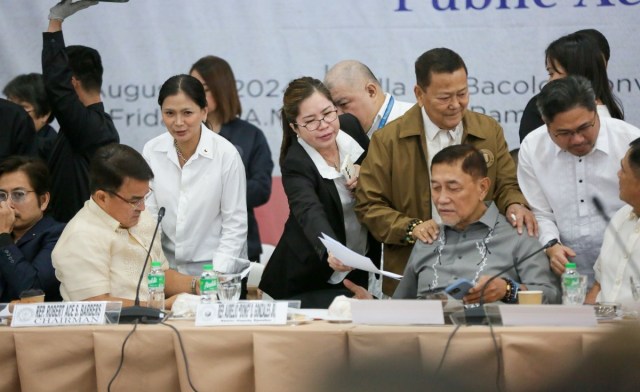
I was struck by the power of the Philippine House Quad Committee findings as presented by the head of the effort, Surigao del Norte Rep. Robert Ace Barbers, in the following Inquirer article: “Quad comm: Chinese-led crimes akin to ‘rape’ of PH“.
The focus was on President Duterte’s works and those of Chinese gangs operating through pogos, all assisted by Filipinos of weak or corrupt character. Remarkable work. Stunning in its accomplishments. I wish voters in the Visayas and Mindanao could read the article and come to grips with what went down.
But irony is a crop in the Philippines.
They’ll get served a different meal.
And the Quad Committee did not go “all the way”, in digging up dirt.
The House is itself one of the vehicles propping up Philippine corruption and incompetence. That’s a fact.
How nice it would be if the House decided to really clean up the Philippines, and looked inward.
Here are the three pillars of corruption in the Philippines enabled by the House or its members:
- Vote buying, or the process by which the entitled get in office, and remain in office, to stay entitled.
- Pork, or the lawful distribution of tax money that local officials can dispense to earn commissions.
- Dynastic advantage, or the way power, riches, and entitlement are kept in the family
I suspect it is a bridge too far to expect the House members to demonstrate the same accountability that they wish to impose on others.
But what a remarkable nation the Philippines would become if the entitled stopped hoarding riches and blocking progress and the good character of the nation from emerging.
Think about it. The House, with some hard introspection, could become the founding fathers, and mothers, of an honest, more productive, and richer Pearl of the Orient.
The Philippines rising. No land of happy fools, this.
_________________________
Cover photo from ABS-CBN article “DOJ to investigate Quad Comm revelations once House submits report“. The picture shows the Quad Committee at work.


 The Society of Honor by Joe America
To be Quad like the number of the Quad committee membership
I will add one more plillar.
a fourth Pillar would be absenteeism when it is time to vote killing an important bill.
Maybe instead of voting those who want to be in the Senate, one should vote two out every two weeks like in Pinoy Big Brother.
That BTW was the context of my comments on PH as a tsismis nation. More people on Pinoy Twitter were interested in Shukla (the next big thing after what haffen vella) than in Inday Sara impeachment just recently.
Before Big brother there was this gameshow franchise called the weakest link.
https://en.wikipedia.org/wiki/Weakest_Link
The Congress men can do a weakest link every now and then and vote out someone. Then there must be a replacement system. The downside would be conspiracies to vote out the strongest link.
There is the Greek procedure called https://en.m.wikipedia.org/wiki/Ostracism
I suggested it be applied to Chiz Escudero in my old blog, satirically of course.
Persona non grata has been diminished by kapal muksism.
He is definitely getting heavily criticized. Maybe his wife will get some of the burn and ostracize him.
ahem, the wife got sent off from bahay ni kuya, wailing, I want to stay! I want to stay! no overstaying guests allowed yata, no matter how pretty fantastic they are. she has been so busy apparently that entering bahay ni kuya was such calming sanctuary, she was unwilling to leave. but forthwith is forthwith and she has to march to the marching order. left, right, left right!
I don’t know if that is exactly corruption though if no money is transferred. More unethical than anything. And there is no accountability for bad ethics.
back to a tripod then.
poor work ethics has no cure, except people getting tired of them.
Paquiao comes to mind though some would claim that going against Digong alienated him from Mindanaons.
From wiki
A dispute within the PDP–Laban, the ruling party of the Philippines, began on March 12, 2021 when Senator Manny Pacquiao (who was named the party’s interim president in December 2020) began to criticize President Rodrigo Duterte and the government regarding the dispute in the South China Sea, alleged corruption in the …
If you drew a chart with politics on the X axis and patriotism on the Y axis, most politicians here would be lower right quadrant. Pacquiao illustrates why that is so. Hontiveros is the only senator upper left.
Agreed
me didnt believe that going against digong cause pakyaw to lost senate seat. bam aquino and kiko arent big on digong and yet, both bam and kiko won senate seats.
pakyaw can punch in the ring, but cannot punch his way out of senate work and ethics. leni endorsed him for being good man, but voters want a better man, and pakyaw lost. had he maybe as senator punched bato’s shield and once in a while spar (debate) with bato, thus showing that he can punch above his weight, he might have a good chance, but that did not happen.
bato issued quite a number of challenges to taumbayan that he would box anyone who opposes his, ahem, I forgot what the issues were, was about, and cannot forget how quiet senator pakyaw was then, knowing full well na hinding hindi patas ang hamon. a good man indeed, but methink voters want a better man, one with sense or propriety, and pakyaw was marked then.
what pakyaw said about digong was lame 2025 electioneering utterances, not enough to help him win senate seat.
Veeery perceptive
Bastardized or mangled party list system.
mining interest= self explantory
Landed interests= Land reform law compromised
If loss of sugar lands can prevent diabetes then I am for it.
We need to be self sufficient in salt but we have many people with kidney problems maybe we should remain importers. Half joke
Seriously our importation practices limits our Agri contribution to just 9 percent of the GDP, it is not the number of farmers or the lack of it.mechanization also turns off even young farmers because of being crowded out.
Many traders close shop many throw their produce away and it is still happening.
smugglers make farmers near obsolete. what’s the point of farming when nearly all farm produce can be easily bought, washed and ready to eat! farmers can barely compete in both price and availability. smugglers have so many enablers and colluders that farmers are left with barely no choice but to abandon farming.
and all the while, a much bigger hunk of agri dept budget goes down to research, more research and them some more agri research. we are oozing with research projects time and again, and yet, we rarely benefit from those numerous researches. except the researchers maybe. but of course, they give to the farmers kuno and share research findings with them, pero kakarampot lang na mga binhi ang binigay, the rest farmers have to buy from their own pockets at such exorbitant price, they would have to be king midas to be able to afford them.
really, govt need to step up in stopping these smugglers, and agri dept need to do more to help farmers on the ground, and spend less on promos of who’s who in the agri sector hierarchy, having their pics posted in socmed as though that is the extend of their job. we want results, not more decorative pics!
Ahem Cynthia Bilyar
oh yeah, how apt cynthia did not get elected. she tried to be on the farmers good side and complained about agri research, research kayo ng research, hindi naman nakakain yan.
tama siya, of course. the farmers didnt get to eat, only gotten more utang hanggang sa nabaon tuloy. but the researchers did get to eat! I am presuming by kayo, she meant researchers. and there are plenty of them well heeled and titled researchers in UP diliman, in villar university, in villar city! so much government grants, kaya tingnan mo, napaka progressive daw talaga ang villar university sa villar city. home of quality research kuno!
Even legal importations hurt
It’s not really legal or smuggled imports that are the main issue in Philippines agriculture. The real problem is a complete lack of an agricultural policy that fits the natural interest and wellbeing. The lack of adequate transportation, even on a mid-sized island like Cebu compounds the former. These are not problems that can be solved by protectionism, as the market always find a way even if less than legal. If the Philippines across administrations and congresses wants to have a laissez-faire approach where the government abdicates responsibility, then with that approach comes laissez-faire problems.
aba, agri dept is so full of policies, one such policy is the forever funding of researches and grants year after year. the score, farmers near zero, researches quadruple digits. and what have researchers got to show but the need for further researches is the usual answer. as is the conclusion.
now listen here me hearty, there is transportation by the millions some rustic and literally rust buckets falling apart, and their rents are eye watering. most funds allocated for transport got salted away elsewhere. and cannot be audited. gone as the wind.
Well as I said to Karl before the policy research papers coming out of commissions in the Philippines I’ve read are well researched, detailed, with multiple policy suggestions including possible pitfalls, and over all are excellent. The problem is when politicians either don’t act on the advice contained within the policy research papers, or the politician values their own performative patting of their own backs over making the lives of the Filipino better.
One of my good friends is a DA agriculturalist who is based in Koronadal City, South Cotabato. She is a top passer and very dedicated to her job, which she got into studying agriculturalist after growing up on her family’s small maize farm nearby Koronadal. Dedicated public servants like her who choose to go back home to work within their community are who are so necessary in the Philippines. Instead, she started feeling jaded with the implementation of fertilizer and more productive seed programs being used by local politicians as a form of vote bribe. She related to me about the lack of enough funds to engage in building agriculture collectives, farmer education, and the mechanization funds were inefficiently used while going to preferred farmers who are related to politicians. Recently she shared with me that she will be leaving the Philippines to pursue her masters in agriculture at a US university, and will probably never go back to working in Philippines public service again. There are countless public servants both current and former like my friend in the Philippines. There is an absence of leadership.
That could be due to what I call the senyorito mentality, the mindset of many in power in the Philippines that attention to detail is for servants, not for masters. That is in high contrast to how attention to detail is valued in developed economies, not brushed off. The Marcos Sr. administration had I think three traffic studies and master plans done for Metro Manila in the early 1970s with World Bank money. Well, nomenclature like C5 for the circumferential road that comes after EDSA, C4 in those studies, did come out of that plan. But it is a lot like a Constitution exists in the Philippines that isn’t even adhered to if one looks closely, like laws that lack IRRs or if they have IRRs aren’t fully implemented, or unused “clean kitchens”. Research is meant to be applied eventually, not just framed and put on the wall like many a college diploma in the Philippines. Lots of theory not applied over there. Instead, stuff is often done “any old way,” like my Canadian piano teacher said when my technique was sloppy.
Yes, there are Philippine laws that have been enacted but do not yet have Implementing Rules and Regulations (IRRs) — or had significant delays in their issuance. This situation creates legal ambiguity or hinders full implementation. Here’s a breakdown of this issue:
—
✅ Examples of Philippine Laws Without IRRs (as of recent years)
1. National ID Law (RA 11055)
Status: IRR was eventually issued in 2018, after months of delay.
Point: For some time, the law existed without a clear mechanism for implementation.
2. Philippine Space Act (RA 11363)
Status: Law passed in 2019, but early implementation was slow due to the absence of an IRR for months.
Issue: Lack of structure delayed the creation of the Philippine Space Agency.
3. Human Rights Defenders Protection Act
Status: Passed by Congress (in various versions) but implementation delayed or stalled; no IRR due to non-signing into law or lack of priority.
Point: This is an example of a bill or enacted law where IRR delays weaken impact.
4. Children in Situations of Armed Conflict Law (RA 11188)
Status: Passed in 2019, delayed IRR issuance until 2021.
Effect: Left child protection measures unenforced for over a year.
5. Ease of Doing Business Act (RA 11032)
Status: Passed in 2018, but IRRs were delayed and spotty in implementation across LGUs and agencies.
Issue: Reform was stifled due to lack of coordinated enforcement.
—
📌 Key Facts
Under the Administrative Code, agencies are generally required to issue IRRs within 90 days after the effectivity of a law unless otherwise specified.
However, non-compliance is not uncommon, especially when:
Political will is lacking.
There are budgetary or institutional limitations.
There’s controversy or opposition surrounding the law.
—
⚠️ Why IRR Delays Matter
Legal Limbo – A law without IRRs may be hard to enforce or operationalize.
Confusion Among Agencies – Implementing agencies may not know their exact roles or limits.
Public Unawareness – Citizens cannot benefit from or comply with provisions they don’t understand.
Judicial Gaps – Courts may hesitate to act on laws with vague or absent procedural guidance.
—
📚 Suggested Follow-Up
If you’re investigating a specific law, I can help check whether its IRR has been issued or not. Just name the law or Republic Act number.
Would you like a list of pending laws or major bills recently passed that still lack IRRs or have unresolved implementation issues?
Laws in the sense of somewhat predictable rules make it easier to get stuff done without power or a powerful network or backers.
Laws that don’t work predictably make power direct or acquired necessary.
Made up quote or not, it has a life of its own.
Because only the messsenger had been shot.
https://politiko.com.ph/2015/11/18/the-truth-on-quirinos-golden-arinola-and-avelinos-what-are-we-in-power-for-qoute/headlines/
Perhaps it is a senyorito mentality, though sometimes it would seem more of a Mickey Mouse mindset in comicality if not for the serious nature of leading other people. Though it has to be said that the more successful Medieval European dynasties did place effective majordomos and stewards in charge of the day-to-day of the castle and demesne. On less optimistic days, it feels to me like the nation is just trying to get by with what it can — this really becomes apparent when observing the daily life of the urban poor and rural destitute. Filipinos are bound in to those Filipinos up on higher rungs, while those at the top are bound to power and money. It’s really jarring to see from the perspective of an American, where it is possible for the children of impoverished immigrants to become doctors, lawyers, and businessmen within one generation by the help and support of the government and community. Without government intervention in the Philippines, the only way out for the poor is to leave the country as an OFW, hopefully to support a hardworking child, nephew or niece to become a nurse or engineer after which that young person also leaves and the cycle repeats.
the only way out for the poor is to leave the country as ofw. a number of very poor pinoys have proven that is not quite true. look at the villar family of cynthia villar, owner of many business developments, holders of vast real estate property developments in prime locations, owner of the recently beleaguered prime water, and also owner of villar university in villar city. where many government researches are funneled.
the villars apparently started very poor, its scion manny villar once sold fish in a public market. apparent good business sense made manny villar edge out the competition, and become supplier of quality fish to top hotels and restaurants, and then his business grew unabated far and wide. and he did not need to become ofw. outlier siya, and there are outliers like him who made it big without being ofws. the dutertes and the marcoses did not need to be ofws to be super rich, as well as many others. and as the wont, they started poor too. makoy’s parents were farmers, young imelda’s family used to lived in a garage. there is opportunity in this country if you know how to play the game, be patient and have longevity.
the poor who live above their means and dont know how to save money – lost.
and those early tsinoys who made philippines their home are admired for their determination and business sense, frugal and thrifty. they’d sell their grandmothers if that would make them money goes the saying. and even if they already had saved much money, they would still be frugal and eat sparingly, rarely gorging on abundant and luxuriant food. had become naturalized filipinos too, and stayed here, and did not become ofws.
Yes one can say that through ruthlessness a person can attain wealth and power. The early human society had a more egalitarian structure; those early humans were little more than extended clan groups. When humans discovered agriculture and pastoralism, the first sedentary societies were quickly ruled by chieftains and their warbands — who had little difference from gangsters taking a protection fee from the other farmers in society below them. The accumulation of wealth and power through ruthlessness favors the few and is not accessible to the many. While it’s great that some families like the examples given attained great power through ruthless, sometimes less than honorable means, that type of aspiration is just not possible for most Filipinos. After all, if everyone was ruthless in pursuit of wealth and power, then no one would have wealth and power as most people simply would be dead.
by going overseas, joey nguyen’s agriculturalist friend could be missing out, heaps. when the going gets tough, the tough gets going! sad.
if she is as multi tasker and multi smart, smooth talker and uber confident, she can very well play the game and seek out powerful politicos willing to have their good name bandied about, politicos who could do with extra bouts of publicity and have their names equated further with benevolence of higher degree; revered.
as top class agri consultant with letters to her name, joey nguyen’s agriculturalist friend could work with them powerful politicos, open webpage and advertise far and wide their activities and achievements, to the benefit the nation. and she is likely to have her farming ventures funded, albeit circuitly. or she could apply for government grant and be well funded researcher for years!
nothing ventured, nothing gained. in the absence of leadership, she can be her own leader. isnt that what is taught at school?
It so happens that most people in STEM are not smooth or even confident talkers, or even that organized to the point of being an efficient multitasker. Well, that’s why people like myself exist — to help focus the subject-specific talents of others in an organization towards a larger goal. If things were that easy, then everyone could become a leader. I haven’t found that to be in reality though, at least in my private career or in volunteerism I’ve engaged in. Even myself who can be described by some as a leader in my area of expertise, require guidance from someone higher up the ladder. When I was younger and had more time for volunteerism, I was pretty much the muscle and labor, a temporary simple cog in an NGO.
So the reality with my agriculturalist friend is she will likely never work in the Philippines again. She will enjoy more freedom to do her research, more prestige, more respect for the work of her and her colleagues, better guidance from superiors, a better salary. That just won’t be enjoyed in the Philippines. Her story is just one example of countless initially enthusiastic Filipino public servants including DoTr civil engineers, DepEd teachers, and so on who wanted to help their community and their fellow Filipino, only to eventually feel jaded and thought of an exit plan. And so the status quo continues year after year.
From moi
https://joeam.com/2020/09/28/what-now-philippine-agriculture-food-security-or-rice-self-sufficiency/
Thanks Karl. Always a good re-read.
The magnitude of issues plaguing Philippine agriculture sometimes feels overwhelming. Rice being over emphasized as a source of calories also begets other problems like early-onset diabetes, salt-preserved foods contribute to high blood pressure, while I have become less surprised that gallstones are prevalent. At minimum better transportation infrastructure to get from farm-to-table is needed, as well as refrigerated panel trucks and cheaper access to electricity for refrigerators to store vegetables and sources of fresh proteins.
I have a certain friend who judiciously saved his money earned as a seaman and installed solar panels on the house he built. He got the idea from a non-Filipino ship captain. Even in Cebu and Mactan, electricity is not reliable and brownouts are common. Bigger business complexes and hospitals use generators as a workaround to what should’ve been better government policy.
Because of what China is doing, I no longer advice solar.
Yet China(state) cries foul and fake news every time like the power transmission terrorism.
https://www.reuters.com/sustainability/climate-energy/ghost-machine-rogue-communication-devices-found-chinese-inverters-2025-05-14/
How will the US fight China with Chinese spare parts?
https://warontherocks.com/2025/03/finding-adversaries-hiding-in-the-defense-departments-supply-chains/#:~:text=In%20September%202022%2C%20the%20Defense%20Department%20temporarily,and%20samarium%20alloy%20that%20came%20from%20China.
I had written previously about post-Civil War political cronyism and the attendant network of political bribery, and how the corruption in politics was related to the monied interests of the business tycoons of that Gilded Age. It’s not a coincidence that the Philippines readily adopted some ideas from the old American patronage system, applied on top of the existing patronage of the Spanish colonial era, as when the US took over in 1898 the Gilded Age was at its height. Now the system of partisan appointment and office buying is not inherently bad in itself as the US Founders implemented it. There was an idealistic assumption that men who pursue public service would be of good character and temperament — after all, the term “public service” itself implies sacrificing oneself for the greater good of the society. The trouble came when political factions started to coalesce into political parties, funded by oligarchical interests; another aspect of human behavior that the US Founders too idealistically did not account for.
What got rid of American political patronage was that a few civic-minded reformist leaders stood up — the leaders of the Progressive Era, most famously the Roosevelt family. These leaders also came from the elite, but chose to be tribunes of the plebs, much like the patres of leading Roman gens of the past who walked amongst the people rather than stay cloistered within the patrician class. Muckraker publications, often owned and published by progressive elites, supported journalists who exposed corruption. In many ways the Progressive Era ushered in the Second US Founding, bringing the US closer to her stated Constitutional ideals, creating the conditions for what some historians describe as a Pax Americana or an American Century.
1968 was the height of American progressivism, at which point oligarchical interests started a concerted effort through local and state government to build power in a correction of the top-down effort of the 1933 Business Plot. American progressives fought amongst themselves and American liberals over not the 80% they agreed with each other on, but the 20% they did not. How human is this reaction, just like how the Christian church split schismatically over minor doctrinal disagreements while barbarians built their forces at the doorstep. But in the excess of accumulated monied power and the politicians that money buys, there is a point where the people have had enough that then starts a counter-reaction that may be occurring now in 2025.
The Philippines was brought into the American fold in 1898, 127 years ago this December 10th. At that time the excess of American oligarchs (who pushed for the Spanish-American War in the first place) was defeated by American progressivism, the US experienced a rapid expansion of political and economic rights, only to be slowly undermined by the oligarchical forces once again. There is a feeling in the air here in the US that America is on the cusp of a period of renewal — a Second Progressive Era — that will be a great reformation. It’s not too late for the Philippine elites who want to leave a better life, and a greater country to the next generation of Filipinos to stand up as a Filipino version of tribunes of the plebs. But that will take courage to gamble giving up some of one’s power, to gain even more power by popular accolade. And we all know, the scarcest resource in the world is that of courage.
In the Philippines, there is very little sense of “common weal”. It is nearly always the well-being of one’s own group.
Someone who lets others in can more easily get screwed over there like PNoy was screwed by Grace Poe.
Those who ally with someone can be seen as dependent like Akbayan was seen for its coalition with PNoy. So Walden Bello went against PNoy at some point.
Sometimes I struggle with *how* the Philippines can change for the better. One can say that other countries whether they follow a European or East Asian tradition are able to eventually rise again after a fall because the country has history and philosophy to draw from. Over the last quarter-century educated Filipinos I know were first shocked at the rise of South Korea, then Thailand/Indonesia/Malaysia, now Vietnam. I’m bracing for the next quarter-century where those same educated Filipinos will soon relate to me their shock about the rise of the African nations. Of course, all the countries that educated Filipinos used to look down on have something on common, which is a past history of high culture and economy.
If focused narrowly on this aspect, it would seem that it’s impossible for the Philippines to ever rise. But it’s also possible to borrow ideas from others successes to increase one’s own chances of eventual success. Learning new ideas doesn’t really have much value though, if those lessons are not applied. Fomenting revolutionary thought among the masses is a illusory lie, though there is social good and benefit in helping the masses better their economic conditions. Ultimately everything really seems to depend on the elites of society — enough need to look towards the betterment of their countrymen rather than hoarding and protecting their own wealth and power.
This blog tries to give nudges to members of the elite who happen to read here. In fact, nudging was one thing LCPL_X suggested a decade ago, while sonny used the Catholic mustard seed analogy for our writings here. As for hoarding, the newer elites are more likely to be greedy than the older, more secure wealth. The likes of Cynthia Villar are the worst, while very established elites like Mar Roxas or PNoy tried to change the system. Imelda Marcos was a bit like Cynthia Villar, but her son is different. So it isn’t completely hopeless.
Just went through the comments on Joe’s most recent FB post. Oh boy.
Fun times. haha
I saw an old friend who does the interviewing here wanting Joe to do the interviewing of BBM. Shifting the onus if I should say so.
Kuya Will you do it, pretty please, unless he owes you money or worse.
Hoping not to offend.
That’s a great idea and I hope he gives it a shot. His portfolio is impressive enough.