The 1935 Philippine Constitution: Foundations, Structure, and Legacy
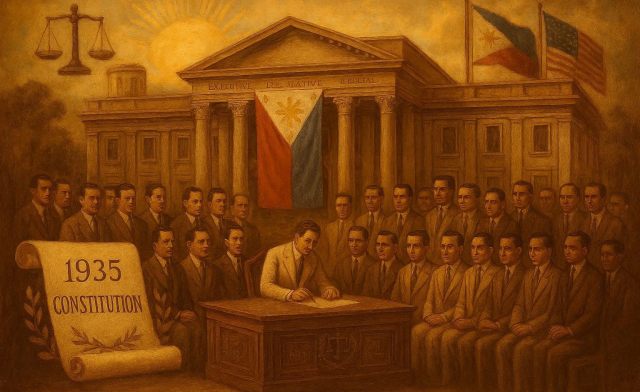
By Karl Garcia
The constitutional history of the Philippines reflects an enduring effort to institutionalize democracy while navigating colonial transition, national identity, and governance challenges. Among its foundational charters, the 1935 Constitution stands out as the country’s first fully operational framework of republican governance—bridging colonial rule and eventual independence, while embedding liberal democratic principles that would shape Philippine politics for decades.
I. Historical Context: Transition to Self-Government
The 1935 Constitution emerged from the Tydings–McDuffie Act, a U.S. law that provided a 10-year transition period toward full Philippine independence. This period, known as the Commonwealth era, was designed to prepare Filipino leaders and institutions for sovereign rule.
A Constitutional Convention convened in 1934, composed of Filipino delegates tasked with drafting a charter that would balance democratic ideals with political stability. The resulting constitution was ratified by plebiscite in 1935 and inaugurated alongside the Commonwealth government under President Manuel L. Quezon.
The broader context was crucial: the Philippines was not yet fully independent, but it was no longer a typical colony. The Constitution thus functioned as both a training ground for self-rule and a symbol of emerging sovereignty.
II. Structure and Key Provisions
The 1935 Constitution closely followed the model of the United States Constitution, reflecting American institutional influence while adapting to Philippine realities.
1. Presidential System
The Constitution established a strong executive branch, with a President elected for a four-year term (later amended to allow re-election). The President served as both head of state and head of government, wielding significant authority over administration and national policy.
2. Separation of Powers
A classic tripartite system was adopted:
- Executive – President and administrative departments
- Legislative – Initially a unicameral National Assembly, later amended (1940) into a bicameral Congress (Senate and House of Representatives)
- Judicial – Independent courts led by the Supreme Court
This structure institutionalized checks and balances, aiming to prevent concentration of power.
3. Bill of Rights
A defining feature was its comprehensive Bill of Rights, guaranteeing:
- Due process and equal protection
- Freedom of speech, press, religion, and assembly
- Protection against unreasonable searches and seizures
These provisions firmly embedded civil liberties into Philippine governance, reflecting liberal democratic ideals.
4. Electoral and Democratic Mechanisms
The Constitution emphasized representative democracy, with regular elections and defined terms of office. It also laid the groundwork for political party development and electoral competition.
5. National Defense and Economic Provisions
It mandated the creation of a national defense system and included provisions regulating natural resources, reflecting concerns over sovereignty and economic control during the transition period.
III. Significance: Liberal Democracy as State Foundation
The 1935 Constitution represents the Philippines’ first sustained experiment with liberal democracy at a national scale. Its significance can be understood across three dimensions:
1. Institutionalizing Democratic Governance
It transformed abstract ideals—elections, rights, representation—into functioning political institutions, many of which persist today.
2. Preparing for Independence
By the time full independence was granted in 1946, the Philippines already possessed:
- An experienced political leadership
- Established governmental institutions
- A working constitutional order
This made the transition smoother compared to many post-colonial states.
3. Establishing Political Culture
The Constitution helped entrench:
- Electoral politics
- Civilian supremacy over the military
- Legalism and constitutionalism
However, it also revealed early tensions—particularly the concentration of power in the executive and the elite-dominated nature of politics.
IV. Strengths and Structural Limitations
A closer examination shows that while the 1935 Constitution was foundational, it was not without flaws.
Strengths
- Clear institutional design and stability
- Strong protections for civil liberties
- Familiar and tested governance model (U.S.-inspired)
- Effective preparation for independence
Limitations
- Elite Capture: Political power remained concentrated among landed and economic elites
- Executive Dominance: The presidency accumulated significant influence, especially during crises
- Limited Social Justice Framework: Compared to later constitutions, it placed less emphasis on redistributive policies and structural inequality
- Dependence Context: Its design was shaped under U.S. oversight, raising questions about full constitutional sovereignty
V. Legacy and Influence
The legacy of the 1935 Constitution is profound and enduring.
It served as the governing charter of the Philippines from 1935 to 1973, spanning:
- The Commonwealth period
- The disruption of World War II
- The early decades of independence
Many of its core features—presidentialism, separation of powers, and a robust Bill of Rights—were later carried into the 1987 Constitution of the Philippines, albeit with modifications designed to correct past weaknesses.
More importantly, it established a baseline expectation: that governance in the Philippines should be constitutional, democratic, and rights-based—even when political realities diverged from these ideals.
VI. Conclusion
The 1935 Constitution was not merely a transitional document—it was the architectural foundation of modern Philippine democracy. It translated the aspiration for self-rule into a functioning system of government, embedding liberal principles that continue to shape the nation’s political life.
Yet its experience also offers a cautionary lesson: institutions alone do not guarantee democratic outcomes. Their effectiveness depends on political culture, leadership, and the broader social structure in which they operate.
In this sense, the 1935 Constitution is both a blueprint and a benchmark—a reminder of what Philippine democracy set out to be, and an enduring reference point for what it must continue striving to achieve.


Damn dynasties, LOL. There is no purely sovereign governing document in any democracy I suspect. They borrowed and adapted. If the Philippines adopted it, it was sovereign. To say otherwise is not sovereign.
Even without Internet we were able to mix Spanish Briish Latin American and American Documents into one. We drafted , FDR approved it. As to sovereignty, my rhetorical question is, is it the same or equivalent to independence.
Don’t give me headaches trying to figure that out, lol.
Hehehe
https://www.facebook.com/manolo.quezon/posts/pfbid02sBu6TD1qwhF4FQJJVEMSWP4FmS6yPzJAV5G343HhLawy3kMdufRyCpTYC65EfRJQl MLQ3’s comment on the Senate issues:
the senate boycotters, cayetano et al, had not the hindsight of the supreme court 1949 ruling, too busy grandstanding, drunk on power. and as they say, power can be fleeting. and it is! cayetano lost the majority. the empasse is gone.
AI Overview
In the landmark 1949 Philippine Supreme Court case of Avelino vs. Cuenco, the Court ruled that the active membership of the Senate—not the total constitutional number—is the basis for calculating a quorum. Because one senator was out of the country (beyond the Senate’s jurisdiction), the active total was 23. A majority of 23, which is 12, was deemed a valid quorum to conduct business and elect a new Senate President.
The Core Facts and Logic
Modern Application
This case remains a highly cited and debated precedent in Philippine legislative history. It is frequently invoked in modern controversies when a smaller group of lawmakers continues a session after a walkout, or when there are detained or incapacitated senators who cannot attend proceedings. For a broader look at how this impacts legislative procedure, you can review the Senate of the Philippines rules.
my reply is gone, maybe on hold?
it was auto-classified as spam. Retrieved it now.
Thanks partner.
kind of you, thank you. the session that cayetano led at the senate on thursday, 4th may was just a gathering attended by the 18 questionable ex marines. since the secretary of the senate and the stenographer were absent in abeyance to new sp gatchalian call to work from home on thursday, cayetano’s gathering was not officially recorded.
monday, 8th of may should be a big day when all senators attend work. there will be much media presence as well as well wishers. hope cayetano will accept his loss then and will step down, gracious in defeat.
karG, the answer to your thetorical question? force majeure is probly what senator robin paddilla would say! so much so that senate majority vanished and could not be found for the pm session.
jinggoy’s daughter janelle estrada showed her own version of force majeure by swearing and giving the interior secretary jonvic remulla the dirty finger, her father arrested for plunder yet again. jonvic remulla did not disappear though, unaffected at may tamang pangontra laban sa force majeure.
just an update:
janelle ejercito estrada was apparently replaced and no longer the director of the national authority for childcare, an agency attached to dswd. atty maria garbriela concepcion is now the new director.
to me, losing her cool, swearing at the dilg secretary and giving the secretary the dirty finger in front of the media and the nationwide broadcast, janelle estrada did not further the cause of the agency she has led. if it was manifestation of personal angst because her father was arrested for the umpteenth times, as high profile public servant, she should have shown decorum. pero, had janelle shown hindsight and apologized after the fact and shown remorse, she might have kept her job, methink.
it is okay to make mistake, it is even better to acknowledge a mistake and apologize for it. without apology, it is bad precedent for children in her care. impunity should not be entrenched.
Thanks for that reply.
while our international sovereignty is intact, with vietnam’s president recent visit to our shores, bolstering both our economy and trade, our internal sovereignty has gone bananas! very apt that president lam of vietnam cancelled his meeting with senate president cayetano.
after the apparent snub of president lam, cayetano seemingly consoled himself by being absent yesterday at the senate. absent as well, is the senate majority, and together with sp cayetano, they went on strike and boycotted the senate, hence forum cannot be formed yesterday. their common sense arrested and gone. now that jinggoy is arrested for plunder, senate majority went along for the ride with plunder boy jinggoy, maybe for the indefinite future.
it is not only that we have dynasties to contend with, senate majority is also distorting our democratic process. na-conflated and truly na-head over hells over plunder boy jinggoy. wait until majority members marcoleta, escudero, villanueva et al got their subsequent warrants, senate may totally be somersaulting, for the indefinite future.
A sovereign mess, haha.
blue ribbon committee shredded.
I just asked Claude for a summary of what institutions were built during what era:
————————————————-
Here is a comprehensive text summary across all four periods:
—
**Insular Government (1901–1935)**
The American colonial administration systematically built the foundations of modern Philippine governance. In 1901 alone, several foundational bodies were established: the **Philippine Commission** as the supreme governing body, the **Philippine Constabulary** as the national police force, the **Bureau of Education** which deployed the Thomasites and established the public school system, and the **Bureau of Health**. Technical bureaus for agriculture, forestry, lands, and science followed shortly after.
The **Philippine Military Academy (PMA)** was founded in 1905 in Baguio, modeled on West Point, to train Filipino officers. The **Philippine Assembly** (1907) gave Filipinos their first elected legislature, and the **University of the Philippines** was chartered in 1908 as the national university. The **Philippine General Hospital** opened in 1910 as the country’s premier public hospital, and the **National Library of the Philippines** was formally organized in the same era. The Jones Act of 1916 created a fully **bicameral Philippine Legislature** with both a Senate and House of Representatives, and for the first time Filipinos controlled both chambers. The **Philippine National Bank** was established in 1916 as a state bank to support agriculture and commerce. The **Bureau of Science**, the **Weather Bureau**, and the **Bureau of Prisons** also date to this period.
—
**Commonwealth Period (1935–1941)**
The Commonwealth, inaugurated on November 15, 1935 under President Manuel L. Quezon, was a transitional self-governing period preparing the Philippines for full independence. The **1935 Constitution** was the foundational document, establishing a strong executive presidency and initially a unicameral **National Assembly**, which was restored to a **bicameral Congress** (Senate and House) in 1940.
The **Philippine Army** was formally organized in 1935 under the National Defense Act, with General Douglas MacArthur serving as Military Adviser. The PMA was integrated into this new defense structure. The **Government Service Insurance System (GSIS)** was created in 1936 to provide pension and insurance coverage for government employees. The **Court of Appeals** was established in 1936 as an intermediate appellate court between the trial courts and the Supreme Court. The **National Economic Council** was set up for economic planning. The **Commission on Elections (COMELEC)** was created in 1940 to oversee elections. The **Civil Service Commission** was strengthened and formalized during this period. The **Philippine Veterans Legion** had its roots here as well. Public health infrastructure was expanded through the reorganized **Department of Health**, and efforts to develop a national social insurance framework began, though the war interrupted them.
—
**Japanese Occupation (1942–1945)**
After the fall of Bataan and Corregidor in 1942, Japan dismantled Commonwealth institutions and erected a set of collaborationist structures. The **Philippine Executive Commission** (January 1942) was the first puppet civilian administration, headed by Jorge Vargas and tasked with maintaining order under Japanese military command.
**KALIBAPI** (*Kapisanan sa Paglilingkod sa Bagong Pilipinas*, or Association for Service to the New Philippines) was established in 1942 as the only permitted political organization, replacing all political parties. In October 1943, Japan granted nominal independence and the **Second Philippine Republic** was proclaimed under President José P. Laurel, complete with a rubber-stamp **National Assembly** selected by KALIBAPI. A **Council of State** was also constituted. The **Bureau of Propaganda** controlled all media and promoted pro-Japanese and Greater East Asia Co-Prosperity Sphere messaging. **MAKAPILI** (*Makabayang Katipunan ng mga Pilipino*) was formed in late 1944 as a pro-Japanese armed volunteer corps. Japanese-era schools were reorganized to teach Nippongo and Japanese-aligned curricula. All these institutions were dissolved and delegitimized after liberation in 1945, and their officials were tried for collaboration.
—
**Post-Independence Republic (1946–1953)**
The Third Republic was proclaimed on July 4, 1946 under President Manuel Roxas, with the United States transferring sovereignty. Philippine institutions were rebuilt and new ones created to meet the demands of a fully independent state.
The **Congress of the Philippines** was reconstituted as a sovereign bicameral legislature. The **Department of Foreign Affairs** began conducting independent diplomacy and the country joined the United Nations. The **Philippine Veterans Board** (later the Philippine Veterans Affairs Office) was established in 1947 to care for veterans and guerrillas of the Second World War. The **Armed Forces of the Philippines (AFP)** was formally organized in 1947, unifying the Philippine Army, Philippine Navy, and what would become the Philippine Air Force under a single command. The **National Bureau of Investigation (NBI)** was created in 1947 for criminal intelligence and investigation. The **Commission on Elections** was constitutionalized and given greater independence.
The **Central Bank of the Philippines** was established in 1949 under Republic Act 265 — one of the most consequential postwar institutions — giving the country its own monetary authority, control over currency, and independence from the U.S. dollar peg. The **War Damage Commission** addressed postwar rehabilitation, and the **Philippine Rehabilitation Finance Corporation** was set up to fund reconstruction. The **Social Security System (SSS)** had its legislative groundwork laid during this period, though it was formally established by law in 1954. The **Civil Service Commission** was strengthened for a merit-based bureaucracy. The **Government Corporate Counsel** and various new government corporations were chartered to manage state enterprises. The **Philippine Military Academy** resumed full operations and was reorganized under the AFP.
By 1953, when Ramon Magsaysay was elected president, the basic architecture of the Philippine republican state — its Congress, judiciary, military, central bank, civil service, and social welfare apparatus — was largely in place.
Irineo, the latest grads of PMA this year 2026 are the most tech savvy.
https://tribune.net.ph/2026/05/16/pma-class-of-2026-graduates-with-new-tech-international-training-milestones
Irineo, one of the foundations put in place in the 1935 Constitution (Article X111) was the requirement that Filipinos maintain majority ownership in the development of natural resources and utilities. This requirement was “suspended” by the Bell Trade Act in the US and a legal “ordinance” in the Philippine attached to the 1935 Constitution thanks to a little help from our dear Pres. Roxas who did some questionable political maneuvers to remove some dissenting voters in Congress (led by Congressman Luis Taruc and Sen. Claro M. Recto) so as to allow the provisions of the US Bell Trade Act granting Parity Rights to American citizens.