Starlink for ALL in the Philippines by 2028

By Lance Corporal X
When I added that tenth group to Joe’s peoples’ coalition opposition to PBBM and VP Inday Sara, I was envisioning Sharon Cuneta with a bigger role than back in 2022.
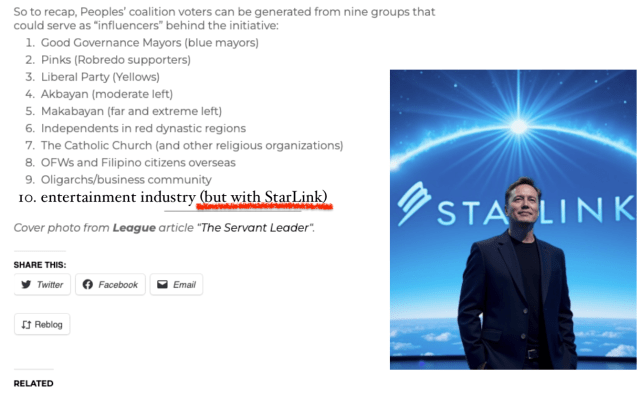
I realize now it’s about Starlink. But with musicians and actors and entertainers , as well as the other nine in Joe’s group, promoting Starlink.
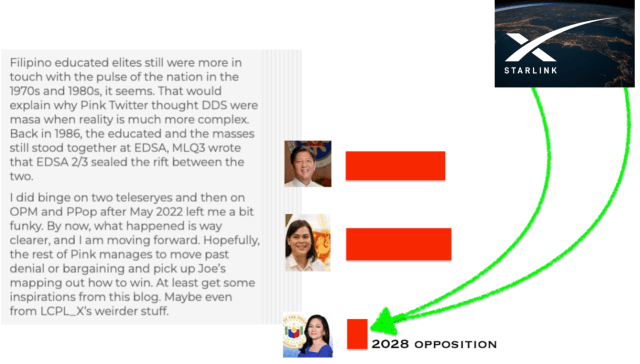
Realistically, Joe’s opposition group is at a very low point for 2028. PBBM and Inday Sara already have their base. But if you inject Starlink in there, that red bar graph for the opposition will surge, taking away from PBBM and Inday Sara.
If you look at Starlink’s website they have a Personal plan and a Business plan, focus on Business plan and don’t worry too much about pricing I’m sure all that is negotiable with wholesale.
I’m reading 200+ devices can be supported within Starlink’s wifi router. Now I’m no techie, I’m a Luddite, so you guys will have to figure all that out.
I’m just saying it’s very do-able.
- Good Governance mayors can go up to their barangay captains and set-up Starlink for each barangay.
- Pink maybe thru Angat Buhay other NGOs can set-up Starlink.
- Yellows especially thru Bam’s Negosyo Centers can have Starlink.
- Akbayan with Risa at the helm can spread Starlink.
- Makabayan those commies can set up Starlink.
- Independents can do the same in their dynast regions.
- Catholic Church, each parish and schools can have Starlink, maybe stream Conclave all day long (good movie)
- OFWs, Fil-Ams etc. etc. can fund Starlink.
- Oligarchs/business community can totally offer Starlink.
- Lastly, and this is the kicker here, entertainers can promote Starlink maybe mention who is giving Filipinos Wifi and internet access– namely, Joe’s opposition. But that’s more about campaigning, so long as the entertainers just focus on Starlink, they don’t have to worry about getting cancelled. But get more entertainers to talk about connecting the whole Philippines via Starlink. It’ll be good for their industry.
Now , of course, as a VP Inday Sara guy here, I have to warn you that Inday Sara will swoop in and steal this idea. Without intel/confidential funds now, she too can access church groups especially INC, as well as NGOs and barangay halls and mayors. More importantly, OFWs and overseas Filipinos. And don’t tell the USA but China too will give her funds to do this.
PBBM will probably just be looking at his million dollar watch and not pay attention to 2028, so we’ll be safe there. But Martin is a tambaloslos and he’ll surely steal this idea too, cuz he wants to be president.
So jump on this now because after 2025, it’ll be 2026, then 2027, and 2028 will just be around the corner. The clock is ticking. Added bonus is, Starlink would totally topple Philippine dynasts and oligarchs.
Now for the weirder stuff… After Starlink spans the whole of the Philippines (thanks to the opposition, of course), I would also encourage Filipinos to volunteer for Neuralink. Boom! Mic drop.
Thanks, to Joey & Ireneo for their discussion on data plans and internet video watching habits of CDE Filipinos. Now let’s get Starlink for ALL in the Philippines by 2028.


 The Society of Honor by Joe America
Just dropping hopefully related links.
https://www.pna.gov.ph/articles/1235547
Bill granting legislative franchise to Elon Musk’s Starlink PH pushed
https://business.inquirer.net/471223/starlink-speed-has-yet-to-match-local-telco-services
Starlink speed has yet to match local telco services
thanks, karl. so that guy in the video above is saying that aside from individual or commercian Filipino customers that buy Starlink, Starlink Philippines will also do business with existing telcos there to augment their signal, so won’t be competing per se.
I did hear that Starlink isn’t as fast in urban areas, but better in rural to suburban areas. But this other video below , he’s doing speed test with his Starlink in the middle of Manila and looks fast enough, karl.
I gotta feeling though as bill, telcos there will probably block that Starlink bill, territory stuff. i dunno. So in the mean time, I think Joe’s 9 and my 1 (= 10) can totally push for Starlink now.
I used to like Sen. Grace Poe, but as usual she is pushing for vaguely populist sounding ideas without explaining any of the crucial details, or even the outline of details. Like how granting a telco franchise to Starlink to cover internet access to far-flung barangays would be affordable when those residents are so poor they can barely afford food. Moreover, as much as I hate to say it, but I’d rather telco infrastructure remain under the control of the Philippines government as it may become a national security matter. Giving people power to a questionable businessman such as Musk may not be a good thing. Not that Musk cares about rules because those who can afford Starlink in the Philippines have already been using it despite not having full blessings of the government regulators. Musk certainly doesn’t have a problem with geofencing Starlink in countries whose leaders he respects, i.e. countries led by dictators where he has business interests.
But foremost, Starlink requires a satellite terminal, the cheapest of which is the Starlink Mini that costs PHP 33,500 upfront, and a reoccurring monthly cost of PHP 4,100. All for speeds that on average are 25-100 Mbps with high latency. PLDT Fiber 500 tier costs PHP 2,099. Globe GFiber 500 costs 1,999. Both include a “free” router-optical terminal combination (WiFi + ONT), with no installation fee on most promos. Those who can’t afford fiber often get “Home WiFi” hotspots that cost PHP 199 per 25GB load that already includes unli access to basic socmed services, PHP 999 a month for unli data. Latency and upload are important if one needs to do any productivity work like schoolwork or work-from-home, and fiber typically has 1-3 ms latency compared to satellite’s latency can average 60 ms with spikes well past 100 ms, practically unusable for anything but media consumption (that is if the media streaming app buffers properly).
One can argue that the remote bukid should have better internet, and I don’t oppose that, but how will it even be affordable? The Philippine government is used to either getting cheap sovereign loans or sovereign-to-sovereign foreign development assistance to accomplish any major infrastructure project. Expecting the Philippine government to come up with the money is a fantastical proposition, which is why Poe’s suggestion is laughable. Musk isn’t going to “donate” anything. Musk is used to milking the US and PRC governments for subsidies then claim he gave things away for free, and the Philippines is a thin, milkless cow on that analogy. No, the people in bukid have more pressing problems than having better internet.
Suppose if the Philippine government decided to aggressively build out internet connectivity to the remote bukid. That would be better and more cheaply done with existing Philippine telcos laying fiber trunk lines then sending signal by traditional high-gain long-range radio point-to-point links to cover the “last mile.” I have a lot of experience in this as a technologist and from my “wardriving” days. A family clan in Cotabato still use the simple homemade parabolic antenna setup I made in the mid-2010s to connect two of their family compounds together.
But all through this, the point that is missed is that the E’s living out in the bukid have more pressing matters to address than niceties like internet. They often don’t even know what they will have to eat 2 days hence. They barely have shacks to live in. There are often no more suitable natural materials to construct a bahay kubo/payag and need to make do with salvaged materials. There are holes and gaps in the walls of their houses covered by plastic curtains crumbling under the sun. Everytime it rains the roof leaks everywhere. Not once when I talked to bukid dwellers in desperate circumstances did they say “it would be nice to have internet” or “it would be nice to have a new phone.” They ask instead, what’s for dinner and if it’s just gulay with tinapa once again.
, as much as I hate to say it, but I’d rather telco infrastructure remain under the control of the Philippines government as it may become a national security matter.
from that above video I shared with karl, Joey. it does look like Starlink really has no use competing with local telcos, since their business plan is to to sell signal that will augment local telcos’ signal , and then directly to individuals and businesses internet from the sky by-passing telcos and government regulations cuz Philippine territory doesn’t extend to outer space.
Musk certainly doesn’t have a problem with geofencing Starlink in countries whose leaders he respects, i.e. countries led by dictators where he has business interests.
here’s a good article on that issue…
https://www.theregister.com/2024/05/03/spacex_roaming_lockdown/
Giving people power to a questionable businessman such as Musk may not be a good thing.
I think your reading of Elon Musk is wrong, Joey.
Unlike Zuckerberg and Bezos who have hired fashion and work-out consultants to up their “image”, Musk still looks the same as in the 90s. i mean day to day. which tells me he’s got priorities and looking good for public consumption is not one of them.
Bill Gates too kinda looks the same, never started working out, but he lost bigly backing Kamala Harris, so he’ll have to sit the next 4 to 8 to 12 years out, but he ‘s got good nuclear energy plans hoping that continues.
Musk however not only bet he went all in with Trump, very big gamble cuz the polling was 50/50 unless he and Peter Thiel had different polling numbers at their disposal. looking back now of course Kamala had no chance winning.
but that was a big bet. Give the dude props for that atleast.
So since Musk (along with the Paypal mafia give or take one or two) will essentially make up a big part of the American gov’t and its policies our reading of the guy has to be spot on. if you input too much personal bias into your divination process then your prognostication will be skewed.
I notice he talks about the Culture and the Minds a lot when talking about the future, he’s fan of sci-fi literature for sure but lately its all Iain M. Banks this and Iain M. Banks that (i’ve never read him just youtubed ).
So like Gates, Musk’s trajectory is to optimize. unlike Gates who just pretty much had his foundation on top of software etc. Musk has a bunch of companies. as to “questionable businessman” that questionability only happened vis a vis with him and Peter Thiel duking it out early on, to which
Elon Musk lost. and that lost going up against Peter Thiel is informative, ever since that bout he’s been a pretty savvy businessman all throughout. so what Musk learnt from Peter Thiel is not all fight have to be zero-sum , why they both use positive sum all the time, win-win-win.
Well Thiel learned that lesson in Stanford, his philosophy professor. but Musk i think learned that lesson thru Iain M. Banks thru his Culture series.
I don’t know what Peter Thiel is playing at less data available, but Elon Musk all indications i can see he just wants to go inter planetary in his life time and all his plans converge into that one goal. his Boring company is for outer space best place to live out there will be underground in the Moon or Mars or asteroid belt, etc.
then of course Tesla isn’t a car company but an AI company. cuz in the Culture series, life forms are in big spaceships runned by different AI. cars as sentient.
So whatever scenario you’re imagining in your head , Joey, where Elon Musk turns off Starlink to starve out Filipinos is ludicrous , theres no reason to turn off Starlink since tampering with his tech because of some petty politics below makes no sense. at all.
And if you read that article on Starlink in Africa thus to Russia, it makes sense. hard to really geofence space, that’s politics below issues petty. so how do you solve political problems, not by cutting off connection but offering more of it, Joey.
And that’s how you read Elon Musk vis a vis Starlink et al. So if you’re picturing him as some simple Bond villain thats already wrong, i’m saying look at Iain M. Banks and look at positive sum and that’s pretty much Elon Musk. but i’ll be the first to concede that in this first principles process, there’s also a big chance that
Elon Musk can just snap his fingers like Thanos. for optimization. but at this time I think he just wants everything optimized more Starlink satellites means better connectivity. means better for his other companies to proceed, means getting off planet quicker in his lifetime.
So geofencing is really counter productive. when the whole point is to connect the whole world, Joey.
Expecting the Philippine government to come up with the money is a fantastical proposition, which is why Poe’s suggestion is laughable.
I’m saying by-pass the Philippine government, Joey. 1-10 plus more Filipinos getting Starlink would create its own economy.
Musk isn’t going to “donate” anything.
Everything is negotiable with Musk, Joey.
Not once when I talked to bukid dwellers in desperate circumstances did they say “it would be nice to have internet” or “it would be nice to have a new phone.” They ask instead, what’s for dinner and if it’s just gulay with tinapa once again.
Youre thinking small now. Think connectivity and networks of networks. not gulay with tinapa.
So I’ve been following the “PayPal Mafia” since the … before the PayPal startup days, when the predecessor companies were Cofinity and X.com (the payment services company, not Twitter). I’m well aware of all the players involved and their ideologies and philosophies. If one digs deeper into Thiel and Musk, the picture isn’t that pretty. It’s in fact terrifying. And unlike Thiel who has actually built companies, Musk was known even back then as a domineering grifter, incompetent, and basically took credit for the inventions and work of others. Musk has never created a successful company. His successful companies have been either corporate takeovers or taking credit for the work of others (yes, even SpaceX). In Leadership, we are encouraged to share the accomplishments with the team, not take all the glory for ourselves. That’s my philosophy even though more than once I’ve been the main contributor to the project.
1. Starlink “Global Roaming” is a quasi-legal way to get around local government regulations. While no nation can claim space according to the Outer Space Treaty, Starlink satellites use radio communication that goes through regular airspace, which is sovereign to each country. The Philippines, or any other nation, has absolute national sovereignty over its own airspace, and I would even argue a national security prerogative. To suggest otherwise is to suggest allowing multi-national corporations that are beholding to no elected government, and thus do not have the consent of the people, to run roughshod. There are plenty of dystopian sci-fi novels that illustrate the dangers of such corporate dystopia, including many sci-fi novels and films that Musk purports to love, yet he clearly didn’t understand the whole point of the novel or film. His childish brain only sees “cool flying cyber cars.”
2. Musk can and does back down. Brazil banning Starlink recently is an example. I would not want my government to roll over to people like Musk, who regularly parrots Russian and PRC propaganda.
3. Musk has actually had a full makeover, complete with extensive plastic surgery. His early pictures from his X.com and early PayPal days are easily searcheable. I do not make a habit of mocking someone’s physical attributes, but … search and compare the then and now. All this makes the argument that Zuckerberg and Bezos, who are problematic in their own, lesser extent, a bit of a straw man because Zuckerberg and Bezos actually bulked up through hard work, and their other changes were warddrobe related. I also don’t respect people who make threats and challenges like Musk did to Zuckerberg about duking it out, then backing down. Make a challenge, follow through like a real man.
4. Musk’s obsession with The Culture series illustrates his shallow and childish view of the world. If he really understood The Culture series, he’d understand the novels are about a society that surpassed scarcity in order to find abundance and thus build a utopia. The novel series is about liberation, and Musk is an exploiter, the opposite of the goals of liberation. If he had actually read and understood the books as I have read them, he’d know that. The novels don’t use very deep words, as the novels are geared towards the teenage level. Likewise Musk misunderstands his other sci-fi obsessions like Bladerunner, Judge Dredd, and so on. If his brain is that shallow, he should stick with Marvel (no knock on Marvel, the first set of films in the reboot universe I enjoyed).
5. Tesla is not an AI company. Non-military “AI” is a false prophet basically because it’s trained on bad data. In data sciences and analysis, we have a saying “garbage in, garbage out,” and “AI” trained on social media posts and webcrawling will never output good data. This is why serious technologists and cryptography scientists are skeptical of “AI.” It’s all a scam as it is now. When someone had t-boned my last car, I was shocked when the tow yard was full of Teslas with front-end damage caused by the “Full Self Driving” … driving itself into inanimate objects that even a modern Kia would avoid. As a technologist, I was shocked when Musk raged and ordered LIDAR taken out of Teslas and then stuck with it for a while (years), when LIDAR is one of the most effective methods of affordably measuring distance to objects. Instead he insisted in shoving increasingly more powerful computers into Teslas to do image-optical processing. LIDAR costs a few bucks per sensor, and is more effective than processing images to ascertain the environment. Cameras also can’t easily measure distance, especially in low light settings or when the cameras are obscured by environmental conditions like rain, fog, dirt, etc. Ah, and I had a Tesla Model S before, which was the last great car Tesla made, because it was designed by the actual co-founders of Tesla (who Musk will never be a co-founder even though he ordered the company history re-written to say so).
6. Maybe I’ll believe Musk more if he actually rides one of his rockets, which he still hasn’t.The Boring company was hyped up but was built around one of Musk’s rages about LA traffic. Ultimately Boring failed and wasted tons of money because Musk didn’t take into account relatively simple, common sense problems. I care not to explain it all here. “Mars” is probably a scam to get more government subsidies, which all of Musk’s companies post-PayPal depend on. If Musk ever manages to make a Mars rocket, I’d gladly pay my part in sending him directly there.
7. Like I said, the poorest Filipinos, that is the E’s in the bukid, don’t even care about internet. It is common for multiple family members to share a single phone bought on home credit. Load is a luxury. People would rather buy food, pay for electricity and a tank of gas for the motor, or send their children to school with enough supplies for projects. And the Philippine government doesn’t have enough money to give free internet to all. Private companies don’t do things for free.
8. The existing Filipino telcos have the technology and expertise to extend fiber trunks out. Even “provincial” towns often have PLDT Fiber or Globe GFiber now. Fiber is much cheaper and reliable than satellite internet, being able to be extended to over 200km/125mi without optical amplification (passive fiber). “Single Mode” OS1 and OS2 Fiber laid down 10-20 years ago are easily upgradeable to increasing trunk speeds by changing out the optics at the end points. For that reason, trunk fiber, even undersea fiber cables are all Single Mode Fiber. OS2 fiber cables started out at 10 Mbits years ago and have since been proven to carry 10 Gbits and beyond, a 1,000x increase, by changing out optics. Typical fiber trunks bundle multiple OS1/OS2 fiber cables together. Once fiber has been built out as far as it can reasonably go, then telcos would switch to radio transmission (cellular signals and point-to-point WWAN technologies) using simple, proven parabolic antennas. This “last mile” is using radio technology, just like satellite. But as fiber had carried the signal most of the distance, the radio signals are much cheaper to implement than going full satellite. The speed and network capacity (max users) is also higher than satellite. Philippine networks should be *owned* by Filipinos, just like US networks should be owned by the Americans, accountable to the elected representatives.
9. Any suggestion to bypass the Philippine government, or any government elected by the people, is anti-democratic. Are we really at the point where we’re cheerleading for billionaires who couldn’t give a damn about regular people? The Philippine government, like any elected government has a responsibility to its constituents and citizens. Allowing private entities to run amok with no oversight is shirking that responsibility.
Have a Merry Christmas buddy, rest well and enjoy.
Musk tweeting in support of the German AfD has generated some tension in Germany in the snap federal election approaching soon. Usually, there is very little attention paid to foreigners making comments about elections here.
Hmm, interesting details on connectivity stuff there. I recall how low capacities were going to Eastern Europe in the late 1990s when I was part of a project with endpoints there, we had to cache TIFF files (not yet PDFs) locally for the solution to have acceptable speed.
I feel a certain shame that other countries need to reign (anti-American/anti-humanity) American billionaires. That’s really something my own country should be doing. The US is at a crossroads after 40 years of undermining the system by the alliance of billionaires, corporate interests, and the “Christian” right-wing. Hopefully my country wakes up before it’s too late. Humans have a flaw in that we must feel immense pain before realizing harm.
On Musk, Thiel, Sacks and their acolytes like Vance, once one delves more deeply into the moral philosophy underpinning their beliefs, it’s downright terrifying. Increasingly their fig leaves are falling off as they have grown older and more impatient. Their ultimate dream is not one where they are making a world better for humanity, or even one with less regulation like some people mistake them to have libertarian leanings. They want a world where they are the techno-overlords and everyone else is underneath them. It’s interesting that their philosophy comes straight out of Apartheid South Africa, from whence Musk, Thiel, and Sacks all “fled” from once the native South Africans re-took power. Their philosophy aligns more with the Russian neo-fascist Aleksandr Dugin’s worldview of Daseinism that derived from the Nazi philosopher Martin Heidegger. But even these philosophies they hardly understand. Ultimately their philosophy is one of childlike nihilism, tantrums fueled by the “I” and not the “we” of improving society as they claimed for for years.
I was still in school in the late 1990s, but I do recall that “sneakernet” was often a much faster way to transfer data. Sometimes I feel a bit amazed at all the points of technology I’ve been able to touch over the years, given that I don’t even have a technical degree. Then again, many of my fellow enterprise architects also don’t have technical degrees. But yes, fiber was decided early on to be a suitable connective “fiber” between endpoints due to the fact that copper is not only expensive, but the impedance of attenuation caused by distance ultimately pushes the SNR to levels that cannot be cleaned up by analog, then digital means. The other strategy to combat SNR would be to provide greater electrical amplification of the input signal, but then that introduces other problems chiefly pollution by background noise, for which shielding of the copper must be done. Eventually one would need to use massive power sources for amplification at the endpoints, while having heavily shielded cable. Expensive either way compared to fiber conduit. Passive single-mode fiber can go quite far (200km/125mi) and carry very large amounts of bandwidth, with no fear of introduced noise as the conduit itself isn’t a giant copper antenna that is attracting all manners of electromagnetic radiation. For that reason in my home network while I’ve pulled Cat-6E runs to each room, I try to not use those, and use multi-mode fiber instead. My 48U server rack has fiber interconnects to each node in the rack. I think most of my gear started off at 1 Gbps fiber (SFP), then later 10 Gbps SFP+, 40 Gbps and so on. For my virtualization nodes I ran Infiniband for a while (enterprise surplus), but now I’m looking into 25/50/100 Gbps fiber as the enterprises move onto 400 Gbps Ultra Ethernet.
Hmm, I am reminded of Thursday evening and a colleague who is a network veteran telling us about what issues token ring had in its heyday. The Dilbert comic to that topic is classic:
My only exposure to token ring was from very old equipment I encountered in the university lab. That networking equipment had been long outdated by then. I can see why token ring lost to the current star topology though. Some of my oldest computer stuff still have network cards with BNC connectors (early Ethernet). I’m constantly amazed at how far networking has come along, to the point where most people don’t even think about the different terminologies. What I used to run on my home network in the 1990s, multiple routers, a (very expensive) switch, and hubs connected to a modem has been rolled into a single device. I still keep my router, ONT, backbone switches and WiFi APs separate though since my network has more granular control. Fond memories of the first router I had built, which was based upon a BSD variant (NetBSD) on a massive old Fujitsu “mini” i368 server, and ISA 10Base-T NICs. Now my current router which is still based on NetBSD is a single 1L mini PC with multiple built-in 2.5GBase-T NICs, though I added a quad port 10GBase-T NIC.
Only Leni can save this country. I am disgusted on how many people in this blog have turned against her.
She will not run for President again, it seems. If she does my support will be the same as in 2022. However, expecting ONE PERSON to save the country sounds like what happened to both Cory and PNoy. The expectation was of a miracle, and they even multiplied bread at times, but when miracles did not happen, they were blamed by many. A nation like that seems to indeed often deserve the false messiahs it gets. Maybe it is better for Atty. Leni to quietly do her Angat Buhay work and not go where she can only fail because of a people that expects miracles from the best, crucifying them if they don’t happen and asking for thieves to be pardoned instead.
Since miracles won’t come, we look for other solutions. God helps those who help themselves.
talk about synchronicity, Ireneo. was just watching on youtube and these two videos came on automatically as I was making coffee:
VP Leni is indeed Superman, especially now that PBBM and VP Sara are suppose to team up again let bygones be bygones. But I think James Gunn has the right idea here Superman has to have a team around him. not just a stand alone superhero.
And this PhilHealth looks like a good fight.
I don’t know who Cielo Magno is but she sounds like she knows what she’s talking about and ever since I watched that DU30 press con in Davao where he unfolded a piece of paper with a list of names and numbers pointing to PhilHealth and saying to the press look you guys need to look into this closer. 2 months later its all about PhilHealth apparently.
It’s like the OVP budget stuff just got over shadowed by this PhilHealth stuff. so even if VP Leni just plays a supporting role for 2028, it does look like theres a very good reason to get back in the fight nationally, like I said before she can keep her political persona she just needs a heavy. a number 2 or even number 3 that can fight back. and like Superman keep her honor clean.
I know of no one here who has turned against Leni Robredo. Everyone respects her values, her talents, and her successes. I agitate for a pink political organization, which does not now exist, because I WANT her to succeed. She has to want to compete against dirt slingers and it can’t be done only by being “good”. Maybe read more here, not less, to pick up the full context. Thanks for commenting.
G should start with this, Joe.
(will be off-grid til after Christmas, so Merry Christmas , everyone!!! )
Enjoy your break, LCX. Good cheers for the holidays.
Merry Christmas LCx, Joe and the rest.
ps LCX enjoy your rest and recreation.
Hehe, you are wishing it to the two Americans first. It makes me think of the “we wish you Amerikano, we wish you Amerikano” version of we wish you a Merry Christmas. Anyhow, Merry Christmas to all, including NHerrera, the snowman in Canada.
Hehehe what follows cannot be done nowadays( and a Happy N…) Merry Christmas Irineo.
She is not running, but if snd when she does, I will support her to do her best for our best. I agree on not expecting miracles but I am in no way against hope.
Irineo maybe something analogous to life saving is more apt than super hero or god like saving.
(Note: My apologies if this comment is posted twice. I posted this comment first under one of my emails yet it was unable to be published. I have posted this comment under another email.)
My apologies for the length of this article and I must place a caveat beforehand that I am just a young and dumb midwit of a layman and all the errors in this rambling are mine.
—
I.
An intriguing article—but I disagree with the argument presented above, save for one detail.
The gist of the argument above is that Starlink shall enable communication (via connection to the internet) even in the remotest parts of our archipelago nation and that this will therefore facilitate enlightenment (in the form of progressive and reformist voices having their ideas spread more). In short, more access to communication = enlightenment. But when Gutenberg invented the printing press, fake news quickly followed. And we all know about the non-sense one finds on Facebook, etc. More access to communication does not automatically equal enlightenment, for two simple reasons. First, the “bad” guys—not just the “good” guys—want to spread their “ideas” and “feelings” too; there is often a thin line between wise man and con man. Second, “bad” ideas and feelings (like racism, hate and lies) often spread much faster—and are much sexier—than boring “good” ideas and feelings (like reasonable discussion, humility and truth). From an article discussing an MIT study on the spread of misleading information:
If Starlink (or any similar technology) does broaden access to the internet to Filipinos—even in the most remote provinces—this broader access to communication shall not be automatically positive. For it remains an open question whether the “good” guys will do as good of a job at spread their ideas and feelings compared to the “bad” guys. While Hontiveros is doing a fine job (if her statistics on Facebook and her polling in Publicus are to be seen as good enough measures) in the social media age, she is an exception in the broad progressive and reformist opposition—not the rule.
—
I said earlier that I disagree with the argument, save for one detail. That detail is space, and in relation to that—one thesis which I have come around to believing is that Filipinos must go into space, in order to uplift our nation. I believe that we must embrace a…to put it boldly, a Filipino Cosmism.
I know I sound crazy, but to partly understand why I have come to this…heterodox view…let us go back to Joe’s previous article. In a way, this comment is also a reply to his previous article demanding that the Opposition be FOR something rather than just simply AGAINST something.
It is good that Joe has raised that point—and it is sad that the Opposition has not asked that enough, has not reflected enough on the core of the spirit of their approach.
The Opposition is FOR something. But the issue is that the (Broad Left-Liberal) Opposition’s “For” (or shall we say, “vision”) was something born in the 70s and 80s, in the struggle against Marcos. For the Left, Sison’s blend of Marxism, Leninism and Maoism applied to Filipino circumstances. For the Liberals, a mixture of Catholic social justice, social democracy and liberalism both classical and progressive that was similarly adapted to Filipino circumstances.
An old shirt can be filled with tears and may barely fit a bulging belly.
Sison’s vision for the Left—protectionism and alliances with the national bourgeois, the empowerment of peasants, all to demolish the “semi-feudal,” “neo-colonial” order—is more than a bit ill-fitting in a time where the national bourgeois are more into malls funded by the bounty of OFW remittances than factories producing sophisticated goods, where the countryside has faded as urbanization has risen, where the economy is more driven by services than by either industry or agriculture, where geopolitics—in our multi-polar age—is no longer “black-and-white” (from the perspective of the Left, that is: “good” USSR, “bad” US) but varying shades of gray (Washington, Beijing, Brussels, New Delhi, and so forth…all with their own interests).
And the Liberals? We won. The 1987 Constitution is the ideals of Filipino Liberals embodied in the Highest Law of the Land. Such a lofty Constitution. Witness the heights reached in Article II—Declaration of Principles and State Policies. We can’t explicitly list them in full all here because there’s just so many of these high-minded principles and policies written down. According to Article II of the Constitution, the Philippine State values, in no particular order: Filipino labor, the private sector, the environment, health, education, science and technology, the youth, women, the family, social justice, indigenous peoples, NGOs, communication and information, public service, autonomy of local governments, honesty and integrity, freedom of information, a self-reliant economy, freedom from nuclear weapons, the arts and sports, and human rights.
Quite a mouthful.
There are two things going against Filipino Liberals, from what I can gather.
First, Filipino Liberalism is—despite the lack of appeal of its modern-day adherents in the ballot-box—the ideological bedrock on which the Filipino state is (on paper) built upon. In short, Filipino Liberalism cannot (despite its present feeble state) run away from the fact that it is the “establishment.” In our populist age, that is already one kiss of death.
Second, Filipino Liberalism (in the form of the Constitution and in our present rhetoric) promises everything for everyone. This has two obvious implications. The first implication is that this has contributed to—unsurprisingly—a deep amount of disillusionment; the 1987 Constitution promises everything lofty, and Filipino liberals promise the implementation of all that is promised and lofty—but anyone with eyes who can see can see that reality has fallen far short of what was promised. No surprise that BBM—whose father was toppled by the same liberals who wrote the Constitution he now swears to faithfully implement—is now President. But that, I think, has been discussed quite a lot—especially by the Left.
The second implication is what I think needs much more discussion. The problem with Filipino Liberalism is that in promising everything for everyone—no one (especially at the rank-and-file level, at the level of the average citizen) quite exactly knows what it stand for or what it exactly aims to achieve. There’s no…singular anchor…no…guiding light…with which to pull people forward; all that people see is a bunch of flashing lights in red, yellow, purple, pink, brown, green, and what else.
Contrast that to Marcos and Duterte. Marcos promises a “Bagong Pilipinas” — evoking his father’s “Bagong Lipunan,” a nostalgic return to a fantasy of an orderly, modern, economically progressive country under his father’s watch. “Go back to the good old days when Pa ruled.” Marcos sells a two-in-one package: past and future in one—the disciplined society of your parents, which is also more modern than your dreary present. Reminds of you that saying, no? “Ang hindi marunong lumingon sa pinanggalingan, hindi makakarating sa paroroonan — He who does not look to where he came from, shall not arrive at his destination.” Duterte, much simpler. “I will kill all the druggies and you will have peace.” This is powerful stuff. Just this week, I personally overheard a response from a working class man, when asked about whether they support the Dutertes. To paraphrase: “Even if they stole, at least they did something (May ginawa).” When asked what they did, the response, to paraphrase: “Killing (Patayan). When I go travel a certain route during Duterte’s time, I don’t see the bad people anymore. But ever since Duterte left, the bad people have returned to that corner.”
“New Society.” “Killing.”
Don’t they tell salesmen—you need a USP: a Unique Selling Proposition? I don’t think enough people have observed that what is powerful about the visions that the Marcoses and Dutertes are selling is their simplicity. There is a singular anchor, a guiding light which can move people.
It is not enough to ask “what is the Opposition FOR” as it is necessary to ask “what, above all else, is the Opposition FOR.” What singular dream can the Opposition sell?
Now—I think I’ll flesh this out in a later comment tomorrow as this is already quite long of a comment as it is—my answer is, briefly, that Filipinos should reach space. We should aim to not only send satellites to space, but to build space stations, to build rockets and launch them, to send Filipinos to space. To make the space our own, as our ancestors made the seas their own—To have balangays fueled by rocket-fire reach the stars, as our ancestors arrived at far-away islands with balangays fueled by wind and muscle-power. I know this sounds fanciful, but this is, at least, singular task (I stress “singular” here very, very much) which the Filipino nation can focus on (and can easily see whether it succeeds or not—in the form of a rocket either reaching space or blowing up mid-air), a task that while singular will require the Filipino nation-state and people to exercise every bit of intellectual and creative talent, to push our universities, our factories, our government offices to their limits.
A whole-body rigorous exercise for the nation. To not only build muscles, figuratively speaking—but confidence as well. (I remember talking to someone about how I excited I was that nuclear power might come to the Philippines and he responded, if I may paraphrase, that Filipinos can’t be trusted to run such a thing. How sad! How can we achieve greatness if already we are locked by our own pessimism and lack of self-esteem!)
(To those who might find this too fanciful: a more realistic [and boring] alternative: modernization against the threat of China, broadening modernization of our military to include modernization of every facet of our society to withstand and sufficiently deter China. In short, use fear of China to provoke progress in every part of stagnant PH society.]
Addendum:
Note, I am not saying here the 1987 Constitution—or Filipino Liberalism—was 100% wrong in setting up all these lofty goals, all these promises to all these sectors. But what’s crucial, I think, is finding amid all these idealistic goals, promises and principles—one core dream that can serve as an anchor to pull everything else with it forward. A vigorous horse, if you will, to carry the carriage of the broader vision forward.
Duterte had a very clear one. “I will kill the undesirables.” As morally distasteful as that sounds—that unfortunately sold well in the ballot-box. And it allowed Duterte to have the political capital to pursue other parts of his agenda, to the extent one could call it a coherent agenda: to pursue closer links with China, to give Mindanao (and the provinces in general) more of a say (e.g. the talk of federalism). “Killing the undesirables” was the horse and the rest—such as the pviot towards China—was the carriage that was being dragged.
The opposition needs to find a horse—a singular kernel of a dream—that Filipinos can hold onto, to drag our people to progress.
Re the two visions shown by Marcos Jr. and Dutz: the Philippines DOES have a better standard of living now than in 1986. See the article below and the reference to Andrew E’s Alabang girls. (Joey Nguyen might see it otherwise, though)
BUT Randy David for instance has analyzed that the old values like delicadeza are gone (and Duterte in a hearing is even proud to say “wala talaga akong hiya”, I would add) but a new really modern Philippines isn’t there yet. Maybe liberals should try to build that vision, including modern industries, for instance, aerospace and maritime. Get out of the rut of the 1970s/80s. Marcos Jr. just responded to a certain disorientation at loss of old values, just as PNoy was carried on a final nostalgic wave for 1986 after his mother had died, while Duterte responded to a sense of feeling unsafe in a country where the boats have risen unevenly, so some resort to crime, even as some issues are due to parents being absent to work abroad so kids take drugs.
Thanks Irineo for mentioning the article that I heavily consulted you with.
Thanks Irineo for mentioning the article that I heavily consulted you with.
Welcome back, Francis. I might have said that the Philippines isn’t ready for nuclear. It is realistic, just like I can’t run a marathon now, but might if I train for 3 years at my age. Gary V is older than me by a few years. He probably already can run a marathon as he kept in shape.
Building capabilities takes its time. The Filipino music industry now manages to mix and master songs properly and has ONE firm that makes world-class music videos for the two groups now getting globally known. Five years ago, that all was not there. BUT some months ago, the background music failed on the stage of Billboard (!) Philippines, just as microphones often fail during festivals, something that would get people fired in more advanced countries. That the two affected groups pushed through in spite of glitches is VERY Filipino, though.
To be continued..
Irineo,
I certainly agree with you that “building capacities takes time” but I am a bit more optimistic.
On nuclear (just as in space) — my answer on one level (on national confidence/self-esteem) is “you don’t know until you try.” A person doesn’t know his limits until he pushes himself to his limits—and only then can he exceed his limits. A nation can’t do big things **until a nation tries big things.**
But on a more practical level, I think there’s much to be optimistic about. This isn’t going to be like the nuclear power during the Marcos-era—very opaque and implemented by a corrupt dictatorship. I think our state and private sector are approaching this methodically and practically. DOE has a detailed roadmap for nuclear energy in the country. Meralco is taking the initiative of sending personnel abroad for study and training to build up technical capacity. Slowly, the Philippines is passing laws to serve as legal framework for nuclear. It also helps that there are materials incentives for the state and for the private sector to adopt nuclear—material incentives which I think will transcend administrations. One of our comparative advantages is in export of services (BPOs) which will be impacted by AI and to remain competitive, we will need energy-guzzling data-centers that can handle AI. Our manufacturing sector also has high energy prices as a key bottleneck.
Nuclear won’t be coming soon, but I think we are getting there, slowly but surely.
(One of the reasons why 2030s will be interesting to me. Coincidence of positive factors for PH. Introduction of nuclear. Completion of major infrastructure projects in rail and in the Luzon Economic Corridor. PH hitting its demographic sweet-spot as well. Only potential black swan: China-US War in Taiwan.)
—
On space, I think that there is reason to be cautiously optimistic. We have made quite a bit of progress. In the 80s-90s, our “first” satellite (Agila-1) was a satellite we bought from an Indonesian company. Then came the Diwata (50-100 kg, scientific/experimental/research) and Maya satellites ( >50 kg, education purposes, nano-satellite) which we built in conjunction with foreign assistance. In either late 2025 or 2026, the Philippines is set to launch its first commercial-grade satellite (MULA), built upon the progress made in the earlier satellite programs. It’s not sending people to Mars, but it is a clear trajectory forward.
(An interesting digression: One thing I found was that one of the reasons cited in support of our micro-satellite program—which was initiated during the PNoy administration, in 2013—was that satellites allowed for better disaster response; we had to pay PHP 56 million to access certain imagery of areas affected due to Typhoon Yolanda. Coincidentally, one of the reasons mentioned in support of MULA is that it had considerable ROI in that it would pay for itself four-fold with all that data it would allow us to gather—removing the need to pay for certain subscriptions to access certain forms of imagery and data.)
—
I know people might be skeptical of how I emphasize the need to build up national confidence and even more skeptical of how I emphasize the need to pursue certain ambitious projects with the goal of building up national confidence (in addition to the practical benefits)—but I am deadly serious.
I read a book recently entitled “The Power of the Space Club.”[2] It is essentially a book on international relations that explores how the notion of the “space club” is shaped by and shapes the nations that comprise the international community. Just as how the “dreadnought club” gave nations an idea as to who was a “major” nation in the early half of the 20th century, the “space club” helped nations understand who was a “major” nation during the Cold War and who is a “major” nation today.
(It worth noting that the notion of “club” here is actually a very relatable one. Think of the “clubs” of “cool kids” that were formed when we were students in elementary or high school—the concept as discussed in the book and applied to nation-states is essentially the same. Clubs are a means of socializing persons—or nations—and a way of enabling stratification and demonstrating hierarchy, including one’s place in it. The “cool kids” in high school had Gucci bags or the latest iPhone—the “cool” nations have access to space.)
But as interesting as the above sounds, that is not the point I wish to highlight. What I do wish to highlight is one of the case-studies brought up in the book I mentioned above—that of the contrast between the Britain and France. The gist of it is that the Britain was actually ahead of Europe with respect to space technology early on after WW2 but soon was left behind, in particular by France. The explanation for this was due to varying perceptions of the two nations.
Britain, after WW2, still saw itself as a major power—an empire. And a major power “had” to be in the “space club.” Being one of the victorious allies in WW2 contributed to this “illusion.” But eventually—with decolonization and waning influence—British policymakers had to confront the diminished role of their nation and eventually admitted that they were essentially just a “middle power” in the grand scheme of things. This meant that they no longer had any interest in being a major player in the “space club.” Besides, if the British wanted to materially benefit from space technology—they could always rely on their “special relationship” with the United States, and lease or build upon American space technology rather than independently build their own “British” space technology entirely. Britain’s interest in space was primarily financial and they could leverage close ties to the US anyway.
France, on the other hand, saw things differently. WW2 made it clear France was a declining power. Despite this and the global phenomenon of decolonization, France still felt the need to be a major force in the world e.g. De Gaulle viewing France as a “third force” between the US and USSR, De Gaulle wanting to “restore” French glory. France’s interest in space, in this situation, was clearly strategic. They valued having autonomously-developed space technology, apart from the US. Now, France remains one of the pillars of Europe’s space efforts.
The lesson I wish to emphasize here is that while too much ego is a bad thing—you do need to have a certain amount of ego (or confidence) to do big things. What set apart Britain and France was confidence—and that factor cannot be ignored in nation-building and national development.
One thing Filipinos are sadly good at is beating ourselves up. We always think we’re the worst. As I mentioned in my earlier comment above, when I brought up the prospect of nuclear power in the Philippines—the person I was talking to scoffed; how can you trust Filipinos with such a dangerous and sophisticated technology—just leave it to the foreigners. There are memes online, such as those where a reincarnated baby is miserable upon finding out they were born in the Philippines.
I think our nation’s mediocrity is to a large extent a self-fulfilling prophecy. If you think yourself to be mediocre—you will certainly end up as a mediocrity. I think that applies to nations too. A nation that always considers itself mediocre will stay mediocre. **For nation to become great—it must believe that it can be great.** That’s one of the biggest things we lack, I think.
Now, this doesn’t mean I want big things done immediately. To me, slow and steady progress is fine—but so long as the dream, the goal is high and something we honestly believe in.
If Filipinos have to get out of their rut, they have to dream big and believe in themselves—believe that they can reach their dreams.
My personal belief is the Opposition should inspire Filipinos to dream. Maybe it will be about space. Maybe it will be about something else. But I do hope that I live to see an Opposition that can inspire Filipinos to dream big.
I like the French example as without French pride, as difficult as it can be at times, Airbus as a European brand might never have existed. Who would have thought it would one day be at a par with or even nearly exceeding Boeing when it was founded in the 1970s?
Filipino pride is often derided as cringe, and for some Filipinos on the Liberal side it might still have the touch of Marcosian bombast, as in Marcos Sr.s slogan “this nation can be great again” – even as that slogan from 1965 proves it isn’t always Pinoys who imitate the Kano. 😉
Filipino gold medalists, or Filipino pop groups getting internationally known in the past few years, are positive examples of Filipinos reaching for the stars and succeeding. Even song contestants abroad, derided by Rappler last year, now have proven detractors wrong.
It is good to know there is a plan for training Filipino specialists in nuclear, which parallels the steps taken to build satellite capability. You don’t become as strong as Hidilyn Diaz at once. You start with smaller weights and go up gradually, or for marathons, you build up endurance.
BMW built motorcycles before it built cars, and it is hard to believe but true that Bavarians were derided as peasants even just after WW2 by the more industrialized parts of Germany. Of course, the BMWs of the 1960s weren’t at the level of Mercedes, but those of today almost are.
I do believe that Filipinos can build up capabilities, but it should not be just dreams like Sec. Manglapus in Cory’s time dreaming of a Filipino car. It should be more like what President Habibie of Indonesia did to build his country’s aerospace and maritime industries step by step.
In fact, I was heavily annoyed at the lofty words of the 1987 Constitution when it came out – FYI I was 22 years old then. I thought yes, this is Filipinos as usual, full of bullshit making something they can hang on the wall for prestige. Just as I didn’t see PNoy’s good work at first.
P.S. my skepticism about nuclear in the Philippines was due to the MRT3, among other things. But the recently opened LRT1 extension has shown a Philippines that has learned from mistakes, something I did NOT believe possible considering examples from before.
The stations are clean and modern, and one even has a direct interface to a bus terminal. Maybe there are too few ticket machines, especially if some fail, which is bound to happen, but that is me, the IT specialist thinking ahead. BTW, that extension was started in PNoy’s time.
“But when Gutenberg invented the printing press, fake news quickly followed. And we all know about the non-sense one finds on Facebook, etc. More access to communication does not automatically equal enlightenment, “
So you want to keep DE Filipinos in the dark cuz there might be fake news to more access to communication, Francis? now I’m a Luddite, have still my flipphone and drive an old corolla. but I want more information, not less. my biggest pet peeve is when people tell me you should not read more but less. though I agree in general (with goods and services) less is more. but when it comes to information, more is good. DE Filipinos will come to consensus. because the point of information is to spread take root in peoples minds and people are social. herd immunity will develop, some information will be prefered to others.
You also gotta by-pass the Philippine public and private sectors, I think they are keeping DE Filipinos down. Starlink is that. a variable that’s not from the Philippines, thus above the Philippines. literally in space. going down to DE Filipinos.
and then Grok goes on…
4. Technological Development
5. Mission Planning
6. Public Engagement and Education
7. Infrastructure
8. Safety and Regulations
9. Timeline
This roadmap requires aggressive acceleration of current capabilities, significant international cooperation, and a bit of luck, but it’s not outside the realm of possibility with strong political will, public support, and strategic planning.
========================
Grok’s pretty smart.