President Marcos is a peaceful man
Analysis and Opinion
By Joe America
It is easy to criticize presidents. They never do things 100% the way we would. That is a given. So in assessing a president’s performance, one must accept imperfections and calculate, using the well-being of all Filipinos, does the president build or destroy? And if he builds, does he reach north of 80% in doing things the way we think they should be done?
I tend to think people and presidents divide into two types, with shadings either direction. There are intellectual presidents who tend to build things. There are emotional presidents who tend to destroy things.
How is that?
Peace is arrived at through understandings codified in laws. War is arrived at through power dealt emotionally.
President Marcos is an intellectual President. He is more like President Aquino than President Duterte, an emotional man.
Most Filipinos are emotional souls, thus we see them relentlessly vote for entertainers, showmen, and losers who destroy the framework of Filipino well-being.
It makes sense in that context.
So I personally hold hope for the Philippines that President Marcos will stick to the peaceful path of reason and solutions rather than impetuous punishments of those who oppose him. He seems to do that, showing restraint with Sara Duterte and with China, but not being afraid to state plainly what he thinks. Well, an emotionalist would go quiet then vent. He does not do that.
I hold hope that he will see that the best path to reconstruct his family reputation as builders rather than destroyers is to assure that the nation is in good shape, and in good hands, when he departs at the end of his term.
Our challenge is to be reasonable ourselves, to not be petulent 100 percenters demanding that things be as we want them, to understand the President’s context and recognize that it is not that of his father, and to advocate with our intellectual might to seek the best ways to build a modern and peaceful Philippines.
_________________________
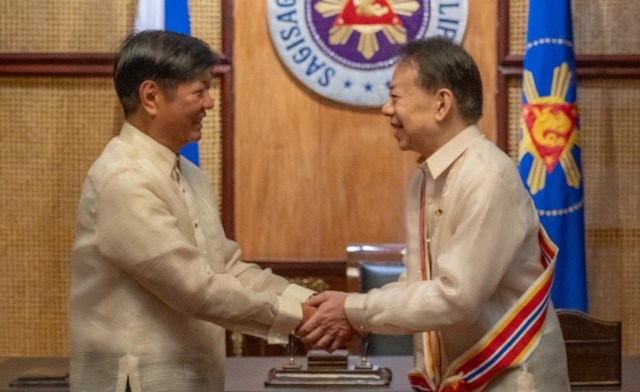
Photograph from ADB article “ADB President Receives Order of Sikatuna from Philippine President Marcos”.


 The Society of Honor by Joe America
well said
Thank you Bart. This is one where the article needs to be read entirely to get the point. Thanks for doing that.
Compared to Duterte, you are on point Joeam although I didn’t vote for the guy. Sana maging peaceful din ang transition whoever the next president will be.
Right, my sentiments precisely. And the main point is the last part urging him to turn the nation over to capable hands, and urging “us” to be sensible.
if peaceful man has good sense and foresight, he ought to help find a capable successor. if he gets the bad successor who is already undermining his presidency; abusive, and called him weak and ineffective, then all he the good he has done and the legacy he hopes to leave behind may well be jeopardized, usurped, dismissed and overturned.
Yes indeed. I hope he realizes that the best path to family redemption is through good deeds, not conniving deeds.
I cannot help it, you mention duterte kasi. he just turned 80 and dds are praying for his health, that he should be home. well, he can be repatriated if his health turned against him and duly snuff the living daylight out of him, then he can come home. in a box. sans ICC ruling. god probly have a hard job listening to both sides of the divide: prayers for his health vs prayers of his victims denied justice.
Ksmbahay, your words remind me so much of a combo of the late Teodoro Valencia & fmr Manila Mayor Arsenic! (my compliments, IOW :-))
I dont those two but I presume they were great men. sometimes, we filipinos think alike across the ages, kudos.
A BIG AMEN to that, ksmbahay!
Sir,
May I humbly ask what’s your take on the following:
Respectfully..
Thanks for the elaborate response. In order.
1. I wasn’t comparing achievements but style. Both are sensible people and frame ideas thoughtfully and constructively. Marcos has done good works, getting the Philippines off the gray list by closing pogos and other acts, has shored up defense and alliances, and run a stable economy. He is not chopped liver.
2. Use sensible rather than intellectual in an academic sense. I used intellectual when I could have used conceptual or sensible.
3, 4. Disagree. He’s done good works and is an active president.
5. You do based on reasonable understanding of a president’s demands and achievements. The point is that to expect a president to do it 100% your way or he is a “bad” president is poor critical thinking.
6. Yes, many hold that view. I think it fits the president into a pre-formed box rather than grasps his context and the difficulty of running the nation while reforming the family reputation. They’d do no different if in his shoes, I’d imagine.
7, 8, 9, 10 continue to recite similar criticisms of the President. I’d suggest, rather than taking the article as a pro-Marcos piece, you reread the last two paragraphs to grasp the point of the article.
As a further point, President Aquino did not end dynastic rule. It’s deeply imbedded in how Filipinos run things and relate to one another. To criticize Marcos for not getting it done falls into the realm of unreasonable expectations, for me. Asking him to admit the crimes of his father, while his mother lives, is another step beyond reason. The big demand is, I believe, that he repay 209 billion in taxes owed. But Duterte did not serve demand for repayment for over four years, so enforcement has lapsed. So who is going to pay 209 billion to satisfy critics? You’d pay it, if in his shoes? Hmmmm.
I don’t worry too much about those things. I want the Philippines to grow productive and sensible, and not remain embroiled in dynastic strife. His critics are attached to dynastic strife, I think. Stop conflating family issues with his acts as president, and encourage him, as President, to think about the nation past his term in office. Get on the building side of life, not the demolition work.
kung ako lang, I am past using ex pres aquino as yardstick of what a good president should be. pbbm is allowed to rule in his own merit and allowed to make his own mistakes. hopefully his mistakes are few and correctable. people can forgive if pbbm makes wrong decision when decision is urgently needed, but what people cannot forgive is if he makes no decision at all, slow and indecisive.
Terrific position to take.
Joe, has TSOH ever done deep dive on the the wisdom of constitutional provision of 6-year term for Office of Pres.?
No we have not. I tend to think revisions are extraordinarily difficult to get done, so just take the Constitution as a reliable “given”, and figure we need to work better at staying true to the intent of the creators, which was honorable.
I just asked Google Gemini to give me a summary of that matter and it answered:
“Understanding the history of presidential terms and re-election in the Philippines involves looking at how the country’s constitutions have evolved. Here’s a breakdown:
Key Historical Points:
Early Period:
Initially, under the 1935 Constitution, the presidential term was set at six years without the possibility of re-election.
However, in 1940, this was amended to limit the president to two four-year terms.
Marcos Era:
Ferdinand Marcos was notably the only president to be re-elected under the amended 1935 Constitution, winning a second term in 1969.
He then declared Martial Law in 1972, effectively extending his rule beyond the constitutional limits.
The 1973 Constitution and subsequent political maneuvers allowed Marcos to stay in power for an extended period.
Post-Marcos Era:
The 1987 Constitution, which is the current governing document, established a single six-year term for the president, with no re-election allowed. This was a direct response to the prolonged rule of Marcos.
This provision aimed to prevent the concentration of power and promote democratic transitions.
Current Situation:
Currently, the Philippine president serves a single six-year term and is not eligible for re-election. This is firmly established in the 1987 Constitution.
The vice president is allowed two consecutive terms.
Important Considerations:
The evolution of term limits reflects the Philippines’ complex political history, including periods of both democratic governance and authoritarian rule.
The current single-term limit is a crucial element of the country’s democratic framework, designed to ensure regular changes in leadership.
I hope this information is helpful.”
Very helpful, PiE! Thank you.
I’m imagining the twin version (AI & Quantum computers) of the Damocles sword will come earlier than current predictions.
There are already AI drones and a startup in Munich is one major manufacturer.
https://helsing.ai/newsroom/helsing-to-produce-6000-additional-strike-drones-for-ukraine
There is also a Munich startup that just test launched its first rocket in the Andoya spaceport in Norway. It blew up after 30 seconds but they will use what they measured to do better next time. Wernher von Braun also did a lot of tests on Peenemünde.
One of the three founders was a Munich student working on a Hyperloop project. There are many such projects globally. BTW microsatellites like those produced by the Philippines with Japan are student projects over here, no shade meant, no joke.
Interesting times in more ways than one.
I am both excited and scared of the future now.
It came out yesterday that the US is introducing more antiship missiles into the Philippines, fast and impossible to knock down, flying just above the water. Clearly China is viewed as an enemy state of the US, and the Philippines has real islands, not fake ones.
Thanks for the input sir. On first 2 points:
What’s your opinion if ProDem forces ally with him, do they gain leverage, or just help extend his rule? 🙂
Yeah we can be sensible to call him “sensible” without having to downplay his lack of competence and help normalize Marcos rule rather than challenge it.
Thank you.
most filipinos are not the challenging types, we are mostly passive aggressive types and we plod and plod and plod and daing ng daing, until change no matter how minor occurs. big things comes from little things. not siesmic to dislodge what has been tradition, but mild enough to rebuke. done with much love and smiles. allows for face savings too. they may get over it but bruised egos can be lethal and dangerous.
i understand the article is about about junior, the good he has done, amirable traits, etc.. i didn’t get the “know the prioritiies” part.. i could have throw a straight instead of a jab.
In my opinion, he is reactive more than proactive so builds because it is the correct thing to do. There are few visionaries in the Philippines I think, so this is not surprising. Even President Aquino was a tangible man. President Marcos is also more a showman and that is a strength in ways. Certainly it helps in international relations where he says the right things consistently. Closing pogos was a bold decision. Building out EDCA was a bold decision. So I don’t see the “failure” you cite.
What is your basis for saying he is incompetent? I don’t see it.
There is no “rule” that I can see. There is a second Marcos presidency. And how is saying he does some good deeds a normalizing of anything. Is objectivity some kind of threat?
Arthur wrote: “However, style / substance—a calm demeanor doesn’t erase weak leadership. A lack of bold decision-making is also a failure. Is Junior. truly a “builder,” or just maintaining stability without meaningful reform? “
I am more concerned about what he is doing that we don’t know about because of lack of transparency or as JoeAm reports “very little scrutiny of what politicians are doing.”
philippines is not so big a country to hide secrets or stymie scrutiny. we now have the internet and info come fast and thick, socmed as well, and almost everyone is commenter and opinion maker until they hit the wall of cyber libel.
secret deals are leaked and published, as well as shortcomings and misgivings sometimes by aggrieved politicians themselves. people talk and almost everyone has good idea of what politicians are doing. though we bid our time to air our side of the story. courts want evidence and fact, not innuendos. they are hard to get, but they can be gotten in time. we also have audits and cross checks and those who think they are smart try to delay the process. but they are gotten in the end. the higher they are . . .
You have the capacity to research things, which was also my point. It is not necessary to operate in a vacuum of knowledge, and then use that vacuum as the basis for projecting bad faith. That’s a classic conspiracy theory. Strive for facts rather than build out a theory that has no basis. Be fair to your homeland.
I understand. We need Junior. He may seek personal redemption. 🙂
Rhetorical differences between Imelda, Imee, and Bongbong, and this could indeed be a critical factor in the unfolding family dynamics. The difference in their rhetoric isn’t just a matter of style—it reflects deeper ideological divides and approaches to power within the Marcos family.Imelda and Imee’s Approach: “Go All the Way”
Both Imelda and Imee seem to favor a more aggressive and uncompromising path for the Marcos family, one that reinforces their dynastic grip on power and aims to restore the Marcos name to its full glory. Their rhetoric often reflects a call for strength, confrontation, and the assertion of power, which is very much in line with the authoritarian approach of the Marcos dictatorship era.Imelda’s Perspective:
Imee’s Perspective:
Bongbong’s Differing Approach:
In contrast, Bongbong appears to have a different rhetoric that’s more focused on political survival and long-term national stability, which may be less combative than what his mother and sister advocate. Here’s where his rhetoric diverges:Bongbong’s More Moderate Rhetoric:
The Tension Between Their Approaches:
This differing rhetoric is where the Marcos family may be experiencing some internal tension. On the one hand, you have Imelda and Imee, who are likely calling for total domination and a return to the days of unquestioned power, even if it means alienating the public or facing a backlash. They might argue that only by going all the way can the family restore its honor and defend its legacy.
On the other hand, Bongbong may be trying to walk a tighter line, balancing the need to maintain the Marcos brand while also preserving political stability. He might realize that pursuing a hardline, authoritarian approach could cause him to lose public support and destabilize the nation in the long run. He may be leaning more toward appeasement and moderation, hoping that a less divisive approach will allow him to consolidate power without generating too much resistance.How This Could Impact His Presidency:
If this rift within the Marcos family becomes more pronounced, it could complicate Bongbong’s presidency. He will have to navigate between his family’s more radical inclinations and the need to maintain political legitimacy. It could also influence the way he handles policy on human rights, the family’s wealth, and relations with the opposition.
If ProDems and Junior makes a deal, I’ll be happy. 🙂
Excellent points.
Imelda will be too old to soon and she is no JPE in terms of acuity.
Imee is indeed too emotional she almost had me with the way Digong was treated. I forgot the man did not care for human rights.
As for BBM. Like Joe I thought he had nothing in his skull(sorry to put words) and I am happy that I think I am wrong.
Wow, superb assessment of family dynamics, Arthur. My neck was cramping up from all the nodding I was doing. I think you nailed all three perspectives, two decidedly authoritarian, and Bongbong quite adept at letting the system work. I appreciate the detailed parsing of my broadbrush statements in the blog article.
Okay, you got me.. bigtime. This article can serve as a bridge for discussion, especially with those hesitant to fully criticize Marcos Jr. Brilliant! From now on, I’m reading with a criminal mind. 🙂
My knee-jerk reaction is from Ecclesiastes (to everything, turn, turn, turn; to every season, turn, turn, …) & THE SOUND OF MUSIC: Climb every Mountain; ford every stream, search hi & Lo, follow every byway every path you know; … 🙂
I like Arthur Lamigo’s thoughts on the subject. They show depth of understanding of the topic especially as related to the role of PBBM’s office and the needs of the country. I note especially his last statement: “The discussion should be about whether he is actively strengthening democracy, accountability, and governance—not just whether he is less reckless than his predecessor.“
The discussion should be about whether he runs the Executive branch of government in a way that improves the lives of Filipinos, not whether he is a perfect man or failure as a dictator.
I agree, and I see that as what Lamigo is doing. I don’t see him as not looking for a perfect man. I do seem him as holding whoever holds the office of president to a higher standard than what you propose. I hope you don’t hold that against him. 🙂
ahem, the sitting president sets the pace, the bucks stop with him and he sets the standard. we can all scream for higher standard, but it’s the president that decides what that standard is going to be like what is happening now. filipinos wants the president to rejoin ICC but the president says no can do. united states is not even signatory to ICC, as well as israel and china. and these countries are not doing poorly. we are maybe in good company, democratic as we are.
“ahem, the sitting president sets the pace, the bucks stop with him and he sets the standard.”
So much for “of the people, for the people, and by the people.” I remember back in my childhood, political banners declared: “Servant of the people.” I think on paper our politicians are considered to be public servants.
There is that expression: “Hold their feet to the fire.” That is another way of saying “hold them accountable.”
So while you are correct that the president sets the standard, with enough pressure from the people, we can get him to change his standard. But if we just fold because “siya ang presidente,” you can be sure he will set the standard.
Improving the lives of Filipinos is a really good standard, it seems to me.
That is a motherhood statement. The devil is in the details…i.e. or the action taken. How about the birthday cake to every citizen on his birthday? Didn’t the Mayor of Makati once have that policy? Isn’t that a way of improving the life of a Filipino – give him a cake on his birthday! That is of course an extreme, but hopefully it makes my point.
it is more than cake that the people of makati get from their elected officials. they have premium free health care and also have a higher standard of education than the rest of the country, their public high schoolers passed international pisa standard beating most candidates from private expensive schools.
after all what has been said, the people of makati are quite happy to receive those cakes, glad somebody made the trouble to remember them.
Every boss has a personality and way of getting things done. Every boss who is successful delegates and understands that subordinates must do things in a way that fits their capabilities. They can’t be clones of the boss. A nation’s President is both boss of his cabinet and subordinate to the People. A whole lot of people are unable to accept that he must do things his way. That makes them bad bosses. It does not make him a bad subordinate. Why be a “grammar cop” that finds fault with every preposition that does not fit Strunk and White’s style guide.
Agree! Thanks for the positive vibes.
our nation needs it. Encouragement.
peaceful man cannot rely on encouragement for there are time when encouragement stops and he is in his own dog house. and he has to take initiatives himself even if it makes him unpopular, his social rating lowered.
Thanks, Art. I’m glad you understand the main message. Some read the title of the article and assumed I’m promoting Marcos (over their interests).
I do hope their interest is not to divide our already much divided country. as celeb boy abunda says, be the change you want to be!
ahem, the peaceful man is probly bayot coz he has not killed anyone, haha. unlike his sister who has apparently ordered the killing of a student. kudos to peaceful man though people are still dying under his watch, specially now that electioneering is in full swing. of course we all want to live in peace and the price of peace is war: total annihilation maybe of opinions and ideas, etc. surrender. those who knew him knew his weakness, hindi raw pikon, yeah right. like a rabbit caught in car beam, stunned and unable to move. but situations call for action and thank god for minions, they got him moving – in the right direction.
The President cannot stop rivers or storms either. But he can move in the right direction.
I worry about things like the Maharlika Fund and the use of Phil Health (surplus?) funds. I was a teenager when Marcos, Sr. first came to power and things looked pretty good at first, probably because we young folk wanted things to look good. We did not look closely. Some people, I recall, hinted that “this man will not give up power, just you wait and see.” I think one of his mistresses actually said that, Dovie Beams? Not sure…just going from memory. This was before Sept. 21, 1972. But I recalled those warnings when Marcos declared Martial Law. What I am saying is that Marcos looked good in the early years. Marcos, Jr. is in those early years. I was fortunate to be resident of another country when the Philippines was bankrupt around 1986! Whew! My father lived in Germany in the early 30s with my grandmother who struggled with the tropical heat of the Philippines. He told me about how Hitler made the humbled Germans (Weimar Republic) feel great about themselves. He told me about how every German would be able to afford a Volkswagen and began a lay away program. But before many could get the car, they were called to “Serve the Fatherland!” Priorities needed to be set. Of course the cars never came, and they never got their lay away money back…it went to the Fatherland! So you will have to forgive me if I’m not impressed by shows of prosperity, and certainly not talk of prosperity like our dear Trump here in the US. Oh, let me add that many young German men in Manila proudly went off to good ol’ Deutschland to serve the Fatherland. These were friends of my father. He was back from Germany by then. He and my grandmother did not like what they were seeing in the 30s and decided to return to the Philippines where my grandfather was. “Deutschland über alles!”
Your view seems to be the most prominent. Extreme distrust of the Marcoses. Well-earned mistrust by the family. Maharlika itself is not corrupt, although it could be used to fund corrupt practices, so warrants scrutiny. The problem is that there seems to be little scrutiny of anything. PhilHealth is gross incompetence at PhilHealth, and not corruption. If Marcos intends to extend his term, I don’t see the vehicle by which he does that. When 2025 elections are done, all eyes will turn to 2028. So we can see what develops.
pbbm summat surprised me, he is not one of those presidents that as soon as they are thru inauguration, the 1st thing they actively promote is federalism and spends millions on consultants for feasibility studies.
He failed to live up to my expectations, too. I was expecting a clown but got a president.
yeah, and he tried to ply his father old axioms but people resisted. and he even tried to lessen the significance of edsa day but people did not buy it and went ahead and celebrate edsa day giving it the full treatment of a non working holiday. and pbbm had the grace to let it slide. admirable. he probly know now that for his presidency to be successful, he needs people’s support and approval, not their ire.
I wish he wouldn’t do those obvious things. It hurts his family’s reputation and extends the strife rather than cures it. It’s an insult to Filipinos, too.
But such “obvious things” reveal the real person that he is.
Only to a 100 percenter. Like Aquino was Mamasapano, Yolanda, and Dengvaxia.
Yep, I have temporarily muted a lot of FB friends from the Pink or yellow spectrum because they were too eager to find fault in Marcos Jr., not realizing that the tone towards PNoy by “the other parlor” or “the other marketplace” (of the National Village, of course) was similar. Recently, they have been gloating too much over Duterte’s imprisonment, not that I am not happy about that, but I always remember the old German saying not to count the dead until the war is over.
It makes it almost impossible to be honest, the meat chopper is so intense. The current article is an example. I’m in the mode of “influencer” to those who may have the power to whisper in the President’s ear that he could do well for his family by turning the Philippines over to a competent successor, something sensible to do. Yet the Marcos haters don’t read that message. They consider the idea that he is sensible to be objectionable. They’d rather hate than encourage the President to do a good deed, for the Philippines. Crazy.
Irineo, were you a critic of Duterte…and if yes, does that make you a 100 percenter?
I thought there would be a chance for him to find common ground with VP Leni which did not materialize and with time he and his followers showed their being 100 percenters so what chance was there to compromise, whereas Marcos Jr. so far respects due process.
Democracy IS about giving a common ground to different groups, but what do you do to those who declare everyone not on their side as the enemy? Democracy will of course have to shut out those who want to destroy it but how does one do that properly?
So if I am a Duterte supporter I can call you a 100 percenter because of your criticism of him. Of course you are not. Just because you have A criticism does not make you a 100 percenter. But JoeAm seems to make such assumptions, thereby distracting from the criticism. I have a cousin who is a Marcos, Sr. supporter and she sites the road building plans he made which were implemented by people who came after him. But I told her “yes, but he bankrupted the country!” She didn’t seem to mind that “detail.”
I minded. I probably would have loved the roads (I haven’t been on them since they were built), but I did not appreciate a bankrupted Inang Bayan. My cousin didn’t seem to mind. Was she right not to mind? Is her argument “well, nobody is perfect” acceptable? I’d like to say that is a rhetorical question, but maybe it shouldn’t be.
Ireneo wrote: “Democracy IS about giving a common ground to different groups, but what do you do to those who declare everyone not on their side as the enemy?”
Yes, that is a problem. It is also called compromise, or reaching a consensus. It is actually the definition of politics, if I am not mistaken.
When Obama was elected during the Derivatives Crisis, Eric Cantor who was one of the leaders in Congress in the Republican Party public told his fellow Republicans (and mind you this was during a national and even world financial crisis) “Everything that Obama is for, we must be against.” That was in December of ’08, even before Obama took the Oath of Office. Mitch McConnell, I recall pretty much said the same thing within a month of Cantor’s declaration. Of course what Obama was for was the survival of the country from the crisis, so I guess the Republican Party was against it. I recall the Republicans openly declared that they want Obama to fail, which would mean that the country would fail. That is when it was clear that for the Republicans, it was Party before country. Very bad.
Ireneo wrote: “Democracy will of course have to shut out those who want to destroy it but how does one do that properly?”
Yes, very difficult. One has to hope that the democratic institutions are strong enough to survive “the enemy within.” Mainly we have our laws and the courts. But ultimately we need knowledgeable and engaged citizens to put pressure on our public servants.
There is that new Testament teaching: “You shall know them by their fruit.” You yourself, Joe, acknowledged that he should not have done what he did. Why? What were his original intentions. Was it good for the Filipino people. If yes, why did he rescind or walk back his original intention. Enlighten us.
It is fruitless to speak to those who do not want to hear.
Thanks, Joe. You dismissed my questions. 😦
Yes, they provide no information, only demand that which you will invariably reject, as you have the other answers you were given. Right now you are in my “troll” box, so no need for me to enter the futile zone, which is not unlike the twilight zone now that I think about it.
JoeAm wrote: “Yes, they provide no information, only demand that which you will invariably reject, as you have the other answers you were given.”
Hmmm…reject, or disagree with? Is there a difference? In my book yes, there is a difference, hence two different words. I don’t know why you are uncomfortable with disagreement.
Well, disagreements from teachers, I appreciate. Disagreements from those pushing agenda are well worth ignoring.
On that we agree, Joe. 🙂
By the way, in terms of statistics, the blog has published over 1,800 articles and received over 175,000 comments. The most elegant disagreements with my writings were from the late great Edgar Lores. We’ve hosted Chinese trolls, Filipino trolls, and American trolls. I know trolls. We have genius commenters because they come here to be intellectually challenged. You are a smart fellow. I have hopes that you will enter the teaching mode, and give us insights, rather than the agenda mode of despising President Marcos for whatever damage his father did to you.
As further information, you did reject the speech to the UN by President Marcos because you don’t trust him. My guess is the speech, which was statesman-like and eloquent, was written by the same DFA official who wrote President Aquino’s speech to the Japanese Diet, possibly his best speech, and one that earned him a standing ovation from the Diet at the close. When you dismiss the President, you dismiss the bright, sincere, talented officials who give him his framework for good deeds. You diss the best of the Philippines because, well, it would offend you if President Marcos betrayed you by doing good works (along with some of the other kind).
c’mon, we cannot be siloed. even fruit trees are now grafted and what was once low bearing trees from bad stock, become highly yielding after grafting. same with people, life is lifelong learning and we learn all the time. forced by circumstances, or perish.
president bong marcos seemingly does not have the making of a dictator even if he comes from one. his good muscle coordination may last him his term, but he has not the mentality, tenacity and the brutality a dictator. he seems well aware of his limits and has no aspiration to be dictator. maybe because his father had hit the wall and the hard hat did not help him.
You say that there seems to be “little scrutiny of anything.” If Marcos, Jr. were as good as you picture him to be, what is the very very very first thing he would do “on the first day of my presidency” to use Trump’s “gulpe de gulat” approach? He would create the means by which EVERYTHING could be scrutinized. But he does not. Why? Well the New Testament says “Jesus is light, but men love darkness because it hides their evil deeds.” So that is why Marcos does not bring light to government in terms of scrutiny of public money and how it is spent. Because he is one among the many who love the darkness of lack of scrutiny to hide his evil deeds. You do not see how Marcos, Jr. can extend his term? How did Duterte hope to do it – with a relative! Isn’t that how dynasty politics works in the Philippines? I’ll stop at that because I am being too judgmental for one who does not live in the Philippines, and for that I apologize. I am just venting my feelings as one who loves the land of his birth and its simple inhabitants (not the complicated ones). My “kilala” Mar Tecson spoke of a “qualified Head of State” for the Philippines who, upon election, would appoint a Corruption Czar and Commissioner (I think that is the title) for the Commission on Audit, and this trinity of President-Corruption Czar-Commissioner would clean up the corruption in the Philippines to the tune of an estimated 700 billion pesos in savings annually (lost to corruption) and begin the progress of the Philippines to match that of many of its Asian neighbors who have left us behind in the dust. It is in Chapter 20 of his book “Inequality: Economic Tyranny.”
Now, having said all that negative stuff, I sincerely hope I am wrong and by 2028 have to give thanks to PBBM for his 6 years of service and eat crow. Believe me, I would love love love to do that!
When one starts with perfection as the standard, it is easy to throw rocks. Audit, COMELEC, the Legislature, and the Supreme Court do not report to Executive. The cabinet is a cumbersome committee and PNP and NBI were stacked with Duterte people. Marcos works through agency heads, some better than others. Journalists are a shallow bunch, not investigative. If the wealth fund invests in projects that send money off into peoples’ pockets, who will find this out? If the President is “in on it”, how are we to know?
There is the ideal world of fairy tales, and there is the real world of rocks and hard places.
I went back on Facebook to gin up circulation for the blog. Now I know why I left. If you write ideas, or strive to be objective and positive, you get ground to hamburger by people who start by hating Marcos and feed everything into their pre-formed grinder. They are a bunch of petty-ass dynasts who are defending their realm whilst complaining about dynasts.
At some point, we have to get past that and think calmly and purposefully. You might want to investigate the Wealth Fund yourself. Let us know how it works, what they are investing in, who is running things. Give us insights and data rather than rocks. Write an article. I’ll publish it.
As for the President extending his term, rummage through publicly available info. Are columnists writing about it? What happened to proposed constitutional amendments? What is the President saying about 2028? MLQ3 says Senator Tulfo is likely to be his pick to follow him. How do you expect me to prove the President is innocent of your conspiracy theory? I can’t do it. Conspiracy theories are nonsense. Get to data.
Thanks, JoeAm. My contribution is not to change the system in the Philippines or to solve its problems. I don’t live there, and I don’t vote there. I used to live there and vote there, but I had the opportunity to go to a better place and I took advantage of it.
My contribution is to point out what I see vs. what you see as you show in your article about the peaceful man our motherland has for a president. If it is in disagreement with your observations, then so be it. I see no need to argue, but I don’t see why presentation of opposing thoughts/ideas should be threatening.
You may label (and dismiss) my observations as throwing rocks with perfection as the standard for comparison? Are you throwing roses with a failed state as the standard?
BTW, your observation that the COA, Supreme Court, Legislature, and COMELEC do not report to the president ignores the power and influence of the president over these bodies, maybe not necessarily on paper, but certainly in practice. Am I wrong on that?
As to something PBBM can do to be even more deserving of roses being thrown at him, check this out from a crusader in the Philippines who has written to practically all our national government leaders including the President:
“To overhaul the deficient national anti-corruption program and address existing vulnerabilities to corruption, the Executive Branch should appoint a CPA and internal-control-specialist Anti-Corruption Czar who, together with competent systems and planning experts, should look at all government units as one entity, then define, integrate, and harmonize the roles of all anti-corruption offices, including COA, based on their respective legal mandates. If the Anti-Corruption Czar finds that COA needs to conduct partial pre-audit and it is not doing it, then the Czar should appeal to COA to do it. If COA will ignore the Czar, then the president, in appointing next COA Commissioners, should consider only those who believe in the wisdom of the COA pre-audit.”
Note for the layperson: The Pre-Audit is a step by the COA in the Philippines that it can prevent fraud by examining funds disbursements BEFORE the funds are disbursed, not AFTER. It used to be in our system, but some administration removed it. My man Mar Tecson has be laboring for it to be reinstated, but of course that would be like asking crooks to approve the stationing of policemen where they plan to do their work.
Yes, the President can interact with independent agencies. My sense is that he does not engage much at all with the independent agencies and with the Legislature in a proper non-intrusive way, or a constructive way to hammer out a budget that satisfies himself and legislators. He was opposed to impeachment of Sara Duterte but the House impeached her, so his influence is as it should be, a wish not a demand.
Critics of President Marcos, such as yourself, take the position that he cannot be trusted. They cite all the imperfections in the Philippines and the errors of government, in their eyes, and his failure to correct all the problems, as proof that he cannot be trusted. This form of argument lacks logic but is emotionally satisfying. The presidency is a hard job. It cannot produce perfection. So critics always justify their beliefs. My process is to look at his acts and identify what I think are good, bad, or risky decisions and total them up. It accepts that the President has reasons and data that we can’t know, and even makes mistakes. Who doesn’t? It starts with the premise of good faith, not bad faith. And it has no point to prove, just a conclusion to reach.
So my process and yours will always differ. Mine will frustrate you because I challenge your belief that he operates in bad faith, and yours will frustrate me because you have no interest in accepting his good works as a statement of who he is, as President. You are a 100 percenter, always able to show his imperfections as proof of your belief whereas I have to relentlessly detail facts that, when added up, do not cure the imperfections. I tire of the effort.
Critics can always throw touchdown passes while guys on the field throw interceptions. The reality is on the field.
“They cite all the imperfections in the Philippines and the errors of government, in their eyes, and his failure to correct all the problems, as proof that he cannot be trusted. This form of argument lacks logic but is emotionally satisfying.” You must be speaking of someone else because I’ve been away so long that I cannot cite all the imperfections in the Philippines and errors of government. What I do know of is the continued lack of transparency which hides the evil deeds of the thieves in government. For so long as a politician condones that lack of transparency by not addressing it EVEN IF IT IS IN HIS POWER TO DO SO, then I do not trust that politician. I think that is totally logical. What I find illogical is saying that it doesn’t happen because we cannot see it. Then when we finally see it, it is long after the money is gone.
Finally, what’s with the argument about looking for perfection? Is someone who is critical of PBBM at the same time looking for perfection? I don’t see that at all.
What I like to see is someone substantiate the reason for his criticism (like pointing to the lack of work on dealing with lack of transparency) and the discussion be on that if one disagrees. I don’t like it being dismissed as the critic looking for perfection.
Lamigo had a good point: >>The article suggests that as long as a president does things “80% right,” they are a net positive. But who decides this percentage, and based on what criteria?<<
I would like to suggest that nobody decides for everyone. Let each person give his opinion and substantiate why. I see no need to be dismissive of someone’s opinion, unless of course his substantiation is “because I say so.” I would not consider that any more acceptable than the argument “well you want 100% so bully for you!” (especially if it is not true.) 🙂
Which makes me wonder, who in this discussion wants 100% and wants perfection? Anyone want to raise his hand? I know I don’t. Hey I voted for Biden and God knows he wasn’t perfect.
You write nonsense. You give yourself an escape clause by not living here, say you can’t cite all the errors and imperfections, then cite the imperfection of transparency and the evil deeds of thieves in government. Haha, thanks for starting my day with a good chuckle. You are a conspiracy theorist who operates in the realm of suspicions and beliefs, no problem, much of the world does which is why Trump is your President and Marcos is ours.
Your answer to the 80% question was the same as mine. He decides. You decide. We each decide. There is a point at which dismissive is as much of a right as an argument, and that’s when nonsense is being dispensed.
Thanks for you comment, Joe….but I am really interested in your comment on this from my post: “What I do know of is the continued lack of transparency which hides the evil deeds of the thieves in government. For so long as a politician condones that lack of transparency by not addressing it EVEN IF IT IS IN HIS POWER TO DO SO, then I do not trust that politician. I think that is totally logical.”
I attach his speech to the UN that cites some anti-corruption initiatives. The COA is active in hunting out financial abuse. President Marcos will have the chance to appoint a new Ombudsman in August of this year, and hopefully his choice will be sound. Right now the Ombudsman does not help much. He has gotten the nation off the gray list for money laundering. He is cleaning up PNP and Immigration. There is a lot more, I’m sure. The biggest corruption is the way LGUs are funded through the House, and he is a party to this systematic way of dispensing taxpayer money to commission earning locally. It is historically the way pork is used, even under Aquino.
I’m sure there are other things being done, and you can research this as well as me.
https://pco.gov.ph/presidential-speech/speech-by-president-ferdinand-r-marcos-jr-at-the-5th-state-conference-on-the-united-nations-convention-against-corruption-uncac-implementation-and-review/
JoeAm wrote: “I attach his speech to the UN that cites some anti-corruption initiatives.”
I prefer independent resources. But thanks…
LOL. You are not here to learn, but to resist learning.
https://www.unodc.org/roseap/en/philippines/2024/09/fight-against-corruption/story.html
https://thediplomat.com/2025/02/philippines-removed-from-watchdogs-money-laundering-grey-list/
JoeAm, you seem to be promoting the small stuff and avoiding the big stuff, like transparency. When I was a little boy in the 60s, I noticed that in the little town of San Juan (where Erap was once mayor), during election season, city roads would get paved over with concrete. Asphalt was no good because it couldn’t survive the first rainy season. There would be signs posted by the incumbent mayor running for re-election: “This is where your taxes are being spent.” So I guess people were expected to re-elect him because he paved their street formerly full of potholes. What good had the other candidate done for the people? As best they could tell, from the paved street, nada!
But I’m an old man now and have seen a few of those rodeos.
Here in the States, we recognize the language of the MAGA folk, regardless of which part of the country they are from, and whether it is industrial, agricultural, urban or rural. They sound alike! Why? Because they drink from the same news well. Like you, they would say “Of course Trump is the best president we ever had. Just listen to his speech about that the other day!” 🙂
So you can mock my goal of learning all you want. Freedom of speech. Us Pinoys are used to that. Learned it from the Americans under their tutelage.
Transparency: https://opengovasia.com/2025/02/07/the-philippines-committed-to-transparency-and-digital-reform/
Joe, from the first article you gave a link to, which was a UN report (in other words it goes out of its way to be diplomatic in its language), it ends with this: >>While enacting this new law is a significant achievement, further efforts are essential to ensure its effective implementation, Marchesi added. “UNODC stands committed to supporting these efforts, working alongside the Philippines to achieve the desired impact.”<<
We Filipinos know that caveat all too well. “Effective implementation” is key. You have to tolerate some of us who insist on vigilance of all our political leaders, and Marcos, Jr. just happens to be the president. I guess you label us “100 percenters,” well so be it. You know, historically, the Spaniards labeled us with the pejorative “indios” because they said we were “a servile and supine race.” So as not to distract from his message, Rizal embraced the derogatory label and stayed focused on his message. He did not want to be distracted by the minor issue of why we were not “indios” or a “servile and supine race.”
Due to general distrust and heavy criticism of PNoy, the Philippines got Duterte, and that is remiscent of the old folks saying “ang masyadong mapili nakukuha’y bungi”. The one who is too picky will get a toothless partner. In the case of Duterte ang nakuha’y panget. The Philippines got a President ugly inside and out. The danger now if one goes too far in criticizing Marcos is that the Philippines might get Inday Sara and become a Chinese satellite. Oh well some Filipinos want to be Little Brown Brothers of China now, definitely these exist.
Ireneo wrote: >>Due to general distrust and heavy criticism of PNoy, the Philippines got Duterte, and that is remiscent of the old folks saying “ang masyadong mapili nakukuha’y bungi”.<<
Was it due to a general distrust and heavy criticism of Leni Robredo that we got Marcos, Jr.? What are your thoughts on that?
Hindi pangit si Marcos Jr. pandak lang hehe.
Oh, all Filipinos are not 100 percenters, there is no racial tinge to my comment. There are Filipino lovers (Robredo followers), Filipino haters (Marcos haters), and Filipino analysts (Irineo, Karl). One cannot criticize a lover’s idol without getting condemned, one cannot praise a hater’s target without getting condemned, and you can say whatever you want to an analyst and they will listen and teach, if they disagree. You are a hater. Your filters reject information.
Duly noted, JoeAm. I’m a major Rizal fan, which is how I stumbled upon your blog not too long ago. It came up in a search. Like Rizal, I will follow Rizal’s strategy with respect to distractions. I hope you don’t mind. >>So as not to distract from his message, Rizal embraced the derogatory label and stayed focused on his message. He did not want to be distracted by the minor issue of why we were not “indios” or a “servile and supine race.”<<
I continue to learn a lot from a lot of contributors to your blog – notably Joey N., Ireneo, Kasambahay, and Karl. Thanks for providing a platform.
Well, they are teachers, after all. I’ve learned nothing from you, but thanks for visiting the blog.
Trump is copying the Maharlika fund.
https://www.whitehouse.gov/presidential-actions/2025/02/a-plan-for-establishing-a-united-states-sovereign-wealth-fund/
I’m just glad hegseth has confirmed america’s commitment to our country that our friendship will continue on, and that edca sites will be maintained with an offing maybe of an additional typhoon missile. as for our very own sovereign fund, there is no report of its robust activity to date. as we know full well, it was fool’s gold to start with, haha. natalano.
When Duterte won I congratulated him on FB and my relatives in Davao thought I was sarcastic….maybe half of me wanted him to succeed and the other half is worried that he might succeed in doing the wrong things.
As for BBM, man his sister is playing to emotions and got the support of Jinggoy Estrada on how former presidents are shabilly treated. If I am a former president, I do not want shabby treatment too.
Arsenic was mentioned..there is this nasty unmentionable rumor and i will leave it at that.
even PNoy was shabbily treated. that’s assumably a common bane of public office. once they’re out of office and no longer in power, they tend to lose not only friends and but also influences, their status lessened. we cannot be forever worshiping them and giving them unreserved dues now given to new incumbents.
yeah, they must have missed having all that adulation, always feted anywhere they go, and things are done for them. sad that good things do come to an end. and all they have is their legacy, buildings and streets named after them and if they are lucky, a statue and lifelong pension. not court cases and lengthy prison sentence.
but if they behaved well, they can run for public office again and be voted in. be congressmen or senators, or mayors, or governors, the choices are plenty. they dont have to mope and feel sorry for themselves. they can get up and go and become actors and celebrities, be endorsers. but if they have done bad deeds, people have long memories.
Right on point.
I wish the President good health so he can do the job he was elected to do well. The Dutertes are not emotionally well it seems to me. Something to do with egos in distress. Imee possibly has the same condition.
imee seems to want attention and seeks it anywhere. she once lamented she and the president havent spoken for a while now, that the president is busy and being rushed to schedule and has not time for almost anything. that is maybe true, but if imee really wants to talk to the president, she can book a one on one appointment with him. or she can be supportive of him and may even be rewarded with some alone time with him.
When you speak of Arsenic, are you speaking of former Mayor Arsenio Lacson? I was a child when he was Mayor of Manila. But up to that point, I believe he was the only mayor of Manila to leave the city in the black. Of course he left prematurely because he died.
Yes, one and the same. I was in grade school at the time. The lasting legacy he left was the sobriquet of “the City’s finest” referring to the Manila Police Dept.
Yes I do not know if this is where I read that he had an affair with Imelda.Arsenic that is.
The circumstances of his last days were happy & sad. Only my guess.
I was not a supporter during the 2022 election and still don’t think Marcos Jr. is an ideal president, but what president is ideal? Idealism exists only in the mind and without recognizing that one is no better than the delusions of far left radicals and often reactionary dynastic forces.
But how should we as ostensibly lovers of liberal democracy approach idealism? Idealism is the goal we strive to get towards. The fact that the goal always seems out of reach is the basis of idealism in the first place. If idealism is seen as a goal to strive for, then being able to snap one’s fingers and instantly arrive at the destination defeats the purpose of idealism in the first place — and such lazy sentiment is why the yearning for a “good dictator” to validate one’s lazy delusions can be popular, a mental laziness that not only affects many Filipinos, but also many Americans and Western Europeans. Liberalism was invented to move humanity away from these “good king” delusions. Not being able to commit to a citizen’s minimum duty of exercising voting franchise and being a participatory member of democracy makes one no better than past peoples who accepted a king’s sovereignty to have come from the divine.
That being said, leaders should be held accountable to whether the leader brings the body politic closer to the ideals of a nation or not. We no longer live in the Dark Ages where peasants obeyed their kings unquestioningly regardless of ability. If we are to recognize our own human frailty and failings, then we must also recognize a leader is also human. What should we then look for? A leader who recognizes his/her own human limitations and delegates to capable subordinates what he/she cannot directly do himself/herself. Otherwise we end up with showmen like Duterte, Trump, Berlusconi, Bolsonaro who are highly entertaining at playing the part of men of action but are completely incompetent, even malevolent.
If one works along the lines of this criteria, then Marcos Jr. is not so bad. Marcos Jr. hasn’t purposely broken anything, and he seems to have the capacity to understand when he has made mistakes (though perhaps he shares the unwillingness to admit to failures like some Filipinos) and change course. Would Leni have been a better president? I think most reasonable lovers of liberal democracy who care about the Philippines would say, absolutely, Leni would’ve been a better president. But we need to work with what we have now, not what we think we can get in the future. Just as a president guides the nation, Filipinos need to guide their president and hold him/her to account in a representative democracy. While at it, Filipinos should hold all their elected officials from local, to provincial, to national levels to account.
The biggest mistake is to judge someone against a past (possibly untrue) ideal. In the Philippines, this often is colored by ill-formed ideas shaped by state propaganda of previous republics that shaped a confused mess of a national mythos. As such by that measure, no president could ever hope to satisfy the mental ideal. There have been 7 presidents thus far in the Fifth Republic, and presidents of the Fifth Republic should be judged on whether they had pulled the Filipino people forward or dragged the Filipino people backwards as it relates to their Fifth Republic predecessors. By that measure, Marcos Jr. has pulled the nation forward even if the distance achieved is debated or minimized. It is up to the Filipino people to demand, and help, give Marcos Jr. (and any president for that matter) to have the courage to do more.
Minor cut-paste error that might change context:
“Idealism exists only in the mind and without recognizing that one is no better than the delusions of far left radicals and often reactionary dynastic forces.”
Should’ve been:
“Idealism _especially absent personal positive action, sometimes_ exists only in the mind and without recognizing that one is no better than the delusions of far left radicals and often reactionary dynastic forces.”
Joey, you read my mind. I had barely time to gather data nor sort them in a meaningful way. You got the words & the music. Lent is a good time for these. 🙂 In my opinion anyway.
Thank you Sonny ☺️ I’m currently hosting 4 priests at my home, family friends of ours. 2 from Rome, 1 from Hong Kong, 1 from the Philippines. 2 are Dominicans, 2 are Jesuits, so I’ve adopted a Franciscan position here hah!
How I wish I had been under History classes taught by Fr Schumacher SJ during my Loyola years … (sigh) I’m imagining him explaining the difference between Propaganda Fide implementation from Rome for Vietnam (French) & the Philippines (Spanish/American).
We are both so lucky in the education we received. After parochial school, I spent 4 years under the tutelage of the Servite Order. The good friars encouraged an open mind, spiritual and mental exploration, and taught us everything from the sciences to theology to history and the arts. At times we were even encouraged to challenge the Canon Law through debate, and consider the positions of Abrahamic and other religions.
Seems mas maganda sa LaSalle; my high school buddy said his Engineering teacher there was the brother of Kim Novak. Can you visualize Kim Novak visiting her brother the Christian LaSallite Brother. BTW my nephew also went to Servite, Orange County. 🙂
I’m an alumnus of that preparatory college, Servite. I’m not sure about how things are there now, but during my time every Servite Man was expected to be a scholar-athlete. I played a number of sports and between Servite and Mater Dei, we crushed other high schools at the regional and state level to the point that the other high schools revolted at our membership in the conference hah!
The Pope beat you to it. I thought he chose the name Francis bcoz of St Francis Xavier SJ; ‘yun pala it was St Francis of Assisi (OFM).(Ang galing!)
I did read before that the Pope chose his pontifical name for the very reason of bridging the more minor rivalry between Jesuits and Franciscans. I for one am glad Pope Francis, however imperfect as a man, tries to lead by example the values of our Church.
The confused mess of a national mythos that you mentioned is evident when speaking to different generations of Filipinos. They often embody the national mythos, including its ideas, prevalent in their respective youths. Sonny for instance is the Third Republic personified as he was born in 1944 and left for the USA in 1968 or 1969, one of the last to take the boat all the way to San Francisco via Guamn and Hawaii, meeting Ilocanos on both stops. cdvictory seems more like someone born in the 1950s to me, one who absorbed more of the First Quarter Storm era that resisted Marcos Senior. Will Villanueva also is a 1950s child who was part of the Diliman Commune but didn’t leave like cdvictory and thus is a true yellow EDSA 1986 veteran.
Karl and I are both Gen X, but of course, I left. When Marcos Jr. won in 2022, I had to deal with OK, I left in 1982, 40 years ago, the old country is a different place now, let me get a feel of how. Most don’t reexamine their way of seeing the world, but I have been forced to so often in life.
Ninotchka Rosca was right when she called the Philippines the Land of Constant Beginnings.
Everyone is a product of their time, and it is hard to let go of youthful idealism. See how privileged White American leftists still cling to their tired “hey hey ho ho” chants, 60 years on (which ironically was appropriated from an African American Soul song no one remembers anymore). The Philippines far left still promotes the same “anti-imperialist” slogans while curiously aligning with actually imperialist PRC and Russia. The more privileged among us often fall to delusion and become radicals or reactionaries, or worse, nihilists. Many of the American anti-war protestors of the 1960s ended up becoming the worst reactionary figures in the US that birthed Trumpism.
We are reduced to becoming complainers and anti-progress when there is no effort in introspection and progression. It would be wise to protect gains however small, then push for more, rather than becoming a 100%’er and getting nothing at all. As a progressive I want all of the things, but we must also live within the reality of our time.
It’s up to us to deploy better arguments and move the body politic’s center towards us and how the commonality of the 80% benefits the greater good. In essence that is what I believe the true meaning of the American (and indeed, liberal universality) to be — getting the 80% wins one after another, and over time we collectively get closer to 100% even if we don’t quite become perfect.
I guess the difference in the Philippines is that different groups and sometimes even different generations barely manage to communicate, thus the big picture is missing, there is little common perspective.
Of course that common perspective has broken down in the USA now but there a probably two continents there now and not many islands of perception like in the Philippines. In Germany the dividing line is where the old border ran through.
filipinos overseas are not that friendly to fellow overseas filipinos, though they readily smile at foreigners but rarely accord the same to fellow pinoys. but pinoys are seemingly aware of one another but hesitant to connect like they dont want to give much of themselves. unless they have to, thrown together by circumstances like when they are in hospital and the nurse is filipino and asking where in the philippines they come from. small talk, better than staring at the wall. beats boredom.
Every country has its “original sins.” For the US, the original sins are a fear of confronting the disconnect between the legacy of slavery in relation to the stated ideals of the US Declaration of Independence and the US Constitution. For the Philippines, the original sins are the inability to accept that non-Tagalog groups were not commensurate partners in expression of political power since the Philippine Declaration of Independence and chasing irredentist fantasy rather than valuing actual contributions of Filipinos more.
From my vantage point, there is a big disconnect between elites in Philippine society and the vast majority, something I mentioned yesterday to a visiting Atenista. Well, she corrected me that Atenean is preferred nowadays, which shows how I myself identify with an older way of thinking in this regard. In order to progress and grow, one needs the capacity to process and absorb new ideas that complement and clarify prior knowledge. Too often, thinking can calcify and become resistant to change. It often takes momentous change in order to “break the funk.” It is up to us to remove rotted pieces of edifice and replace it with something new and stronger, or feel temptation to attempt tearing everything down to build anew. It seems to me that building upon existing foundations, however imperfect, has higher likelihood of success than reengineering everything.
I was a BEDAN (San Beda, 1959) in high school; Bedista, 1980; Atenista (Ateneo, 1967). All trivial changes. Joey, my niece went to Mater Dei also.
I was reflecting in the shower about Tomas “Buddy” Gomez earlier today. He had to leave the Philippines due his position in business that ran contrary to Marcos, probably the early 70s. But he remained engaged and wrote newspaper columns regularly. He became a mentor to me early on when I was struggling to defend Aquino and calmed me down. He knew I was about to quit writing. He arranged a meeting in Tacloban, with my wife and JoeJr there, and said my writing was important, and to ignore the emotionalists. What an enlightenment that was. He died a few years ago. The old souls are a deep, rich, beautiful part of the Philippines to me.
Joe, Buddy Gomez was a colorful personality on the San Beda campus together with Rene Saguisag & Raul Roco. I was a freshman then. The San Beda college community was small healthy size Liberal Arts tertiary department where disciplines easily interacted with each other. Of what I remember Buddy, I am not surprised that you intersected in outlook.
didnt buddy gomez writes the cyberbuddy blog? it is sad that buddy gomez died, had he lived longer and known that the son of the dictator he had so detested has become president, I would give my shoe collection to get his verdict on the before and after. and had buddy gomez lived longer still, he might have been commenting here too and maybe, just as exasperating as some.
Yes, that’s the man. He seemed the realist to me, so would not have had apoplexy, but rather a huge dose of skepticism.
It is a small world, and the early days of blogging introduced us to each other. Rather a writers’ playground.
“… Sonny for instance is the Third Republic personified as he was born in 1944 and left for the USA in 1968 or 1969, one of the last to take the boat all the way to San Francisco via Guamn and Hawaii, meeting Ilocanos on both stops …”
Truly the genuine historian that he is, Irineo (aka PiE, Pinoy-in-Europe 🙂 ) does not forget. Neither does Karl (aka TSOH Tanod). Cards on the table: I’m a Scorpio vintage 1943 and I do qualify seniority since I haven’t heard from NHerrera lately. I do not know Ms. Rosca personally but I believe she belongs to our “era”. Another contemporary used the term ‘inchoate events’ to describe the PH zeitgeist of those times. I came to Minneapolis/St Paul in 1969 and promptly got a 1Y draft classification. My younger brother following 2 yrs later took a 1-A. This was the major circumstance that affected one’s future as a migrant during the Cold War. Looking back, I’d call it the first “homogenizing” filter into American life. The family push-out factor was economic angst & a strong hope for better ‘things’ and some sense of adventure into the unknown.
thank the lord, our Irineo is not one of those PiE that took to the street in netherlands and greeted duterte on his 80th birthday. have I been there in netherlands, I would have heckled them, and digong’s supporters would probly rearrange my god endowed biometrics.
🤣😂🤣🏆 You really should be writing a book.
Well put. Ideals are a target future path and accountability is the method of adjusting actual performance to the vision. Pragmatics are the realities of incompetence, China, budgets, winning elections, and all kinds of surprises. Or it’s a case where the President has better data than we have, or has opposing positions among his advisers, and so takes a decision we do not understand, in good faith. I personally never understood why President Aquino did not clean out Customs, but that didn’t make him a bad president.
I reflect upon the continual American obsession with the Kennedy dynasty as an example of delusional idealism that is not helpful. JFK and RFK displayed handsome youthful vigor, and embodied the possibility, yet it is doubtful if JFK had not been assassinated could’ve and would’ve pulled the US far forward. It took his cranky Texan VP LBJ to progress far forward, then LBJ got killed politically for it by both the left and the right. Obama, the modern JFK, in his 8 years had numerous opportunities to pull the US far forward towards the ideal with his initial supermajority yet chose not to. Obama’s stuttering and often ridiculed VP Biden did more in 4 years with slim majorities than Obama ever did, and got killed politically.
In the Philippines, Cory Aquino literally saved Filipino democracy and was killed politically because she refused to become a martyr. Her son PNoy pulled the nation kicking and screaming towards a better future yet all he did is often downplayed and dismissed because he could not achieve the impossible demands of the left instantly.
If this is how the liberals and left behaves, I’m not sure if power is deserved. But I guess it’s easier to be a purist that way. Protect gains however small and march forward.
I’m increasingly convinced that the right way to go for the left is for economic populism targeted towards the majority a la FDR, which in the Philippines is the DEs. Better jobs, better schools, better infrastructure to facilitate domestic and foreign trade will lift all boats, including the middle class and tycoons. Liberalism has had a decades old illness of out of touch “pilosopo” mentality while being too cowardly to be loud throated in their own convictions which pushes many people away. Voters understand common sense proposals that affect them directly. The emphasis should be on that for 2028.
konting correction lang po: cory aquino died in makati medical center of cardiopulmonary arrest as complication of colon cancer. her husband ninoy aquino was shot at manila international airport and died at the tarmac. he was democracy hero and his death triggered edsa revolution, the bloodless people’s revolution, that catapulted cory aquino to presidency.
Cory did not have to accept the challenge to run for president when Marcos, Sr. called for a snap election. But she did…
Then, she lost the election. Of course it was rigged, but who is going to prove it? She could have pulled a Leni and tell her supporters to accept the results. But she didn’t.
So did she “save Filipino democracy” as Joey N. concludes? I believe so.
Contrary views welcome.
You broke my metaphor KB! 🤣
many filipinos are allegic to the word killing as in gone and deadier than a dodo. though many are spiritually bankrupt.
maybe I am spiritually bankrupt too when asked why digong’s supporters are massing in netherlands. porbida, dds are so like pro-palestinians raleyistas, minus the campus occupying thingy though dds have occupied the space dutch police had set aside for them, else dds will be herringboned and pelted with gherkins! if dds thought their sheer number can intimidate ICC and release duterte and send him home, they really must be desperately bored and in need of entertainment.
I had not considered that. Thanks KB. Btw, when I first learned the word “kilig” long ago, I thought it was a misspelling of “killing” 😅
I am gladdened to see that it seems the amount of Filipinos who are willing to outwardly DDS seems much less. I chuckled a bit about a story out of Danao, Cebu, the former Duterte stronghold before they migrated to Davao, where the fan club appears to be more comedic than dangerous.
Love your insightful posts, Joey. You wrote: “Marcos Jr. hasn’t purposely broken anything, …”
That is as far as we know. But our ability to know is limited because of the lack of transparency in government. As JoeAm has said, there is minimal scrutiny. My doctor “kilala” in the Philippines likes to exclaim: “Nobody goes to jail!”
Did Duterte plunder the government treasury? If yes, when did we know? Up until that point, were we only able to say “as far as we know he hasn’t stolen anything.”?
My CPA “kilala” in the Philippines says that the Commission on Audit used to have a step in the process of disbursement of funds called the “Pre-Audit.” As you know, an Audit checks on where funds went. A “Pre-Audit” checks on where the funds are going, AND I believe, takes steps to make sure that they go where they are supposed to go. He was dismayed when that “Pre-Audit” process was removed. Basically the government (don’t know who) said that we will just do an Audit, i.e. wait until after the funds are disbursed and maybe lost!
My CPA buddy, who is familiar with corruption in the Philippines (in the public sector AND the private sector) and tries to fight it, says that is not the best approach. He says that even if you determine that money was stolen, it is difficult to recover. As the doctor “kilala” says: “Nobody goes to jail.”
Now if seeking the return to having a “Pre-Audit” process (as my CPA buddy is currently fighting for as a citizen of the Philippines) is being idealistic, that means that when we had the system before, the Philippines was in an ideal state.
My point is, people like my CPA buddy are not seeking idealism. They are trying to fix broken things to make life better for more Filipinos, especially those who are not in a position to steal from public coffers. For me, bringing up idealism is a Red Herring.
One of the things I like about that CPA kilala of mine is his term “solutions that are doable.” In the discussion recently of defense “solutions” or “suggestions” for the Philippines, I could feel that many of the suggestions would not fit his “doable” pre-requisite. He worked for many years in the Philippine National Oil Company Group, in the accounting department. I believe he was a sort of auditor and one of his functions was to make sure that company funds went to the right places, i.e. were not stolen.
there are times when I do really really hate cpas! they helped the kuraps here hid money and even launder for them. so very good in hiding and cooking books, creating false accounts and entries and ledgers. so conniving with their bent clients, the sods. cpas are like lawyers, they have ethics code and conveniently chop chop them! and once cpas and lawyers put their heads together, internal revenues have massive headaches.
anyhow, plenty goes to jail for corruption now, found and convicted, except that they sometimes disappear before they can be put in the van and have thier mug shots taken. else they plead sick and ask for hospital arrest, have wheelchairs and neck braces and ply for public sympathy.
This CPA I am speaking of wrote a book: “Inequality: Economic Tyranny”
In his introduction he writes: “Managing the economy requires the collective efforts and expertise of professionals representing various disciplines…”
There are times when we hate CPAs, or Economists, or lawyers, or engineers, or architects, etc. etc. I am totally with you on that.
And then there is a nation to build….the task is daunting, but becomes easier with the “collective efforts and expertise of professionals representing various disciplines.” We, as a people, have choices.
To use your example of a CPA making sure there is accountability in a private or public company, the mechanism of accountability to elected officials including the president ultimately is the people. Assuming a conspiracy within the government, if there’s one thing I learned growing up around conspiracists (gangsters and criminals), is that no actual conspiracy hides from the sunlight forever. Eventually someone will feel guilt and break, or we will have boastful elements act loosely. So no, I don’t believe there is a grand conspiracy in the Philippines government; much of the corruption in then Philippines is actually quite blatant and not hidden. If Filipinos want more accountability in government, then Filipinos need first to have accountability to themselves, and it is incumbent on Filipinos who are privileged with education and positions of responsibility in society to teach in a respectful way to those who lack that privilege. Otherwise there’s no way to organize and convince 93% of the population.
My musings on Philippines idealism is in relation to Filipinos being in my estimation a quite idealistic, sometimes unrealistic, people despite pragmatism on everyday matters. Any nation has its own national mythos, with the Philippines being no different. As a non-Filipino who studies historical trends, my issue with the trending through lines of the Filipino mythos is a lot of it was based on constructed ideas of lost greatness in comparison to other peoples of other “great” nations. Irineo and I had discussed at times how stories were made up whole cloth by certain academic schools of thought that often were absurd to any reasonable people. Fundamentally the Philippine national mythos as taught for decades and understood in corrupted form by many regular Filipinos is an irredentist one, and irredentism most often is bad as it is the source of many excuses. I’ve also pointed out great things about the Philippines that can form the basis of a new ideal and mythos, that are based on actual great attributes of various Filipino cultures.
Joey N. wrote: “So no, I don’t believe there is a grand conspiracy in the Philippines government; much of the corruption in then Philippines is actually quite blatant and not hidden.”
I agree. I think what we have in the Philippines is what we call “the system.” Filipinos generally describe this system as corrupt, not as a conspiracy…not even a corrupt conspiracy. It is described, as best I know, as a corrupt system. And it does work. The Philippines is a viable country among the family of nations. It is not a failed state.
If the way of governance in the Philippines is described as “the system,” then that system exists because it is reinforced not by a dictatorship but by the will of the people as expressed through their votes. Now it can be debated if the collective decisions of the people are sound it not, but if the people are to vote in the direction we purport to be “better,” then the people need to be convinced. Since the advent of liberalism and that political theory’s prevailing acceptance in societies, the way to convince people is to respectfully educate them so they can freely come to the correct conclusions. Failure to do so is the fundamental weakness of liberal elites everywhere including the Philippines.
I often see Filipinos in the Philippines as common sense people. Even weird beliefs and prevalent conspiracy theories seem ”common sense” at face to ordinary Filipinos. To go back to the example, greasing the system with bribes and corruption seems “common sense” where there exists so much red tape and inefficiencies. Where endless requirements and hoops to jump through block economic progression and ease of employment for even those with college degrees, the “common sense” solution is to gain advantage through backers in the padrino system of nepotism and cronyism. And so on.
To change that, people need to be educated in the benefits of change. People need to be treated with respect regardless of education or economic status. Otherwise humans tend to keep doing “what works.” An example from one of my early trips is I met a farmer in Isabela, and though I am not an agriculturalist I have a lay man’s understanding of more modern techniques from my education. Our group made some suggestions, rolled up our own sleeves and demonstrated a different way of doing things, and the result was after the next harvest the farmer realized if he changed to our suggestions he would increase his crop. Liberal and progressive elites in Manila and major cities, no matter how well meaning, just seem like out of touch elites to regular people trying to get by when the “better way” is preached. People respect someone who is not maarte and can get their hands dirty, so to speak. People don’t see it as the elite stooping down to their level, they see it as the elite being willing to stand on the same level and have an interest in learning.
Joey wrote: “If the way of governance in the Philippines is described as ‘the system,’ …”
How have you heard it described among your friends back in the Philippines? Up until fairly recently I still read Filipinos say it is “the system.” Just curious.
Sure, I still hear “the system” expression in the Philippines from time to time. Ironically as ever, the term was a Filipino adoption (and misunderstanding) of the term as used during the US Counter Culture Movement of the 1960s (which appropriated, and misunderstood the term as originally used by African Americans of the prior Civil Rights and Black Power movements). But some things always say the same: those who use the term then, and now, *are* the privileged few who have the capacity and capital to make large changes to the so-called system, yet use their energy to complain fruitlessly against challenges to their own worldviews. Filipinos in the Philippines who I encountered using the term “the system” invariably are elite youth with left leanings colored by a watered down version of decades of Filipino far left ideology, neither being fully committed to the tenets of Joma, while also not being committed to making a personal sacrifice that builds up into collective action that precipitates actual change. So to me, as someone who used to live in poverty, such terms as used are quite silly.
Thank you, Joey….so we have what we have in the Philippines…some would call it “the system”….some would call it something else. I remember back around maybe 1973 or 1974, I was in college then at the nice Ateneo de Manila in Loyola Heights, having the time of my life as a middle-class clueless college kid that did not have his own car, took busses, jeepneys and tricycles, etc. etc. The Osmond Brothers came to the Araneta Coliseum and my barkada and I decided we would treat ourselves to this show. We bought the cheapest tickets, did not bring dates…heck we were starving students so who needed that extra expense.
We were shocked when we got to the parking lot in Cubao as the bulk of people showing up in the parking lot in super nice cars and fancy clothes and all were Chinese! They were dressed in the nicest clothes, as were their dates…beautiful people, big smiles, lots of laughter, etc. etc. We all wondered where all these Chinese came from?! Sure there were some in school, but not a majority as we saw that night in Cubao….and certainly not so dressed up and looking so elite. I’m sure they would have not been caught dead in the bleacher section where we sat with their dressed up lovely dates!
My point is that I took a mental note of this “hidden” class of people that I was quite clueless about. I had some friends from this group…they generally were graduates of the Chinese Jesuit school called Xavier School or “Kuang Chi.”
After graduation, I and my barkada observed another thing…our Chinoy school buddies did not ask as we brown folk asked “Where are you going to work?” Instead, we noticed, they asked their fellow Chinoy school buddies “What business are going to be in?”
This system that that was the working world we were going to be entering, which was quite corrupt and, in many instances not merit-based, was one in which the Chinoy community seemed to thrive in, despite the fact that we Pinoys were quite racist about these “Intsik” as we called them. I ended up in the insurance field in the later 70s. I recall the top insurers at that time were companies like Phil-Am Life and the Ayala companies Insular Life and FGU Insurance for the non-life stuff. But I believe the next 3 in the top 5 were Chinese owned (Chinoy owned) Insurance companies like Malayan is one I can remember, maybe there was one called Prudential…I’m not so sure anymore. But we felt how these money-based businesses were growing and it did not seem too long before they would occupy the top two positions if not later the top 5.
So to the many elite as you speak of, who use “the system” as an excuse for the backwardness of the Philippines compared to many of its neighbors, I would pose the question: Why do the Chinoys seem to thrive in the same corrupt system? I don’t recall ever getting a straight answer. Do you have any thoughts on that?
Most SEA “Overseas Chinese” are Hokkien or Teochew, two Yue subgroups. Vietnam is quite familiar with Overseas Chinese, due to proximity and also because Vietnamese are a Yue people as well. Many of these Overseas Chinese started off as dirt poor fishermen and farmers. In the case of Chinoys, they mostly descend from Hokkien fishermen.
What makes Overseas Chinese so successful? The Overseas Chinese (including Chinoys) use an informal system called the “bamboo network” of business and family alliances that span localities, cities, and across Southeast Asia. Often being locked out of local moneylenders due to racism or being tagged as a foreigner, Overseas Chinese set up their own informal lending networks. Unlike some Filipinos who act like “one day millionaires” on payday treating all their friends out to libre, Overseas Chinese are fine with eating simple at home, saving money, and invite their friends to share a meal at home instead. Unlike some Filipinos who “borrow” from friends, neighbors, coworkers and neighbors, then always have an excuse why they can’t repay at the agreed time (sometimes responding with indignation and warfreaking), Overseas Chinese cut off borrowers who default and blacklist them in the community. Beyond that, a member of the Overseas Chinese community who borrowed and did not repay fear not losing personal credibility, but bringing shame upon their family as the entire family is considered untrustworthy as they raised an untrustworthy person. So there are systems of accountability built in, even if informal.
Due to a habit of saving, there is capital to invest in order to create more money. Once businesses are established, there is a high importance placed on education as in China, Vietnam and Korea, countries that follow the merit-based civic examination system and have a history of the philosophy of Civic Legalism (Faija in Chinese), where even poor kids can hope to rise to the top, right below the king as an advisor, by studying hard and working hard, ambitious children attend to their studies. Education is reinforced by even poor, illiterate parents who are willing to eat less, wear tattered clothes, and sacrifice anything to provide for their children’s education. If education is not accessible, Overseas Chinese will make their own “Chinese schools.” Teachers are held to the same respect as a doctor. Once a child succeeds, the child often feels the need to “repay” his parents by taking care of them by their own volition (“hau” or filial piety), rather than the often abused “utang na loob” of some Filipino parents and grandparents.
But most of all, Overseas Chinese don’t take excuses for an answer. They know that no one is going to hand out anything to them. No one is waiting for a vote bribe or a bag of relief goods. Chinoys often complain very little, rather taking a hard nosed approach of silent hard work when they want something that they cannot yet have rather than complaining loudly why they can’t have it now. Personally, I have also experienced the same as above in my own life.
Many thanks, Joey. Great input as usual. With the help of ChatGPT I researched this Bamboo Network further. I also looked into how much the Bamboo Network helps or hinders the Philippine economy. Looks like it helps a lot. As ChatGPT described it: “the hidden engine that keeps trade, finance, and retail moving.”