From National Village to National Capability
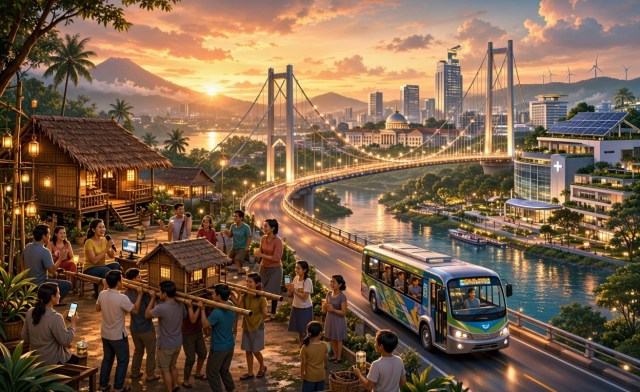
Discussions on Filipino modernity at the Society of Honor
It was just over 6 years ago that Karl and I wrote the Going Home series of articles. It was the pandemic time when we all had a lot of time, and it was a useful thing to do with time.
The first essay in that series, The National Village, described a society more personal than institutional, more informal than formal in its arrangements and with many unwritten rules – with social media acting as its hyperactive village square.
I did also describe a trajectory that started earlier, and today I would even include how an ostensibly entertainment-oriented paper – Mr & Ms Special Edition which would lay the foundations for the later Inquirer – and music like that of Apo Hiking Society played a role in what became EDSA Uno, the first visible manifestation of the national village, and of course I mentioned how cell phone text messages played a role in EDSA Dos over a decade later. We have of course all seen how social media has reached the entire Philippines by now.
The third essay in that series, Widening Philippine Horizons, was about the contrast between often dogmatic and rote education as opposed to personal observation shared in close circles, and I implied that the lack of a bridge between the two can impair discernment. Karl’s recent Beyond Dependence: From Degree to Diskarte to Capability answers some questions raised in that article, indirectly referring also to popular “diploma or diskarte” discussions.
At the very detailed level, Gian’s series of articles about Problem Solving the Philippines are focused especially on healthcare and budget. So we have my necessarily distant view from abroad, Karl’s systemic view based in the Philippines, and Gian’s highly detailed proposals.
Dapitan, Bayanihan and Who Really Knows the Philippines?
One might see the village of San Diego (according to Dr. Xiao Chua, there is no village named like that in the entire Philippines) from Rizal’s Noli as the original “National Village” with its coziness but also its backbiting – and ask if we here are the Pilosopo Tasyos of today as our readership is not particularly big anymore, and my recent stuff about Making Science serve the Country might be just like asking for lightning arrestors in San Diego.
Though one might see the sequel to the Noli (reformism) and Fili (revolution) as Rizal’s work in Dapitan, and my 2022 article Leni’s Bayanihan in that spirit, while Who REALLY knows the Philippines? from 2023 is a warning against being too sure of what one knows.
Karl’s and Gian’s on the ground reality checks of big ideas are important in this light. What still remains work in progress is how to harness the energy of Filipino bayanihan while avoiding the often chaotic aspects of the national village.
Karl and Irineo take the mike and sing
Now we are definitely not the two singers of Cup of Joe, singing Multo at Baguio’s Cozy Cove, but we both have written about contemporary Filipino music, with Karl’s From OPM to P-Pop: Identity, Industry, and the Evolution of Filipino Music making the best bridge between the soul of the people expressed in OPM and the industrial aspirations of P-Pop, with From the Filipino Stage to the World Stage as its recent sequel defining industry more precisely.
Finally, We Have a Tennis Star speaks of Alex Eala and how fandom inspires achievement.
Some looks at the neighborhood
There is often justified resistance in the Philippines at taking Western solutions as blueprints so maybe studying what countries with similar cultures and conditions do is the way to go.
When Migrants Come Home: Turning OFW Migration into Community Development looks at the Indonesian Desa Migran Emas (Golden Migrant Village) Metro Manila – the full catastrophe – One: Public Transport looks at Jakarta’s Mikotrans public transport solution.
Possibly, the Philippines could learn a lot from the Thai approach to developing its tourism, from things Vietnam has been doing to industrialize – of course any solution has to be properly localized, to use the lingo of IT that I am most familiar with as it is my field.
The way ahead
It would not be so interesting if things were simple, and they aren’t. For instance, motivation alone will not solve problems, just like “Handog ng Pilipino sa Mundo” after EDSA Uno was a great song – but history is not a musical where everyone sings happily at the end.
Achieving a bridge between diskarte, diploma and capability is something that has to be prototyped, piloted and rolled out – then adjusted for lessons learned.
Tapping kapwa, personal solidarity and bayanihan for nation-building while avoiding the bickering that the national village often falls into – in the past few days most ridiculously about the suspension of the Pinoy Big Brother livestream – isn’t simple.
Building capability without falling into the trap of cold technocracy isn’t either.
In any case, I definitely hope that readers of Karl’s present articles don’t mistake them for the hopes expressed for instance in Balang Araw PH but as ideas to actually get there. A lot of bridges to cross in the meantime, wherever this all may go.
AI use: the article image was generated in BING Image Creator using a prompt generated by Claude.



Comments
One Response to “From National Village to National Capability”Trackbacks
Check out what others are saying...[…] From National Village to National Capability Categoriespersonal AnGoL […]